DNA and RNA
Nucleic acids make up only about 2% of an animal’s weight, yet they carry the instructions for building all of its proteins. Those proteins, in turn, are what make a frog a frog and an onion an onion.
Two kinds of nucleic acids
Nucleic acids store genetic information, express it (put it to use), and pass it on. There are two kinds:
- DNA (deoxyribonucleic acid) stores genetic information, coded in the sequence of its building blocks. The stretches of DNA that carry instructions are genes.
- RNA (ribonucleic acid) is copied from DNA and helps translate DNA’s coded information into the order of amino acids in a polypeptide.
Nucleotides: the building blocks
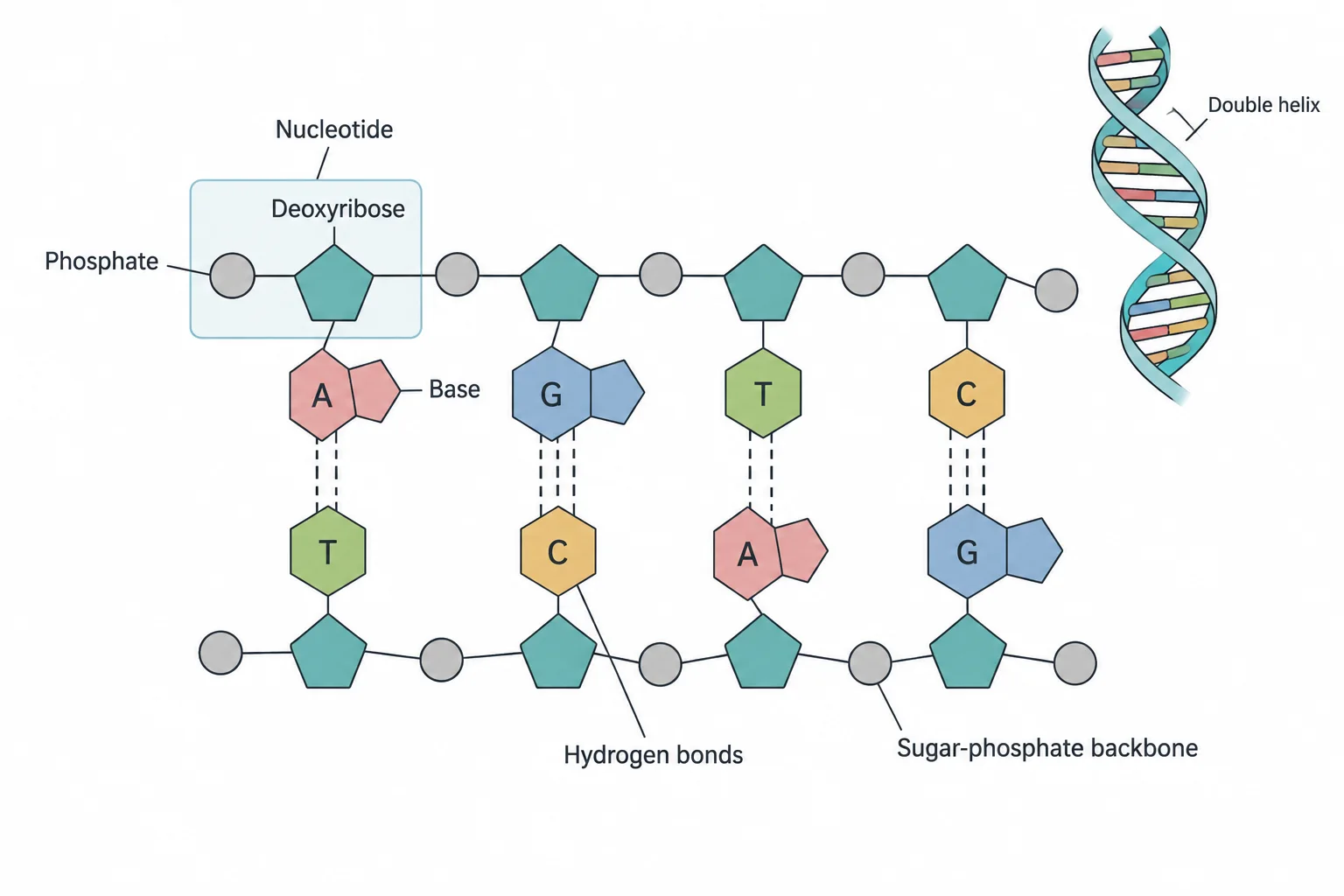
DNA and RNA are polymers of nucleotides, and every nucleotide has three parts:
- a phosphate group
- a five-carbon sugar: deoxyribose in DNA or ribose in RNA
- a base, a single or double ring made of carbon and nitrogen atoms
A nucleotide of DNA is called a deoxyribonucleotide, and one of RNA is a ribonucleotide.
The bases get their name from chemistry. The nitrogen atoms in their rings make them basic (the opposite of acidic), and this property lets them form hydrogen bonds with partner bases.
DNA contains four bases, which fall into two families by shape:
- Purines have a double ring: adenine (A) and guanine (G).
- Pyrimidines have a single ring: cytosine (C) and thymine (T). RNA uses a different pyrimidine, uracil (U), in place of thymine.
The DNA double helix
Nucleotides link into strands, and two strands wind together to form DNA.
Within a strand, the sugar of one nucleotide bonds to the phosphate of the next, forming an alternating sugar-phosphate backbone with the bases projecting from it. The sugar’s carbons are numbered 1′ through 5′ (“one prime” through “five prime”), and each phosphate links the 3′ carbon of one nucleotide’s sugar to the 5′ carbon of the next.
A DNA molecule consists of two strands coiled around each other in a double helix. Hydrogen bonds between bases hold the strands together, and each pair joins a purine on one strand to a pyrimidine on the other. The flat base rings lie perpendicular to the backbones, so the molecule resembles a spiral staircase: the backbones are the handrails, and the base pairs are the steps.
Base-pairing rules
The bases pair in only two combinations: A with T, and G with C. The positions of the hydrogen-bonding atoms on each base determine which partners fit.
Because pairing is so strict, the two strands are complementary: the sequence of one strand determines the sequence of the other. If one strand reads GATTC, the opposite strand reads CTAAG. Once in a while a base pairs with the wrong partner, such as A with C, and that mistake can lead to a mutation, a change in the DNA’s base sequence.
Pairing also fixes the proportions of the four bases.
How RNA differs from DNA
RNA is also a chain of nucleotides joined by a sugar-phosphate backbone, but it differs from DNA in three ways:
| Feature | DNA | RNA |
|---|---|---|
| Strands | Two, wound into a double helix | Usually one, though it can have double-stranded regions |
| Sugar | Deoxyribose | Ribose |
| Bases | A, G, C, T | A, G, C, U (uracil replaces thymine and pairs with A) |
Check yourselfIn a DNA molecule, 40% of the bases are G. What percentage are A?
10%. G pairs with C, so C is also 40%, and together G and C make up 80%. The remaining 20% is split evenly between A and T, giving 10% each.
Practice questions
1 of 2
One strand of a DNA double helix reads ATTGC. What does the matching stretch of the other strand read?
2 of 2
Which base is found in RNA but not in DNA?