Fats and fatty acids
Carbohydrates, proteins, and nucleic acids are each defined by their building blocks. Lipids are defined by a behavior instead: they don’t mix with water.
What makes a lipid
Molecules that are hydrophobic and made mostly of carbon and hydrogen, with a little oxygen, are lipids. Their many nonpolar carbon-hydrogen bonds give water nothing to cling to, so lipids don’t dissolve in water. Lipids make up about 40% of the organic material in an average human body, and the four main kinds are fats, phospholipids, steroids, and waxes.
Lipids aren’t macromolecules: they don’t form chains of covalently linked monomers, although they can cluster into large structures such as membranes.
Triglycerides: glycerol plus three fatty acids
The lipids usually called fats are triglycerides. Each one is built from two kinds of parts:
- Glycerol, a small molecule with three carbons, each carrying a hydroxyl group (–OH)
- Three fatty acids, each a long chain of carbon and hydrogen atoms with a carboxyl group (–COOH) at one end
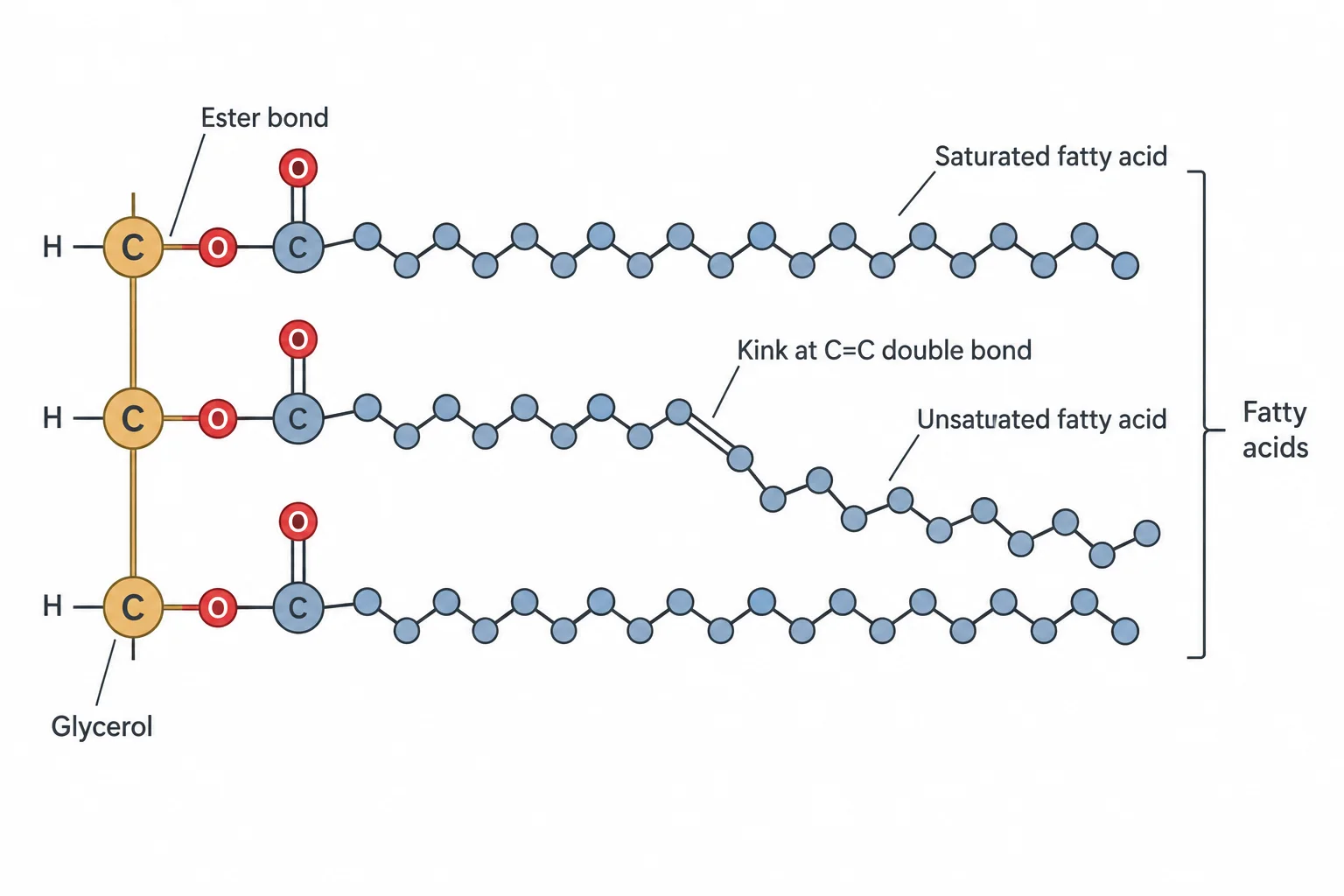
Each of glycerol’s –OH groups links to the carboxyl group of one fatty acid through a dehydration reaction, so building one triglyceride releases three water molecules. The bond between glycerol and each fatty acid is an ester bond. The finished molecule looks a bit like the letter E, with glycerol as the spine and the fatty acids as the three arms.
Saturated and unsaturated fatty acids
Fatty acids differ in length. Most have an even number of carbons, and chains of 16 or 18 carbons are the most common in plants and animals. Fatty acids also differ in their bonds:
- In a saturated fatty acid, every carbon-carbon bond is single. Each carbon holds as many hydrogen atoms as it can (it’s “saturated” with hydrogen), and the chain is straight.
- An unsaturated fatty acid has one or more C=C double bonds, and in natural fatty acids each double bond puts a kink in the chain. With one double bond the fatty acid is monounsaturated; with two or more it’s polyunsaturated.
Some fatty acids are essential fatty acids: mammals need them for good health but can’t make them, so they must come from the diet. Linoleic acid is one example.
Why some fats are solid and others liquid
The straighter the chains, the more tightly they pack and the higher the melting point.
Straight, saturated chains pack closely, with many attractions between neighboring molecules, so it takes more heat to pull them apart. Saturated fats therefore have high melting points and are solid at room temperature. Animal fats are rich in saturated fatty acids. Stearic acid, plentiful in beef fat, melts at 70 °C, which is why hamburger grease is liquid in a hot pan but turns solid as it cools.
Kinked, unsaturated chains can’t pack closely, so they melt at lower temperatures. Fats rich in unsaturated fatty acids are liquid at room temperature and are called oils; most come from plants. More double bonds mean a lower melting point: oleic acid (one double bond, abundant in olive oil) melts at 16 °C, and linoleic acid (two double bonds, abundant in safflower and sunflower oils) melts at −5 °C.
Hydrogenation and trans fats
Food processing can shift these properties. Hydrogenation adds hydrogen atoms to an oil’s double bonds, turning them into single bonds. The fat becomes more saturated and its melting point rises, which is how liquid vegetable oil is made into solid shortening.
Another artificial process reshapes the double bonds instead. Most natural unsaturated fatty acids have cis double bonds, which kink the chain; the process flips some of them to trans double bonds, which leave it much straighter. Fats containing these trans fatty acids pack more tightly, melt at higher temperatures, and keep longer on the shelf, but they’re linked to coronary artery disease, a narrowing of the blood vessels that supply the heart.
Fat stores energy
Fat is a compact energy store. To tap it, a cell hydrolyzes a triglyceride into glycerol and fatty acids, then breaks those down to make ATP.
A molecule’s energy yield depends partly on its number of carbon-hydrogen bonds. Fat is loaded with C–H bonds, while carbohydrates carry many C–OH bonds instead, so a gram of fat stores more energy than a gram of starch or glycogen. That makes fat an efficient reserve for animals that move around, since extra weight costs them.
Fat also cushions and supports organs, and a layer under the skin insulates land animals in cold weather and marine mammals in cold water.
Check yourselfTwo oils are both liquid at room temperature. You chill them, and one turns solid first. Which oil has more unsaturated fatty acids?
The one that stays liquid longer. More double bonds mean more kinks, looser packing, and a lower melting point, so the oil with fewer unsaturated fatty acids solidifies first.
Practice questions
1 of 2
After a cook fries bacon, the grease left in the pan turns solid as it cools, but the canola oil in a bottle nearby stays liquid. Which difference in their fatty acids best explains this?
2 of 2
Fats, phospholipids, steroids, and waxes have quite different structures. What do they share that makes them all lipids?