Phospholipids, steroids, and waxes
Replace one of a triglyceride’s three fatty acids with a phosphate group and you get a phospholipid, the molecule that forms the framework of every cell membrane. Steroids and waxes round out the lipids, each with its own shape and job.
Phospholipids: a polar head and nonpolar tails
A phospholipid is built like a triglyceride with one change: glycerol is bonded to two fatty acids and one phosphate group. In most phospholipids, a small polar or charged molecule containing nitrogen, such as choline, is attached to the phosphate.
That gives the molecule two very different ends:
- The head (glycerol, the phosphate, and the attached group) is polar, so it’s hydrophilic.
- The two tails (the fatty acid chains) are nonpolar, so they’re hydrophobic.
A molecule with both a hydrophilic region and a hydrophobic region is amphipathic.
Why phospholipids form a bilayer
In water, phospholipids arrange themselves so that their heads touch the water and their tails don’t. They manage this by forming two layers. In each layer the heads face outward toward the water, and the tails of the two layers point inward toward each other, shielded from the water. This double layer, the phospholipid bilayer, is the basic structure of cell membranes, the boundaries that separate a cell’s contents from its surroundings.
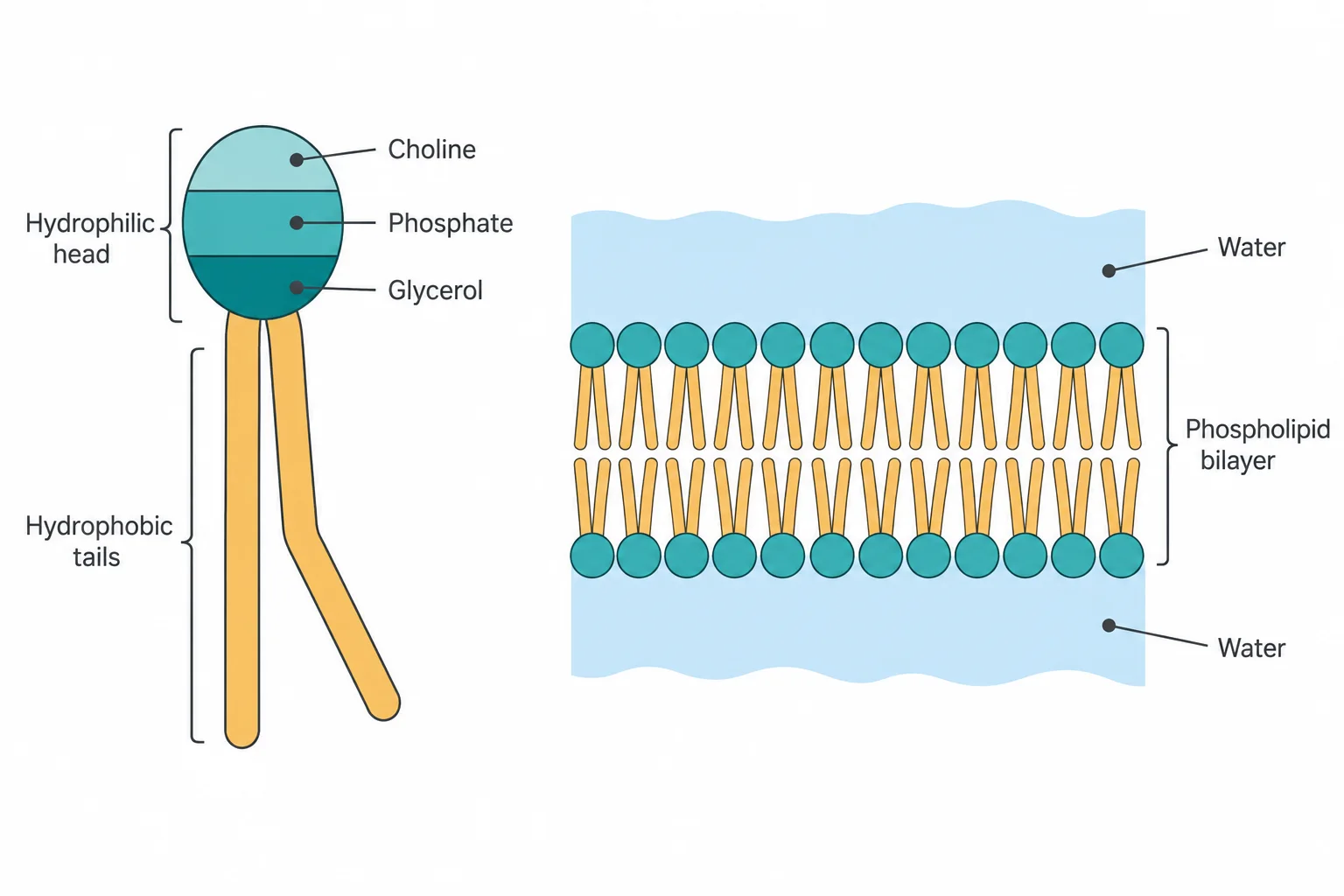
The packing rules that apply to fats apply here too. A bilayer built from phospholipids with long, saturated tails packs tightly and is stiffer, or less fluid. Shorter tails and kinked, unsaturated tails leave more room between molecules and make the bilayer more fluid.
Steroids: four fused rings
Steroids look nothing like the other lipids. Their core is four rings of carbon atoms fused together. A steroid carries one or more polar –OH groups, but too few to make it dissolve well in water.
Steroids with a single –OH group are sterols. One of the best known is cholesterol, found in the blood and cell membranes of animals. Cholesterol is also the starting material for the steroid hormones, chemical messengers that include the reproductive hormones estrogen and testosterone.
Small changes in a steroid’s structure can have large effects. Estrogen, found in higher amounts in female vertebrates, differs from testosterone, found in higher amounts in males, in only three ways:
- Estrogen has one fewer methyl group (–CH₃).
- It has a hydroxyl group (–OH) where testosterone has a ketone group.
- It has extra double bonds in one of its rings.
Even so, the two hormones largely decide whether an animal develops female or male traits, down to the different feather colors of female and male cardinals.
Waxes: waterproof coatings
Many plants and animals coat their surfaces with waxes, very nonpolar lipids found on the leaves of plants and the outer covering (cuticle) of insects. Because they repel water, waxes form a barrier that keeps an organism from losing water. Some also serve as building material: bees build their honeycomb from beeswax.
A wax is usually a mixture of many compounds, but every wax contains hydrocarbons plus long molecules in which a fatty-acid-like chain is joined, through its carboxyl group, to another long hydrocarbon chain.
Here’s how the four kinds of lipids compare:
| Lipid | Structure | Main roles |
|---|---|---|
| Fats (triglycerides) | Glycerol + three fatty acids | Energy storage; cushioning and insulation in animals |
| Phospholipids | Glycerol + two fatty acids + a phosphate group | The bilayer of cell membranes |
| Steroids | Four fused carbon rings | Cholesterol in animal membranes; hormones such as estrogen and testosterone |
| Waxes | Long hydrocarbon chains | Waterproof coatings on leaves and insects; beeswax honeycomb |
Check yourselfA molecule has a charged group at one end and a long hydrocarbon chain at the other. Is it amphipathic, and how would many of these molecules arrange themselves in water?
Yes. The charged end is hydrophilic and the hydrocarbon chain is hydrophobic. In water, the molecules cluster so that their chains hide from the water while their charged ends face it, much as phospholipids do in a bilayer.
Practice questions
1 of 3
Which group of molecules consists entirely of lipids?
2 of 3
Why do phospholipids in water arrange themselves into a bilayer?
3 of 3
Estrogen and testosterone are both steroids made from cholesterol, and their structures differ by only a few atoms. What does this pair of hormones illustrate?