Starch, glycogen, and cellulose
Link many monosaccharides into a long polymer and you get a polysaccharide (“many sugars”). Starch, glycogen, and cellulose are all polysaccharides made entirely of glucose. Two of them store energy and the third builds plant cell walls, and the difference comes down to which form of glucose they use and how the units are linked.
Starch and glycogen store energy
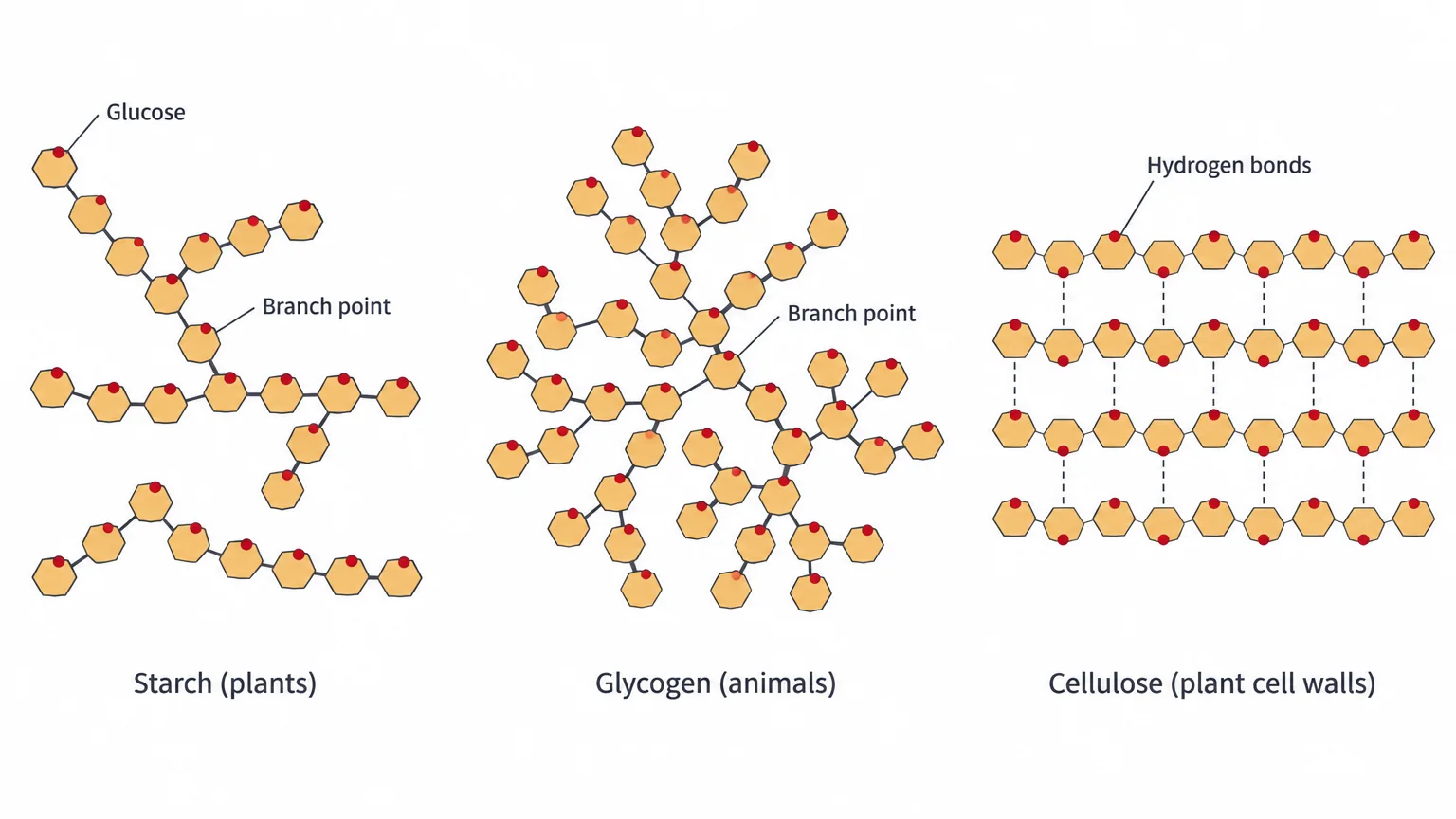
Plants store energy as starch, and animals store it as glycogen. Both are long, branched chains of thousands of α-glucose units. Along a chain, carbon 1 of one glucose bonds to carbon 4 of the next. At a branch point, a bond from carbon 1 to carbon 6 starts a side chain.
The only difference between them is how much they branch. Glycogen is highly branched, which gives it an open structure. Many of its –OH groups are exposed to the surrounding water and form hydrogen bonds with it, so glycogen dissolves well in animal tissues such as muscle. Starch branches less and is less soluble, which suits plant storage structures such as potatoes and corn kernels.
Both work like savings accounts. When a plant or animal can’t get enough energy from its surroundings or diet, it hydrolyzes starch or glycogen into glucose, then breaks down the glucose to make ATP.
Cellulose builds plant cell walls
Not every polysaccharide stores energy. Cellulose, a major part of plant cell walls, has a structural job. It’s made of β-glucose, and its chains are straight, with no branches. The bonds between β-glucose units flip every other glucose upside down relative to its neighbors, and a single chain holds several thousand glucose units.
Straight chains can lie side by side, and neighboring chains form hydrogen bonds with one another. (A hydrogen bond is a weak attraction between a slightly positive hydrogen atom and a slightly negative atom such as oxygen.) Thousands of these weak bonds together lock the chains into strong, parallel sheets that give plant cell walls their strength. Given how much of Earth is covered in plants, cellulose is thought to be the most abundant organic molecule on the planet.
| Starch | Glycogen | Cellulose | |
|---|---|---|---|
| Found in | Plant cells | Animal cells | Plant cell walls |
| Form of glucose | α | α | β |
| Branching | Fewer branches | Many branches | None |
| Main job | Energy storage | Energy storage | Structural support |
Why you can’t digest cellulose
Enzymes that cut the links between α-glucose units in starch don’t recognize the differently shaped links between β-glucose units in cellulose. That’s convenient for plants: a plant cell can break down its starch reserves without dismantling its own walls.
Most animals and plants lack any enzyme that breaks down cellulose. Cows, which eat grass, and termites, which eat wood, get help from bacteria living in their digestive tracts. These bacteria make an enzyme that hydrolyzes the bonds between β-glucose units, turning cellulose into usable glucose. Humans have no such enzyme, so most of the cellulose you eat passes through your body as fiber.
Other structural polysaccharides
Cellulose isn’t the only polysaccharide used as building material:
- Chitin forms the tough outer skeleton (exoskeleton) of insects and of crustaceans such as shrimp and lobsters, as well as the cell walls of fungi. Its sugar units carry nitrogen-containing groups.
- Glycosaminoglycans give structure to animal tissues. They’re abundant in cartilage, the tough, fibrous material in joints, and in the extracellular matrix, the framework of material that surrounds many animal cells.
- Peptidoglycan is the main structural material in the cell walls of most bacteria. It consists of polysaccharide chains cross-linked by short chains of amino acids.
Check yourselfA cow and a person each eat a large salad. Why can the cow get energy from the cellulose while the person can’t?
Practice questions
1 of 2
Which polysaccharide do animals use to store glucose for energy?
2 of 2
Why does most of the cellulose in a salad pass through a person’s body as fiber?