Functional groups and isomers
A carbon skeleton sets a molecule’s size and shape. Much of what the molecule does, though, depends on the small clusters of other atoms attached to that skeleton.
Functional groups
A cluster of atoms with a set structure that behaves the same way in any molecule carrying it is a functional group. Learn how a group behaves once, and you can predict its effect wherever it shows up.
The amino group (–NH₂) shows how this works. An acid releases hydrogen ions (H⁺, positively charged hydrogen atoms) into water, and a base takes them up. The fewer free H⁺ a watery liquid holds, the higher its pH.
At the pH found inside living things, an amino group picks up an H⁺ and becomes –NH₃⁺. By soaking up H⁺ from the surrounding water, it acts as a base and raises the pH.
Common functional groups
Several of these groups form hydrogen bonds, weak attractions between a slightly positive hydrogen atom and a slightly negative atom such as oxygen or nitrogen. The table lists the groups you’ll meet most often in biology.
| Group | Formula | Where it’s found | Properties |
|---|---|---|---|
| Amino | –NH₂ | Amino acids, the building blocks of proteins | Polar; weakly basic (takes up H⁺); forms part of the peptide bonds that link amino acids |
| Carbonyl: ketone | C=O inside a carbon chain | Steroids, waxes, proteins | Polar; highly reactive; forms hydrogen bonds |
| Carbonyl: aldehyde | –CHO, a C=O at the end of a chain | Straight-chain forms of sugars; some odor molecules | Polar; highly reactive; forms hydrogen bonds |
| Carboxyl | –COOH | Amino acids, fatty acids | Acidic (releases H⁺ in water); forms part of peptide bonds |
| Hydroxyl | –OH | Carbohydrates, alcohols, steroids, some amino acids | Polar; forms hydrogen bonds with water |
| Methyl | –CH₃ | Can be attached to DNA, proteins, and carbohydrates | Nonpolar |
| Phosphate | –PO₄²⁻ | DNA and RNA, ATP (the cell’s energy carrier), phospholipids | Polar; weakly acidic; negatively charged in cells |
| Sulfate | –SO₄⁻ | Can be attached to carbohydrates, proteins, and lipids | Polar; negatively charged in cells |
| Sulfhydryl | –SH | Proteins that contain the amino acid cysteine | Polar; forms disulfide bridges (S–S links) in many proteins |
A few patterns make the table easier to remember:
- Every group except methyl contains oxygen, nitrogen, phosphorus, or sulfur and is polar, so it makes a molecule more water-friendly. Methyl, built only of carbon and hydrogen, is nonpolar.
- Carboxyl and phosphate groups are acidic; the amino group is basic.
- Ketones and aldehydes are both carbonyl groups (C=O). An aldehyde’s carbonyl sits at the end of a carbon chain; a ketone’s sits inside it.
Isomers: same atoms, different arrangements
Two molecules can contain exactly the same atoms and still be different substances. Molecules with the same chemical formula (the same number of each kind of atom) but different structures, and therefore different properties, are isomers. They come in two broad kinds:
- Structural isomers contain the same atoms bonded in a different pattern. Propyl alcohol and isopropyl alcohol (rubbing alcohol) both have the formula C₃H₈O. In propyl alcohol the –OH group is attached to an end carbon; in isopropyl alcohol it’s attached to the middle carbon.
- Stereoisomers have identical bonds, but their atoms are arranged differently in space. They come in two types: cis-trans isomers and enantiomers.
Cis-trans isomers
A C=C double bond holds its two carbons rigidly, so the atoms attached to them can’t swivel around the bond. If the hydrogen atoms on the two carbons sit on the same side of the double bond, it’s a cis double bond. If they sit on opposite sides, it’s a trans double bond.
Molecules that differ only in this way are cis-trans isomers, and they can differ in stability and in how they respond to heat and light. To keep the two straight, think of trans as “across,” as in transatlantic.
Your eyes rely on this difference. In the dark, a light-sensitive molecule called retinal is mostly in its cis form. Light flips it to the trans form, and trans-retinal activates the eye’s light-capturing cells.
Enantiomers
When a carbon atom bonds to four different atoms or groups, those four can be arranged in two ways that are mirror images of each other. The two mirror-image molecules are enantiomers. Your hands are the everyday example: each is the mirror image of the other, which is why a right glove never fits your left hand.
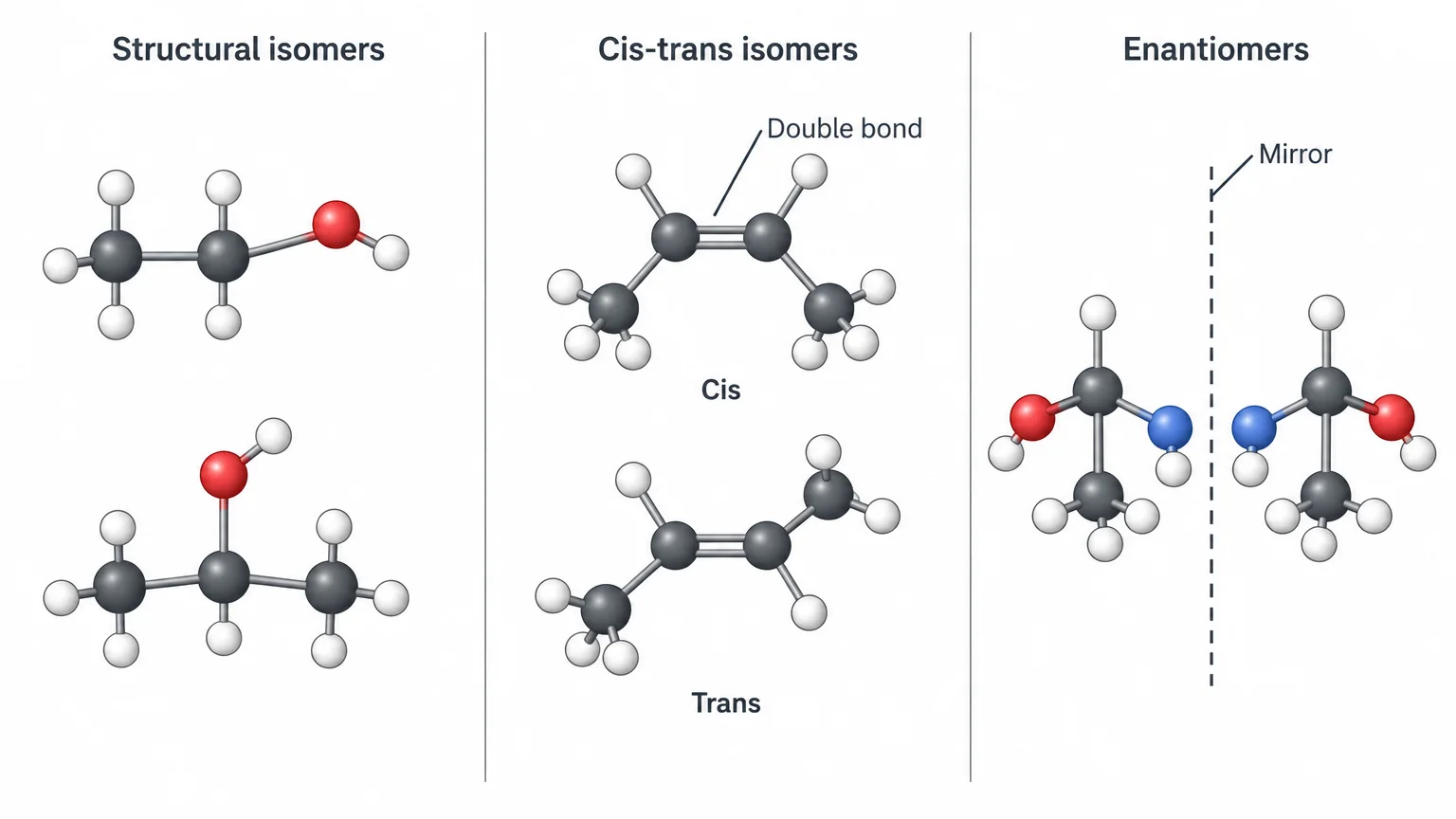
The two members of a pair melt at the same temperature and dissolve equally well. The difference shows up when they bind to other molecules. Enzymes, molecules (usually proteins) that speed up chemical reactions in cells, grip their targets by shape, so an enzyme that fits one enantiomer usually can’t grip its mirror image.
Check yourselfA molecule carries a carboxyl group (–COOH). Placed in water, will it raise or lower the pH?
Lower it. A carboxyl group is acidic: it releases H⁺ into the water, and the more free H⁺ there are, the lower the pH. An amino group has the opposite effect.
Practice questions
1 of 2
A medicine is made as a mixture of two enantiomers, but only one of them has any effect in the body. What is the most likely reason?
2 of 2
Two molecules have the same atoms bonded in the same order. In one, the hydrogens on a C=C double bond sit on the same side; in the other, they sit on opposite sides. What kind of isomers are they?