Amino acids and polypeptides
Proteins make up about half of the organic material in a typical animal’s body, and they take part in nearly everything a cell does. Their range of abilities comes from how they’re built: chains of amino acids folded into precise shapes.
What proteins do
Biologists group proteins by the jobs they perform:
| Kind of protein | What it does | Example |
|---|---|---|
| Gene expression and regulation | Make RNA from DNA, build polypeptides, and control which genes are used | RNA polymerase makes RNA from a DNA template |
| Motor proteins | Produce movement | Myosin powers muscle contraction |
| Defense proteins | Protect against disease | Antibodies help destroy bacteria and viruses |
| Metabolic enzymes | Speed up chemical reactions | Hexokinase acts in the breakdown of sugar |
| Cell-signaling proteins | Let cells communicate with each other and with their surroundings | Taste receptors on the tongue |
| Structural proteins | Support and strengthen | Actin shapes the inside of cells; collagen strengthens tendons |
| Transporters | Move substances across membranes | Glucose transporters carry glucose into cells |
Amino acids: the building blocks
Proteins are made mainly of carbon, hydrogen, oxygen, and nitrogen, with small amounts of other elements, especially sulfur. They’re polymers, and their monomers are amino acids.
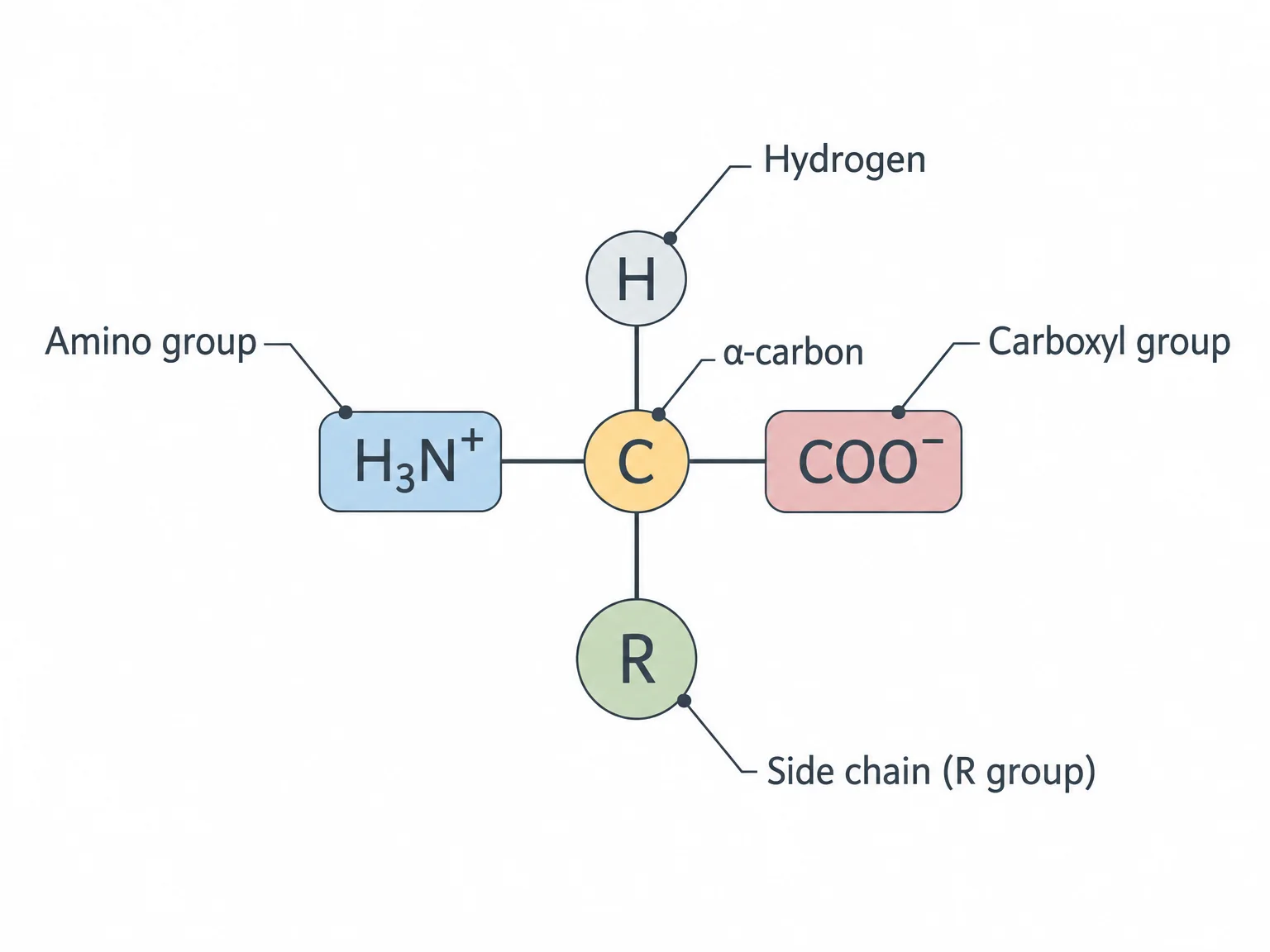
Every amino acid has the same core: a central carbon atom, the α-carbon (alpha carbon), bonded to four things:
- an amino group (–NH₂)
- a carboxyl group (–COOH)
- a hydrogen atom
- a side chain, or R group, which differs from one amino acid to another
In water at neutral pH, the amino group picks up an H⁺ and becomes positively charged (–NH₃⁺), while the carboxyl group gives up an H⁺ and becomes negatively charged (–COO⁻). The name reflects both parts: an amino group plus a carboxyl group that acts as an acid.
The proteins of living things use 20 amino acids, which differ only in their side chains. The side chains fall into three groups: nonpolar, polar and uncharged, and polar and charged. Side chains give a protein its character. Their chemistry determines how the chain folds, and some side chains do the protein’s work directly, such as those in an enzyme’s active site, the pocket where the enzyme’s reaction takes place.
All amino acids except glycine come in two mirror-image forms (enantiomers), called L and D. Proteins contain only L-amino acids.
Peptide bonds, polypeptides, and proteins
To link two amino acids, a cell bonds the carbon in one amino acid’s carboxyl group to the nitrogen in the next one’s amino group. This covalent bond is a peptide bond. Like other bonds between monomers, it forms by a dehydration reaction and is broken by hydrolysis, as happens when you digest protein.
Two linked amino acids form a dipeptide. Keep adding amino acids and you get a polypeptide, a linear chain of many amino acids. A chain always has one fewer peptide bond than it has amino acids, so a polypeptide of 100 amino acids contains 99 peptide bonds. The repeating chain of atoms that runs the length of the polypeptide is its backbone, and the side chains stick out from it.
A polypeptide has two different ends:
- The N-terminus, or amino end, carries a free amino group (N for its nitrogen).
- The C-terminus, or carboxyl end, carries a free carboxyl group.
Cells build a polypeptide starting at the N-terminus, adding amino acids in the order spelled out by mRNA, an RNA copy of a gene’s instructions. The amino acids in a polypeptide are numbered in the same direction, starting with 1 at the N-terminus.
Many proteins also carry sugars (glycoproteins) or lipids (lipoproteins) attached by covalent bonds, and these additions give them special functions.
Primary structure: the sequence
The exact order of amino acids in a polypeptide is its primary structure, and a gene sets that order. Most polypeptides contain 50 to 2,000 amino acids; β-globin, one of the polypeptide chains in hemoglobin (the protein that carries oxygen in your blood), has 146.
Changing even one amino acid can matter. In sickle cell disease, the sixth amino acid of β-globin is valine instead of glutamic acid. That single swap can make red blood cells take on a sickle shape, causing anemia (a shortage of healthy red blood cells), fatigue, and an enlarged spleen.
Check yourselfA polypeptide has a free amino group at one end. Which end is this, and did the cell add that amino acid first or last?
It’s the N-terminus, or amino end. Cells build polypeptides starting at the N-terminus, so that amino acid was added first; the last one added sits at the C-terminus.
Practice questions
1 of 4
Myosin provides the force that makes muscles contract. Which category of protein does it belong to?
2 of 4
A protein in the plasma membrane of a kidney cell carries glucose from the fluid outside the cell to the inside. Which category of protein is it?
3 of 4
When two amino acids are joined, the carbon in one amino acid’s carboxyl group forms a covalent bond with the nitrogen in the other’s amino group. What is this bond called?
4 of 4
A protein on the surface of cells in your tongue binds sugar molecules from food, which is how you taste sweetness. Which category of protein is it?