The phases of mitosis
With sister chromatids built and a spindle ready to form, the cell can sort its chromosomes. Mitosis runs as one continuous process, but biologists divide it into five phases. The process is much the same in plant and animal cells.
Five phases in order
Before mitosis, the cell is in interphase. Its chromosomes have already been replicated in S phase but are still loose threads inside the nucleus, and the nucleolus, where ribosome subunits are assembled, is visible.
- In prophase, the replicated chromosomes condense into compact pairs of sister chromatids. The nuclear envelope starts breaking into small vesicles, and the nucleolus disappears.
- In prometaphase, the nuclear envelope is fully broken up, and the spindle finishes forming as the centrosomes move to opposite poles. Kinetochore microtubules attach to the chromosomes.
- In metaphase, the pairs of sister chromatids line up in a single row on the metaphase plate, an imaginary plane halfway between the poles.
- In anaphase, the sister chromatids separate and move to opposite poles, and the poles themselves move farther apart.
- In telophase, the chromosomes reach the poles and loosen again, and a nuclear envelope forms around each group, making two nuclei.
Condensing in prophase matters. Long, loose threads would likely tangle with each other as they’re pulled apart, and compact chromosomes are less likely to break as they move.
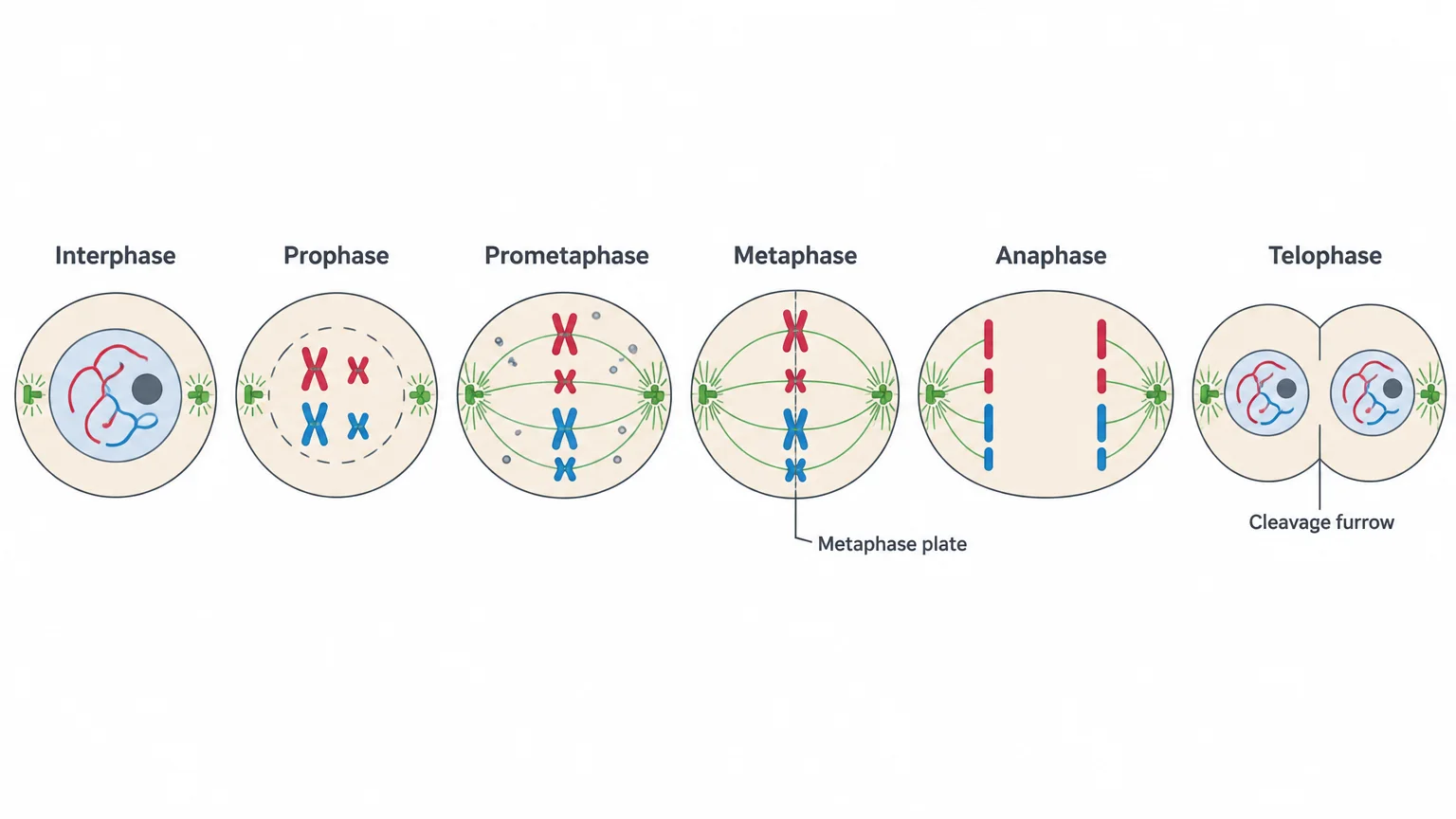
How chromosomes get attached
Attachment in prometaphase is a matter of trial and error. Microtubules grow out rapidly from both poles in every direction. If one happens to touch a kinetochore, it’s captured and stays attached. If it misses, it shrinks back to the centrosome and another grows in its place.
By the end of prometaphase, the two kinetochores of each sister pair are attached to microtubules from opposite poles. Under a microscope, the chromosomes jerk back and forth as the two sides tug on them, until all of them settle on the metaphase plate.
Check yourselfIn which phase do sister chromatids first attach to the spindle, and why can’t it happen earlier?
In prometaphase. Until then, the nuclear envelope surrounds the chromosomes and keeps the spindle microtubules out.
Pulling the copies apart
In anaphase, the connections holding each sister pair together are broken. From that moment, each chromatid counts as its own chromosome. Two things then move the chromosomes apart:
- Kinetochore microtubules shorten, pulling each chromosome toward the pole it’s attached to.
- Polar microtubules from the two poles lengthen and push against each other where they overlap, driving the poles farther apart.
Cytokinesis
Mitosis usually ends with cytokinesis, which splits the cell between the two new nuclei. Here plants and animals differ.
- Animal cells form a cleavage furrow, a groove around the cell’s middle that tightens like a drawstring and pinches the cell in two. Actin filaments just under the plasma membrane do the tightening. The furrow can show in late anaphase and is clearest in telophase.
- Plant cells can’t pinch in because of their rigid cell wall. Instead, vesicles from the Golgi apparatus travel along microtubules to the middle of the cell and fuse into a cell plate, which grows into a new cell wall between the daughter cells.
The result in both is two daughter cells with the same number of chromosomes as the mother cell and, barring rare mutations, the same DNA.
Check yourselfA drug blocks actin filaments in an animal cell that has just finished telophase. What happens?
The cleavage furrow can’t form, so cytokinesis fails. The cell ends up with two nuclei in one cytoplasm.
Practice questions
1 of 3
Looking at dividing cells in an onion root tip, you find one whose X-shaped chromosomes are lined up single file across the middle of the cell. Which phase of mitosis is it in?
2 of 3
In which phase of mitosis do the chromosomes reach the poles and loosen while a nuclear envelope forms around each group?
3 of 3
Which list gives the phases of mitosis in the correct order?