Chromosome shapes and changes in structure
Members of one species almost always have the same number and kinds of chromosomes: two sets of 23 in humans, two sets of 39 in dogs. Rarely, a chromosome’s structure or number changes in one individual, and such changes cause several human disorders. Spotting a change starts with knowing what the normal chromosomes look like.
Telling chromosomes apart
At metaphase, chromosomes are identified by three features: their size, where the centromere sits, and the pattern of bands they show after staining.
The centromere is rarely in the exact middle, so it divides each chromosome into two arms. The short arm is labeled p (for petite, French for “small”) and the long arm q. In a karyotype, chromosomes are lined up with the p arm on top. Centromere position sorts chromosomes into four types:
| Type | Centromere position | Arms |
|---|---|---|
| Metacentric | Near the middle | p and q about equal |
| Submetacentric | Off center | p clearly shorter than q |
| Acrocentric | Near one end | p very short |
| Telocentric | At the very end | p almost nonexistent |
Different chromosomes can share a size and centromere position, so stains settle the question. A stain makes alternating light and dark bands, and each kind of chromosome has its own band pattern. The bands also reveal changes in structure, because a missing, extra, or flipped stretch changes the pattern.
Check yourselfA chromosome’s centromere sits near one end, leaving a very short p arm. What type is it?
Acrocentric. A centromere at the very end would make it telocentric, and one near the middle would make it metacentric.
Four ways a chromosome’s structure can change
Mutations that change chromosome structure happen when chromosomes break and the pieces rejoin the wrong way. There are four kinds.
| Change | What happens | Total material |
|---|---|---|
| Deletion | A segment of the chromosome is lost | Decreases |
| Duplication | A segment appears two or more times | Increases |
| Inversion | A segment flips to face the opposite direction | Unchanged |
| Translocation | A segment moves to a different chromosome | Unchanged in a reciprocal exchange |
A translocation, as Chapter 15 showed, moves a segment of one chromosome onto a different chromosome. It comes in two kinds. In a simple translocation, one piece of a chromosome becomes attached to another chromosome. In a reciprocal translocation, two different chromosomes swap pieces, leaving two abnormal chromosomes.
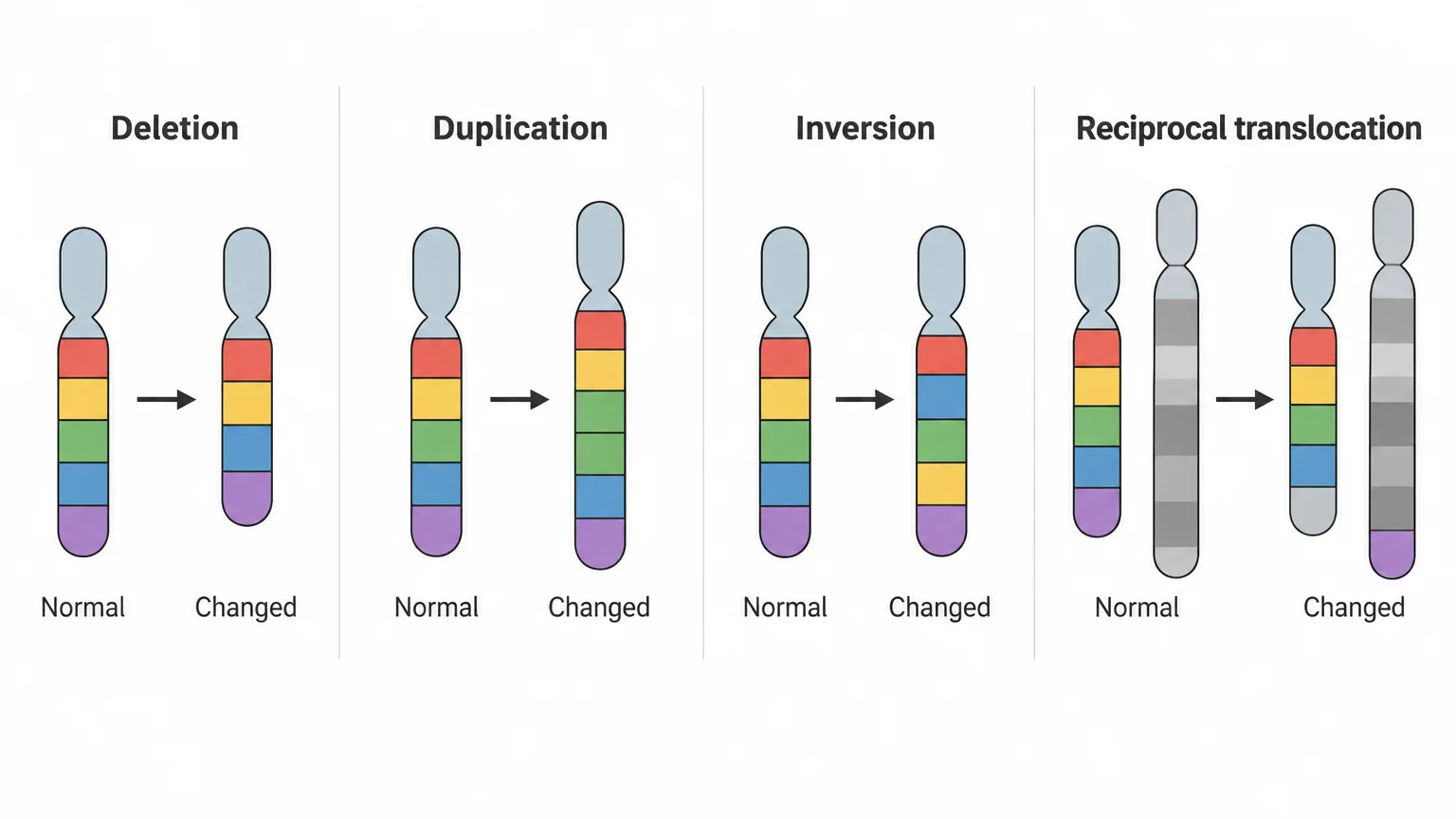
Deletions and duplications change the total amount of genetic material. Their effect depends on how large the segment is and which genes it holds. When they have an effect, it’s usually harmful, and larger changes tend to be worse because more genes are missing or extra.
Inversions and translocations are rearrangements: the genes are all still there, just in a new order or on a different chromosome. An inversion shows up in a karyotype as a stretch of bands in reverse order.
Check yourselfChromosomes 2 and 9 swap end segments. Does the cell gain or lose any genetic material?
Neither. That’s a reciprocal translocation, which only rearranges segments, as an inversion does. Deletions and duplications are the changes that alter the total.
Practice questions
1 of 3
What part of a chromosome does the letter p label?
2 of 3
Which change in chromosome structure increases the total amount of genetic material?
3 of 3
Why is a large deletion usually more harmful than a small one?