Chromosome sets and homologous pairs
Chapter 11 showed how a cell copies its DNA and packs each chromosome into a compact X shape before dividing. This chapter follows what happens next: how a dividing cell sorts those chromosomes so each new cell gets the right ones.
Seeing a cell’s chromosomes
Most of the time, chromosomes are long, loose threads you can’t tell apart. When a cell gets ready to divide, they compact into short, thick bodies with distinct sizes and shapes, visible under a light microscope. So to study a person’s chromosomes, scientists grow cells (often white blood cells) with a drug that makes them divide, stain the chromosomes, and photograph them.
The chromosomes in the photo are then lined up in a standard order, from largest to smallest. That arrangement is a karyotype. It shows the number, size, and shape of the chromosomes in a cell, and the stain gives each chromosome a pattern of light and dark bands that helps identify it.
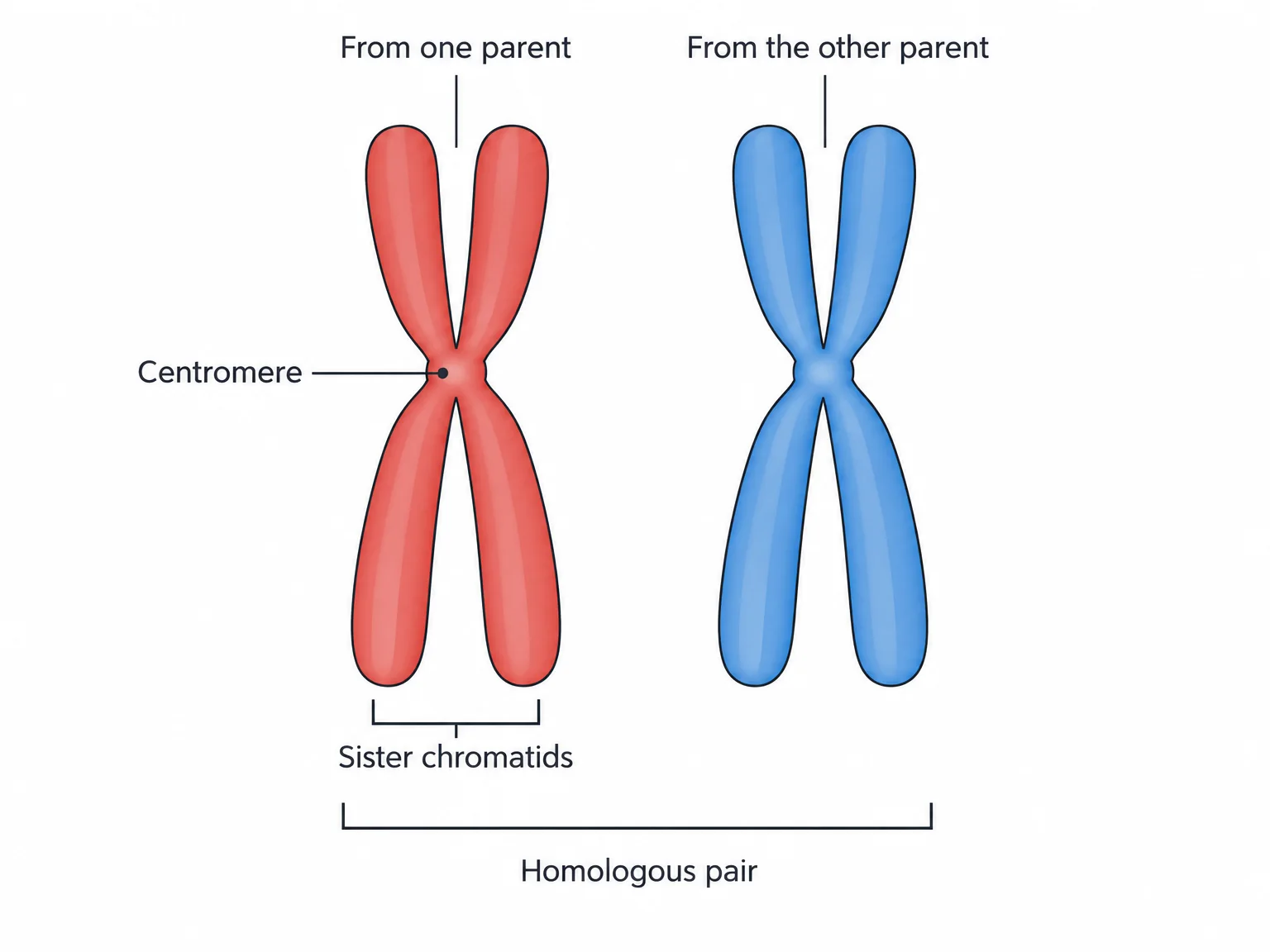
Each chromosome in a karyotype has already been replicated, because it comes from a dividing cell. It is two identical copies, the sister chromatids from Chapter 11, still joined to each other.
Check yourselfA lab tries to make a karyotype from cells that have stopped dividing. Why won’t it work?
In those cells, the chromosomes are long, loose threads that can’t be told apart. They compact into distinct, visible shapes only when a cell gets ready to divide.
Chromosomes come in sets
A karyotype shows that a cell’s chromosomes come in sets. One human set has 23 different chromosomes. They’re numbered by size, so chromosome 1 is the largest and 21 and 22 are the smallest.
Two chromosomes are named by letter instead: X and Y, the sex chromosomes, which determine an individual’s sex (females are XX, males XY). Every other chromosome is an autosome. Each human set holds 22 autosomes plus one sex chromosome.
Most human cells carry two sets, one inherited from each parent, for 46 chromosomes in all. Geneticists write one set as n. A cell or organism with two sets is diploid, written 2n. For humans, n = 23 and 2n = 46. Gametes (sperm and eggs) are the exception: each is haploid, or 1n, with a single set of 23.
Homologous pairs
In a diploid cell, every chromosome has a partner: the matching chromosome from the other parent. The two members of a pair are homologous chromosomes, or homologs. They’re the same size, carry the same genes in the same order, and have DNA sequences more than 99% identical.
That last 1% matters. A gene on one homolog can be a slightly different version from the same gene on the other. For example, a gene on chromosome 15 that strongly affects eye color may come in a “brown” version from one parent and a “blue” version from the other. Homologs carry the same kinds of information, not identical copies of it.
The X and Y chromosomes are the exception. They differ in size and in which genes they carry, so they aren’t considered homologs, though they share short matching regions.
Check yourselfA gene is found only on the X chromosome. How many copies of it appear in a man’s karyotype?
Two. A man has one X, and in a karyotype it has already replicated into two sister chromatids, each carrying a copy of the gene.
Practice questions
1 of 3
How many chromosomes does a normal human egg cell carry, and how is it described?
2 of 3
Two homologous chromosomes carry the same genes in the same order. Why can they still carry different versions of a gene?
3 of 3
Why are the X and Y chromosomes not considered a homologous pair?