Sister chromatids and the spindle
In mitotic cell division, one cell divides into two daughter cells that are genetically identical to it and to each other. It takes mitosis to split the nucleus and cytokinesis to split the cell. Before the division itself comes the equipment that makes accurate sorting possible.
Why cells divide by mitosis
Mitotic cell division does two big jobs:
- Reproduction in single-celled eukaryotes: a yeast cell, for example, multiplies by dividing, and its offspring are genetically identical to it.
- Building and maintaining a multicellular body: a plant, an animal, or most fungi start as one cell that divides over and over. Your skin cells and the cells lining your gut are still being replaced this way.
Because every division hands over a complete copy of the genetic material, nearly all the cells of your body carry the same genes. A muscle cell and a skin cell differ because each expresses the genes its job needs, not because they hold different genes.
Sister chromatids and their attachments
During S phase, each chromosome’s DNA is copied. The two copies, together with their proteins, lie side by side as a pair of sister chromatids. As the cell prepares to divide, the pair compacts into the short X shape seen in a karyotype.
Three structures hold and handle the pair:
- The centromere is the narrowed region where the two sisters are most tightly joined.
- Cohesin is a protein that glues the sister chromatids together along their length until it’s time to separate them.
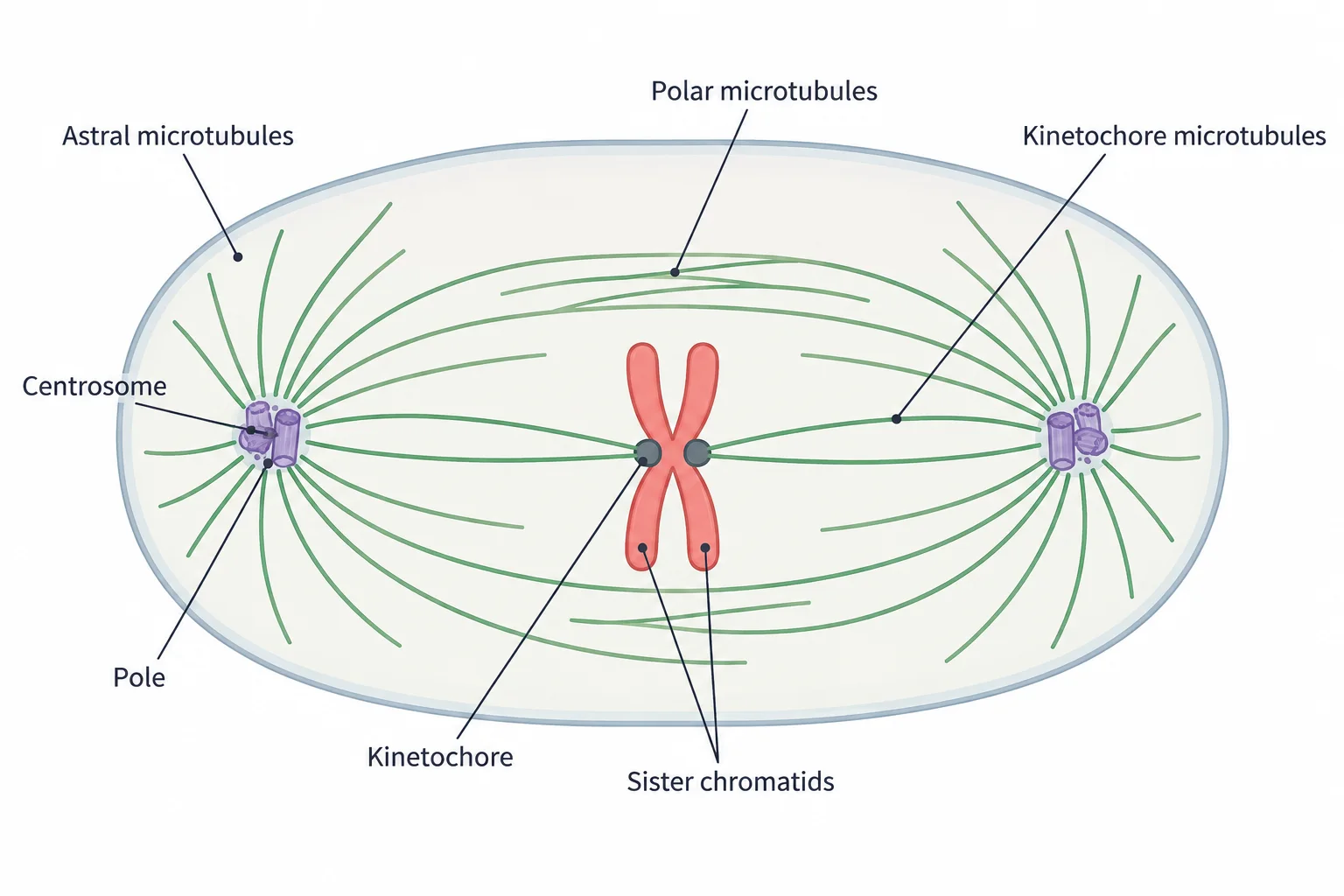
- The kinetochore is a group of proteins assembled on each chromatid at the centromere. It’s the handle the sorting machinery grabs.
Each pair of sister chromatids has two kinetochores, one on each chromatid. In mitosis, the two kinetochores of a pair hook to opposite ends of the cell, which is what lets the two copies be pulled apart.
Check yourselfWhat would happen to a pair of sister chromatids that had no kinetochores?
Nothing could grab them. Without kinetochores, the chromatids can’t attach to the spindle, so they can’t be sorted, and the metaphase checkpoint would halt division.
The spindle apparatus
The machine that sorts chromosomes is the spindle apparatus, built from microtubules, the hollow protein tubes of the cytoskeleton (Chapter 4). Its microtubules grow by adding tubulin proteins to their ends and shrink by losing them.
In animal cells, the spindle is organized by the centrosome, the cell’s microtubule-organizing center. The centrosome is duplicated during interphase. When mitosis starts, the two centrosomes move apart, and each one becomes one end, or pole, of the spindle, one for each future daughter cell. An animal centrosome holds a pair of centrioles, but many eukaryotes, including plants, have no centrioles and build spindles without them.
From each pole, three kinds of microtubules grow:
| Microtubule | Where it goes | Job |
|---|---|---|
| Astral microtubules | Outward, away from the region between the poles | Position the spindle within the cell |
| Polar microtubules | Into the region between the poles, overlapping those from the other pole | Push the poles apart |
| Kinetochore microtubules | To the kinetochores of the chromosomes | Attach to and sort the chromosomes |
Check yourselfA drug keeps the kinetochore microtubules from forming but leaves the others intact. What step of division fails?
Chromosome sorting. The spindle can still form and its poles can be positioned, but nothing connects the chromosomes to the poles, so they can’t be pulled apart.
Where the spindle came from
Bacteria divide by binary fission: after the chromosome is copied, each copy anchors to the plasma membrane, and a ring of a protein called FtsZ pinches the cell in two. FtsZ is evolutionarily related to tubulin. In eukaryotes, tubulin’s microtubules took on new jobs: dividing the nucleus and sorting many chromosomes. It’s an example of descent with modification.
Practice questions
1 of 3
What job do the astral microtubules do?
2 of 3
Plant cells have no centrioles. What does this mean for how they divide?
3 of 3
A fertilized egg grows into a body of trillions of cells that nearly all carry the same genes. Which process makes this possible?