Meiosis II and how meiosis differs from mitosis
Meiosis I leaves two haploid cells whose chromosomes are still pairs of sister chromatids. Meiosis II finishes the job by separating those sisters, and it works almost exactly like mitosis.
Meiosis II
After meiosis I and cytokinesis, each cell goes straight into meiosis II. The DNA is not replicated again. Each cell runs through prophase II, prometaphase II, metaphase II, anaphase II, and telophase II, just as in mitosis:
- Each pair of sister chromatids attaches to kinetochore microtubules from both poles.
- The pairs line up single file on the metaphase plate.
- In anaphase II, sister chromatids separate, and one goes to each pole.
The only difference from mitosis is the starting point. For a cell with 2n = 6, mitosis begins with six pairs of sister chromatids (12 chromatids). Each cell entering meiosis II has only three pairs (six chromatids), one for each homologous pair.
After cytokinesis, the two cells have become four. Each has one complete set of chromosomes, and each chromosome is now a single chromatid.
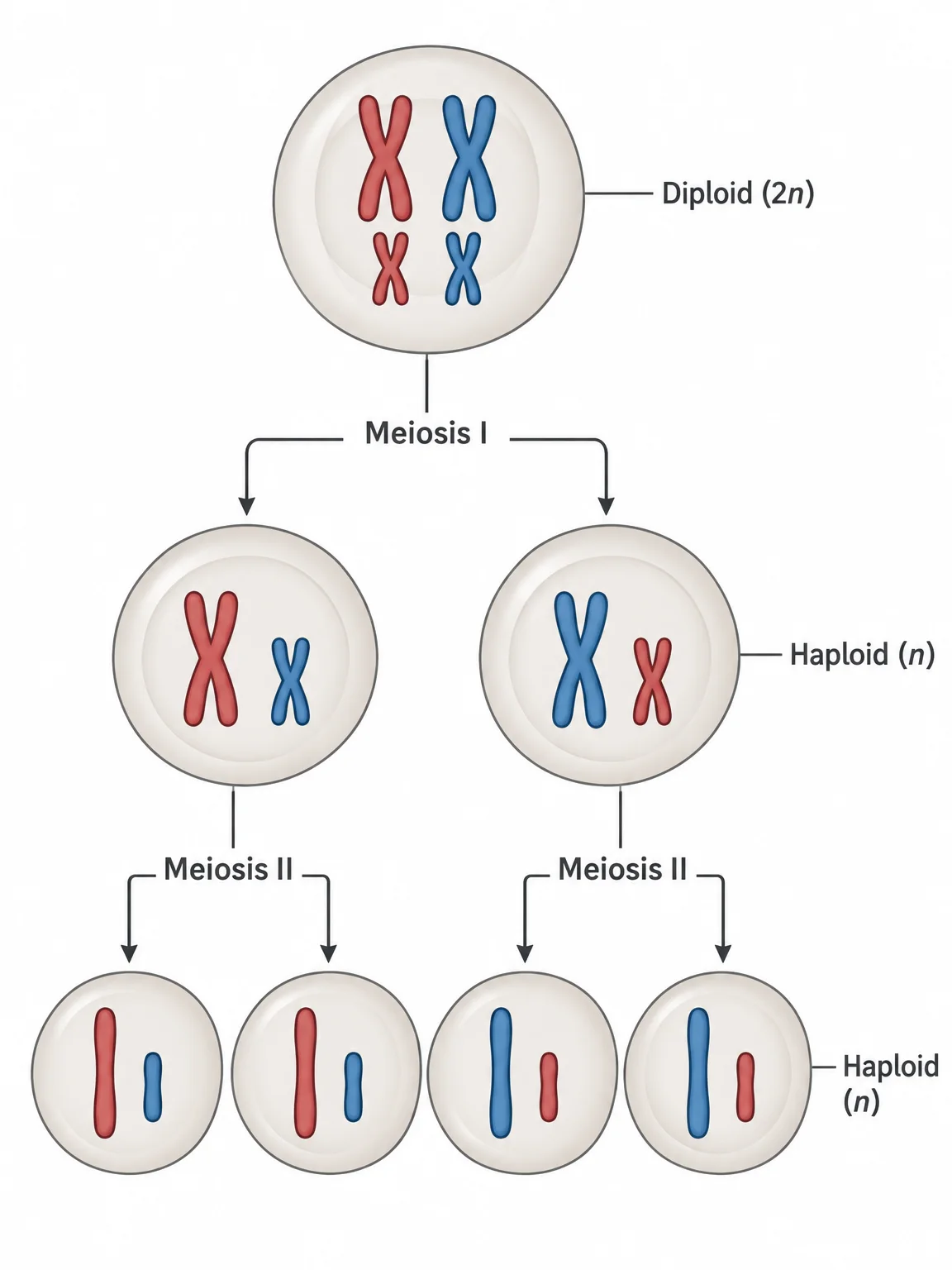
Check yourselfIn anaphase I and anaphase II, what separates in each?
In anaphase I, homologous chromosomes separate, and each sister pair stays together. In anaphase II, the sister chromatids themselves separate.
Mitosis vs. meiosis
Mitosis makes two diploid cells that are genetically identical to the mother cell. Meiosis makes four haploid cells, each with one complete set of chromosomes, that usually differ genetically from each other. A handful of differences in the steps account for those outcomes.
| Event | Mitosis | Meiosis I | Meiosis II |
|---|---|---|---|
| DNA replication | Before mitosis | Before meiosis I | None before meiosis II |
| Synapsis in prophase | No | Yes, bivalents form | No |
| Crossing over | Rare | Common | Rare |
| Attachment in prometaphase | Each sister pair to both poles | Each sister pair to one pole | Each sister pair to both poles |
| Metaphase alignment | Sister pairs, single row | Bivalents, double row | Sister pairs, single row |
| What separates in anaphase | Sister chromatids | Homologs | Sister chromatids |
| Result (diploid mother cell) | Two diploid cells | Two haploid cells | Four haploid cells |
Naming the phase from a picture
Exam questions often show a dividing cell and ask which phase it’s in. Start from the diploid number, then ask two things: how many replicated chromosomes are lined up, and are they in a single row or paired as bivalents?
Check yourselfAn organism has a diploid number of 10. A cell shows 10 replicated chromosomes in a single row at the metaphase plate. Which phase is it in?
Practice questions
1 of 3
Which describes the cells produced when one diploid cell completes meiosis?
2 of 3
What happens to the DNA between meiosis I and meiosis II?
3 of 3
Looking at a dividing cell, you see each replicated chromosome paired tightly with its homolog, four chromatids side by side. Which phase is the cell in?