Changes in chromosome number
Besides changing shape, chromosomes can change in number. The change can involve whole sets of chromosomes or just one chromosome within a set, and the difference between those two matters a great deal.
Whole sets vs. single chromosomes
The suffix -ploid refers to complete sets of chromosomes. An organism is euploid when its chromosomes come in complete sets, whether that’s one set, two, or more. A normal human, with two full sets, is euploid. The examples below are for a species with n = 4.
| Term | Chromosomes present | Count |
|---|---|---|
| Diploid (normal) | Two complete sets (2n) | 8 |
| Polyploid | Three or more complete sets: triploid (3n), tetraploid (4n), and so on | 12 if triploid |
| Trisomy | One chromosome present three times (2n + 1) | 9 |
| Monosomy | One chromosome present only once (2n − 1) | 7 |
Diploids and polyploids are both euploid, because every set is complete. Trisomy and monosomy are kinds of aneuploidy: a change in the number of one particular chromosome, so the total is no longer an exact multiple of a set. A person with three copies of chromosome 21 has trisomy 21; one missing a copy of a chromosome has a monosomy.
Check yourselfA plant species has n = 7. One plant has 21 chromosomes and another has 15. Classify each.
Nondisjunction
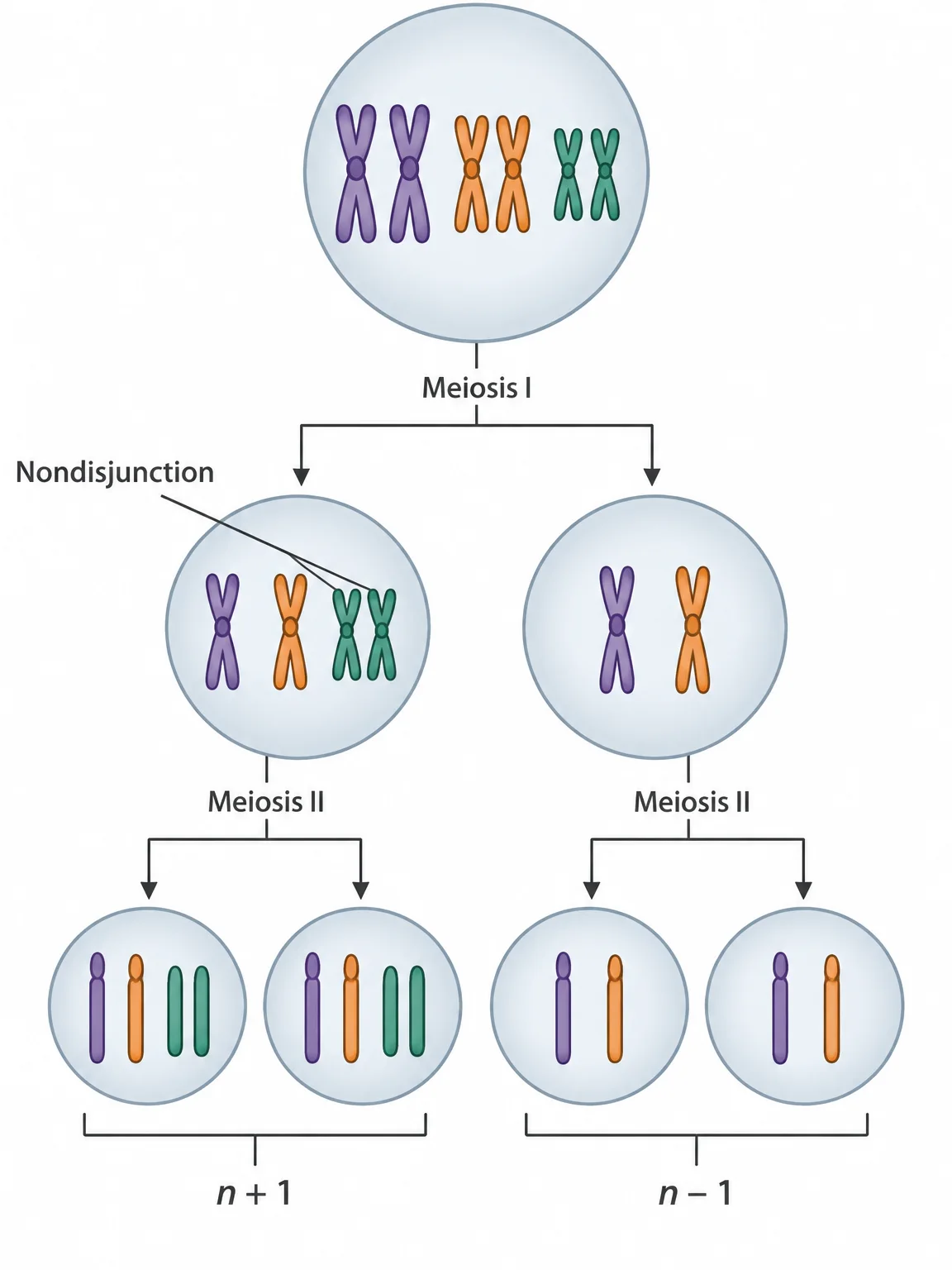
Many changes in number start with a sorting mistake. Nondisjunction is a failure of chromosomes to separate properly during cell division. It can happen in meiosis I, when a pair of homologs moves to the same pole, or in meiosis II, when a pair of sister chromatids does.
- In anaphase I, one pair of homologs fails to separate, and both move into the same cell.
- Meiosis II proceeds normally in both cells.
- Two gametes carry one chromosome too many (n + 1), and two carry one too few (n − 1).
- If one of these gametes fuses with a normal gamete, the zygote is aneuploid, and so is every cell of the organism that grows from it.
Check yourselfA sperm carrying 22 chromosomes fertilizes a normal egg. How many chromosomes does the zygote have, and what is this called?
Aneuploidy in humans
Errors in chromosome number arise surprisingly often when human gametes form. Most embryos with the wrong number don’t develop, and these errors cause a large share of early miscarriages. A few aneuploid conditions survive to birth:
| Chromosomes | Syndrome | Main features |
|---|---|---|
| Trisomy 21 | Down | Cognitive disability, flattened face, short stature |
| Trisomy 18 | Edwards | Severe disabilities, early death |
| Trisomy 13 | Patau | Severe disabilities, organ defects, early death |
| XXY | Klinefelter | Male, no sperm, sexually immature |
| XYY | Jacobs | Male, tall |
| XXX | Triple X | Female, tall and thin |
| X0 (one X only) | Turner | Female, short stature, sexually undeveloped |
The autosomal trisomies that survive involve small chromosomes, which carry fewer genes. Trisomies of the other autosomes, and most monosomies, are thought to be lethal. The risk of having a child with an abnormal chromosome number rises with parents’ age, probably because nondisjunction is more likely in older cells. For Down syndrome, the risk climbs sharply in a mother’s later reproductive years.
Why aneuploidy is harmful
For many genes, a cell makes gene product in proportion to how many copies of the gene it has.
An aneuploid organism has wrong amounts of the products of many genes at once, all on one chromosome, while the rest of its genes stay normal. That imbalance is why aneuploidy is usually harmful in any eukaryote.
Polyploidy in animals and plants
Animals tolerate polyploidy poorly; in mammals it’s generally lethal. A few amphibians and reptiles are polyploid, and male honeybees, which hatch from unfertilized eggs, are haploid.
Plants are different. Polyploidy is common in plants, and polyploid plants tend to be larger and hardier than their diploid relatives and to tolerate harsher conditions. Many crops and garden flowers are polyploid. Bread wheat, for example, has six sets of chromosomes, inherited from three different wild grasses.
Practice questions
1 of 4
A girl has Turner syndrome, with a single X and no second sex chromosome. Which pair of gametes most likely formed her?
2 of 4
An organism whose chromosomes all come in complete sets, whether two sets or more, is described as
3 of 4
Which factor raises the chance of having a child with an abnormal chromosome number?
4 of 4
One pair of homologs fails to separate in meiosis I, and meiosis II proceeds normally. What are the four resulting gametes like?