Genetic diversity and sexual life cycles
Sexual reproduction is costly, so its payoff must be large. That payoff is variety: meiosis shuffles each parent’s chromosomes so that almost every gamete is unique, and fertilization then combines two unique gametes.
How meiosis shuffles chromosomes
Recall that at metaphase I, each homologous pair lines up with one homolog on each side of the metaphase plate, and which side the maternal homolog faces is random. Each pair flips its own coin, independently of the others. So which cell gets the maternal or the paternal copy of each chromosome is a matter of chance.
With n chromosomes per set, the number of possible alignments is 2ⁿ, because each of the n pairs can face either of two ways.
Crossing over multiplies that further. Because homologs swap segments in prophase I, a gamete’s chromosomes are themselves patchworks of maternal and paternal DNA. Together, random alignment and crossing over make it very unlikely that any two gametes are genetically the same.
Check yourselfAn organism has a diploid number of 8. How many different chromosome alignments are possible at metaphase I?
Sixteen. A diploid number of 8 means n = 4, and 2⁴ = 16.
Why sex pays off
When gametes from two parents fuse, the offspring can show combinations of traits that neither parent had. Making offspring with new combinations of traits through sexual reproduction is genetic recombination.
Suppose one parent tolerates heat but can’t digest a common food plant, and the other can digest the plant but doesn’t tolerate heat. Their offspring could get either parent’s combination, but also two new ones: heat-tolerant and able to digest the plant, or neither.
That variety helps a population in two ways:
- Faster adaptation: if the environment changes (say it gets hotter and that plant becomes the main food), some offspring may already carry a combination that suits the new conditions. Natural selection favors them, and they pass those traits on.
- Disease resistance: genes affect how well individuals resist many diseases. In a varied population, some individuals carry resistant versions of those genes, so one disease is unlikely to wipe out everyone.
Three kinds of life cycles
The series of events that leads from one generation to the next is a life cycle. In sexual species, a life cycle alternates between haploid and diploid cells. Species differ in which stage grows into the multicellular body.
| Life cycle | Multicellular stage | What meiosis makes | Found in |
|---|---|---|---|
| Diploid-dominant | Diploid only | Gametes | Most animals |
| Haploid-dominant | Haploid only | Spores | Most fungi, some protists |
| Alternation of generations | Both a diploid and a haploid form | Spores | Plants, some protists |
In diploid-dominant species such as humans, cells in the testes or ovaries undergo meiosis to make sperm or eggs. Sperm and egg fuse into a zygote, and mitosis builds a diploid body.
In haploid-dominant species, the body is haploid. The fuzzy mold on stale bread is the haploid stage of its fungus. Two haploid cells fuse into a diploid zygote, which immediately undergoes meiosis to make four haploid spores. Each spore divides by mitosis into a new haploid body.
Plants show alternation of generations: a diploid multicellular form, the sporophyte, alternates with a haploid multicellular form, the gametophyte. Meiosis in the sporophyte makes spores. Each spore divides by mitosis into a gametophyte, and some gametophyte cells become gametes. Fertilization makes a zygote, which grows by mitosis into a new sporophyte.
How big each generation is varies. In mosses, the gametophyte is the green plant you see, and the small sporophyte stays attached to it. In ferns, both live on their own, but the leafy fern is the much larger sporophyte. In seed plants such as roses and oak trees, the sporophyte is the whole plant, and the gametophyte is just a few cells inside it.
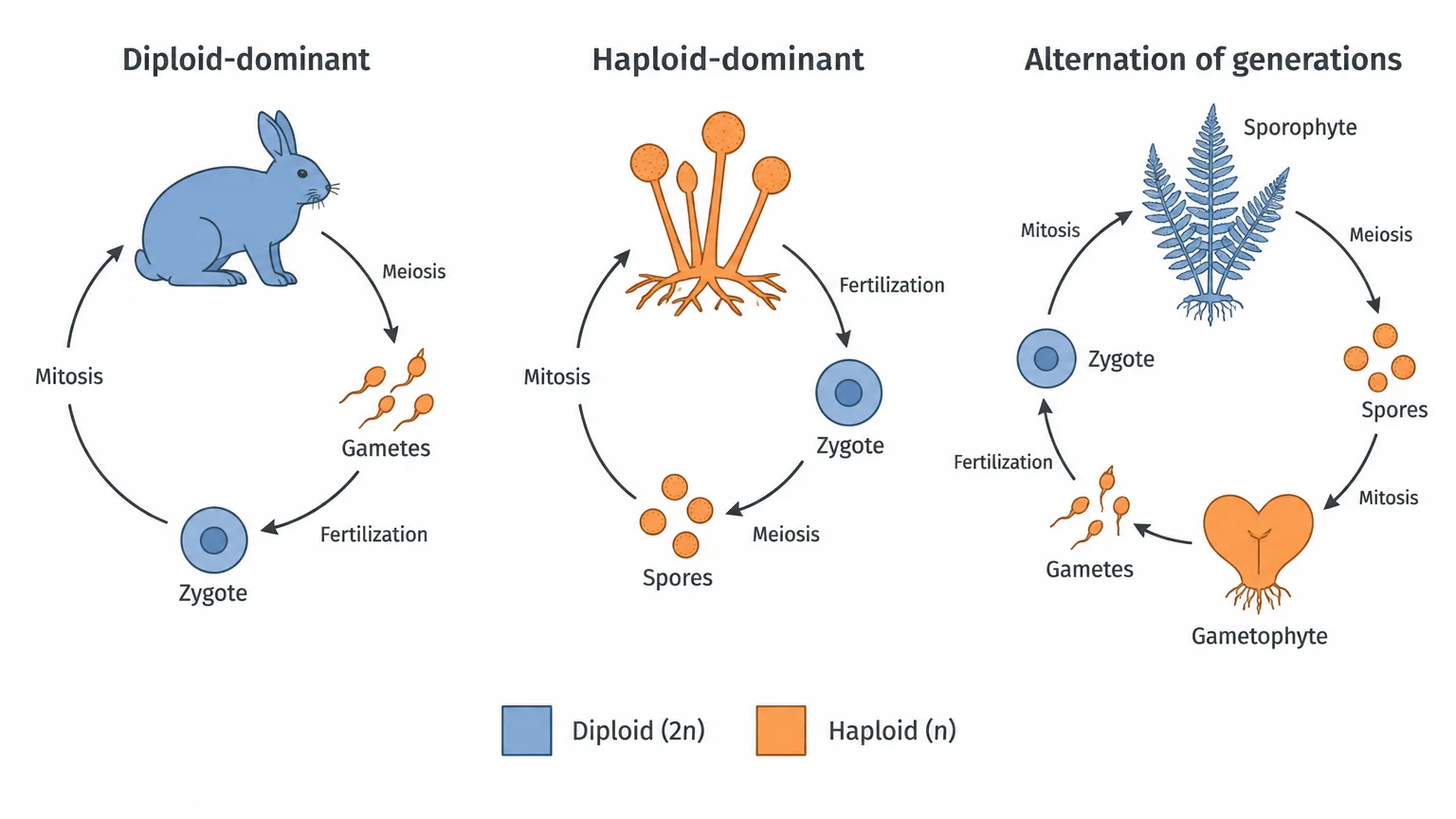
Animals make their gametes by meiosis. Plants and fungi make theirs by mitosis, from cells that are already haploid.
Check yourselfA drug blocks meiosis in an animal but leaves mitosis working. What can the animal no longer do, and what can it still do?
It can’t make gametes for fertilization. It can still grow and replace cells by mitosis, the process that built its body from a zygote.
Practice questions
1 of 4
Most eukaryotes reproduce sexually despite its costs. What is the leading explanation for its advantage?
2 of 4
Two parents produce offspring that show combinations of traits neither parent had. What is this outcome of sexual reproduction called?
3 of 4
What distinguishes a spore from a gamete?
4 of 4
How do plants make their gametes?