The cell cycle and its checkpoints
Cell theory says every cell comes from a cell that already existed. In eukaryotes, getting from one cell to two follows a fixed series of phases, the cell cycle, and proteins check the cell’s progress at key points.
Four phases
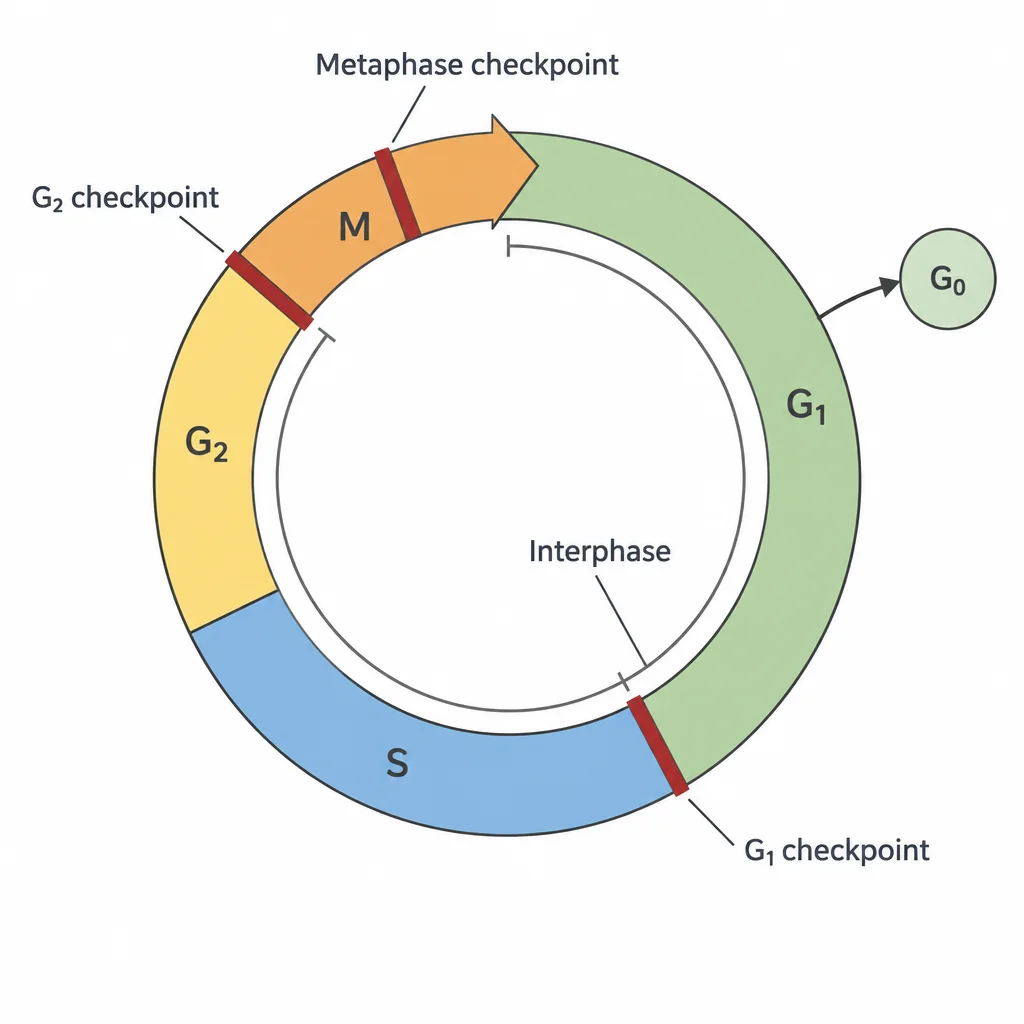
A dividing cell passes through four phases in order: G₁, S, G₂, and M. The “G” stands for gap, the stretches between copying the DNA and dividing.
| Phase | Name | What happens |
|---|---|---|
| G₁ phase | First gap | The cell grows and, given the right signals, commits to dividing |
| S phase | Synthesis | Each chromosome is replicated into a pair of sister chromatids |
| G₂ phase | Second gap | The cell makes the proteins needed to sort chromosomes and divide |
| M phase | Mitosis and cytokinesis | The nucleus divides, then the cell divides |
G₁, S, and G₂ together make up interphase, when the cell grows and copies its chromosomes. M phase has two parts. First comes mitosis, the division of one nucleus into two, which gives each new nucleus the same chromosomes. Then comes cytokinesis, the division of the cytoplasm into two separate daughter cells.
A cell can also leave the cycle instead of moving on from G₁. That nondividing state is the G₀ phase. Some cells rest there for a while and return to the cycle later. Others, such as muscle cells in an adult, never divide again.
Phase lengths vary. G₁ is usually the longest and most variable, and M is usually the shortest: in a cell that divides once a day, M phase takes about an hour.
Check yourselfA cell has 20 chromosomes in G₁. How many chromatids will it have when mitosis begins?
- S phase replicates each chromosome into a pair of sister chromatids, and G₂ doesn’t change the count.
Cyclins and cdks drive the cycle
Whether a cell divides depends on outside factors, such as nutrients and growth factors, and on proteins inside the cell. Two kinds of proteins work as a team to push a cell from one phase to the next.
- One partner is a protein whose amount rises and falls as the cycle goes around, which is how it got its name: a cyclin.
- The other is a protein kinase, the kind of enzyme from Chapter 9 that switches other proteins on or off by adding phosphate groups. It works only when bound to a cyclin, so it’s called a cyclin-dependent kinase (cdk).
Cells make different cyclins at different times, and which cyclin is present decides which phase the cell can move into.
- During G₁, a G₁ cyclin builds up when the cell has enough nutrients and growth factors.
- G₁ cyclin binds a cdk, and the active complex phosphorylates proteins needed for DNA replication, moving the cell into S phase.
- Once the cell is in S phase, G₁ cyclin is destroyed.
- Late in G₂, a mitotic cyclin builds up, binds a cdk, and the complex pushes the cell into M phase.
- After M phase, mitotic cyclin is destroyed.
This timed destruction is the ubiquitin tagging from Chapter 6 at work: getting rid of each cyclin on schedule keeps the cycle moving in one direction.
Checkpoints
The cycle has three checkpoints, points where the cell must pass an inspection before it can go on. The inspectors are the checkpoint proteins from Chapter 15. Some act as sensors. If they detect a problem, others halt the cycle, often by blocking cdks.
| Checkpoint | Where | What it checks |
|---|---|---|
| G₁ checkpoint (restriction point) | End of G₁ | Conditions are right for dividing; DNA is undamaged |
| G₂ checkpoint | End of G₂ | DNA is undamaged and fully replicated; enough M-phase proteins are present |
| Metaphase checkpoint | Metaphase of mitosis | Every chromosome is correctly attached to the spindle that sorts chromosomes |
Checkpoints delay the cycle until a problem is fixed, or stop division if it can’t be. Their main job is to keep cells with damaged DNA or the wrong number of chromosomes from dividing. When mutations disable checkpoint genes, more genetic damage slips through, which can lead to cancer.
Check yourselfA cell passes the G₂ checkpoint, but one chromosome never attaches to the spindle. Where is division stopped?
At the metaphase checkpoint, which checks that every chromosome is correctly attached to the spindle. Division halts until the problem is fixed.
Practice questions
1 of 3
After its DNA has been copied but before mitosis begins, a cell makes the proteins it will need to sort chromosomes and divide. Which phase is this?
2 of 3
Why can mutations that disable checkpoint genes lead to cancer?
3 of 3
What are the two parts of M phase, in order?