Where a mutation strikes
A mutation doesn’t have to land in a codon to matter. And whether it reaches the next generation depends on which cell it happens in. Both questions come down to location: where in the DNA, and where in the body.
Mutations outside the coding sequence
A gene is more than its codons. As Chapter 12 showed, a promoter tells RNA polymerase where to start, regulatory sequences control how much the gene is transcribed, and splice sites mark where introns are cut out. A mutation in any of these can change how the gene is expressed even though the polypeptide’s amino acid sequence stays the same.
| Location | Normal role | If mutated |
|---|---|---|
| Promoter | Where RNA polymerase binds to start transcription | Transcription may rise or fall |
| Regulatory element | Binding site for proteins that turn transcription up or down | The gene is no longer regulated properly |
| Splice site | Marks the boundary between an intron and an exon | The pre-mRNA may be spliced incorrectly |
| Translational regulatory element | A sequence in the mRNA that controls how often it’s translated | The mRNA is no longer translated on cue |
| Intergenic region | DNA between genes | Usually little or no effect |
A promoter mutation that helps RNA polymerase bind more tightly increases transcription; one that weakens binding decreases it. Mutations between genes are the least likely to matter, because those stretches don’t control any gene’s expression.
Regulatory elements are worth a closer look. Recall from Chapter 14 that a bacterial repressor shuts a gene off by binding its operator, a DNA sequence next to the promoter. If a mutation changes the operator so the repressor can no longer bind, nothing switches the gene off, and it is transcribed all the time.
Check yourselfMutation A lands in a gene’s promoter, and mutation B lands in the DNA between two genes. Which is more likely to be harmless?
Mutation B, in the intergenic region. That DNA doesn’t control any gene’s transcription, splicing, or translation, so a change there rarely matters.
Germ-line mutations are inherited
You began life as a single fertilized egg that divided again and again to build every cell in your body. A mutation can arise in any of those cells, early or late. How many cells end up carrying it, and whether it can reach your children, depends on when and where it happens.
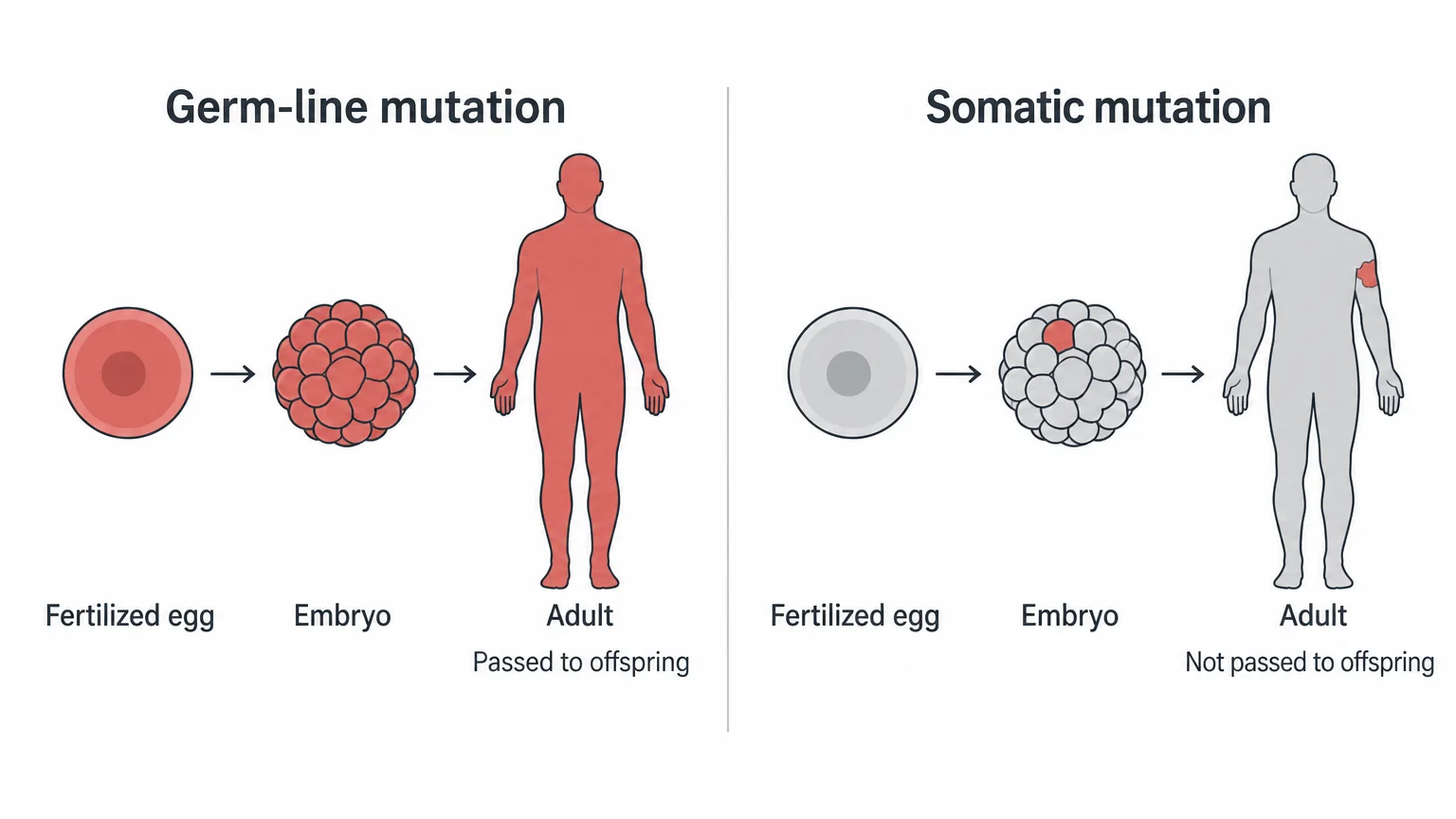
The germ line is the set of cells that give rise to gametes, the eggs and sperm. A germ-line mutation arises in a gamete or in a precursor cell that will produce gametes. If a mutant gamete takes part in fertilization, every cell of the offspring carries the mutation, including that offspring’s own germ line, so it can be passed on again.
Humans carry two copies of most genes. A new mutation in one copy ends up in only half of a person’s gametes, so each child has a 50% chance of inheriting it.
Somatic mutations stay in one body
Somatic cells are all the cells of the body except the germ line: skin cells, muscle cells, nerve cells, and so on. A somatic mutation arises in one of them and is passed only to that cell’s descendants. It can’t reach offspring, because no gamete comes from those cells.
The timing sets the size of the affected area. A mutation in an early embryonic cell is copied into every cell descended from it, so in the adult it shows up as a patch of tissue. The earlier the mutation, the bigger the patch.
A streak of white hair in otherwise black hair can come from a somatic mutation in one embryonic cell whose descendants produced that streak. An individual whose body has regions that differ genetically from each other is a mosaic.
Somatic mutations early in life can be serious if they disrupt development, because so many cells inherit them. That’s one reason to avoid mutation-causing agents especially during pregnancy, infancy, and early childhood.
Check yourselfA mutation arises in a stomach-lining cell of a newborn. Is it germ-line or somatic, and can it reach the baby’s future children?
Somatic, because stomach cells aren’t part of the germ line. Only that cell’s descendants carry it, so it can’t be passed to offspring.
Practice questions
1 of 3
A man carries a new germ-line mutation in one of his two copies of a gene. About what fraction of his sperm carry the mutant copy?
2 of 3
The cells in an ovary that will eventually produce egg cells belong to which group?
3 of 3
In a bacterium, a repressor normally shuts off a gene by binding a DNA sequence next to its promoter. A mutation changes that sequence so the repressor can no longer bind. What happens to the gene?