How mutations change a polypeptide
A gene’s bases are read three at a time, and each codon picks one amino acid. Change a single letter in that message and the protein can change with it. Because DNA is copied before every cell division, a changed sequence is passed on to both daughter cells, which is what makes a mutation heritable.
Small changes in a gene
Some mutations rearrange or remove whole chromosomes. This chapter is about gene mutations, small changes in the base sequence of one gene. They come in two basic kinds: a base is swapped for a different one, or base pairs are added or removed.
A mutation that affects just one base pair is a point mutation. A base substitution replaces one base pair with another: a T–A pair, for example, becomes a G–C pair. Adding or deleting a single base pair also counts as a point mutation.
Four effects on the polypeptide
When a point mutation lands inside the coding sequence of a gene, it can affect the polypeptide in one of four ways. The first three come from base substitutions; the fourth comes from adding or removing bases.
| Mutation | Change in DNA | Effect on polypeptide |
|---|---|---|
| Silent | Base substitution | None; the new codon codes the same amino acid |
| Missense | Base substitution | One amino acid is replaced by another |
| Nonsense | Base substitution | A codon becomes a stop codon; the chain is cut short |
| Frameshift | Addition or deletion, not a multiple of three | Every amino acid after the mutation changes |
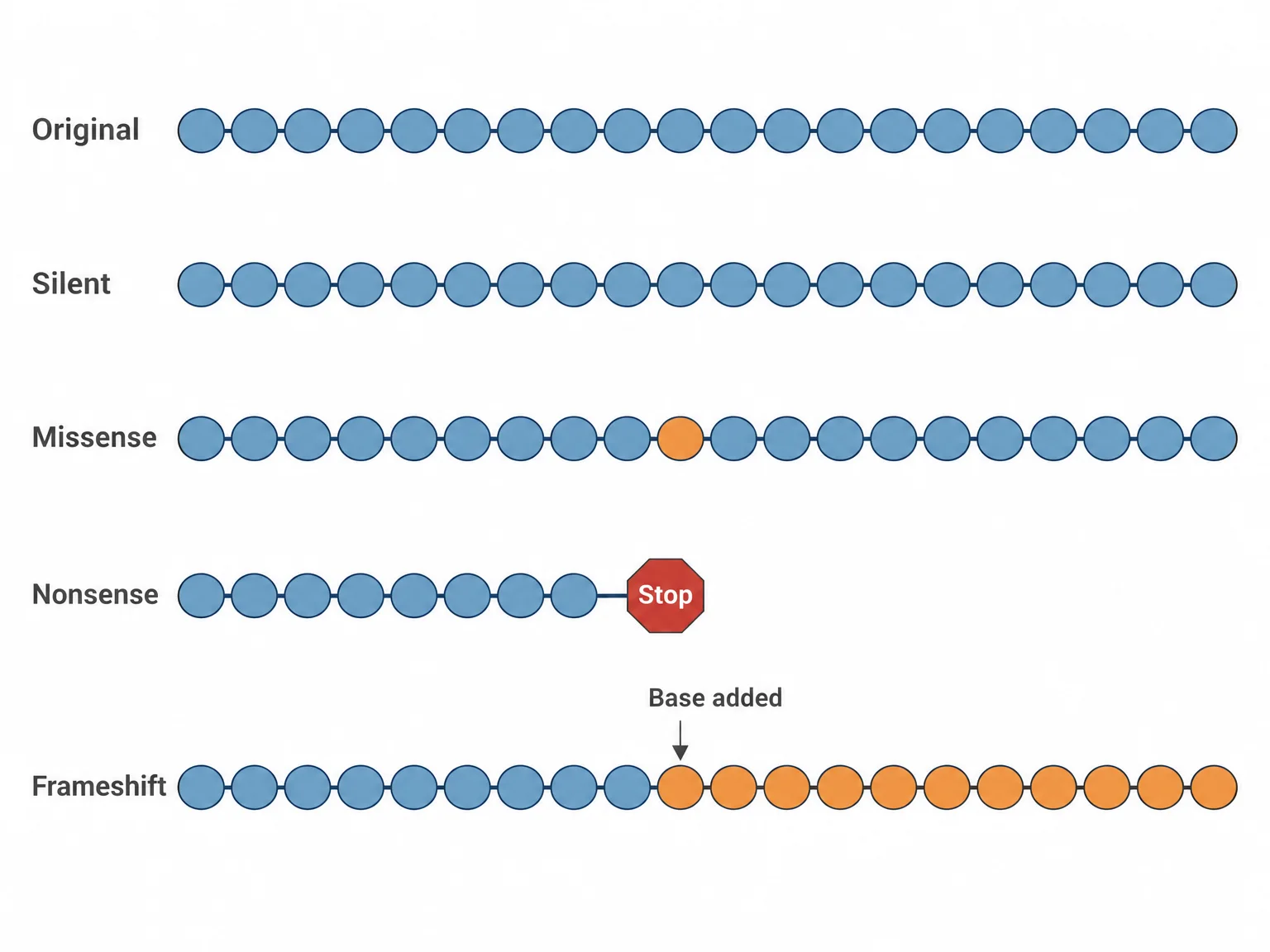
A silent mutation changes a codon without changing its amino acid. This is possible because the genetic code is degenerate: most amino acids have several codons, which often differ only in their third base.
A missense mutation swaps one amino acid for another. Its effect depends on how different the new amino acid is. Trading one negatively charged amino acid for another with a similar side chain may leave the protein working fine. Trading a polar amino acid for a nonpolar one is more likely to change how the polypeptide folds, and so what it can do.
A nonsense mutation turns a codon for an amino acid into a stop codon. Translation ends early, and the shortened polypeptide rarely works.
A frameshift mutation adds or deletes a number of nucleotides that isn’t a multiple of three. The ribosome still reads in threes, so every codon after the change is grouped wrong, like reading a sentence with every word boundary moved over one letter.
Check yourselfA mutation changes the codon UGG (tryptophan) to UGA. Which kind of mutation is it, and what happens to the polypeptide?
It’s a nonsense mutation. UGA is a stop codon, so translation stops there and the polypeptide comes out shorter than normal.
One amino acid can matter
Sickle cell disease, which you met in Chapter 3, is the classic missense mutation. In the gene for β-globin, one of the polypeptides that make up hemoglobin, a base substitution changes the sixth amino acid from glutamic acid to valine.
That one swap matters because glutamic acid is hydrophilic and negatively charged, while valine is hydrophobic. The negative charges on normal hemoglobin likely help keep the molecules apart. With valine in their place, the mutant hemoglobin molecules stick to one another when oxygen is low and form long fibers. The fibers bend red blood cells from flat discs into sickle shapes, which block small blood vessels and cause anemia.
The mutation is common where malaria is common. People with one sickle cell copy of the gene and one normal copy resist malaria without having the disease, so natural selection has kept the mutation frequent there. Thousands of other inherited disorders, such as cystic fibrosis and Tay-Sachs disease, also trace back to a mutation in the coding sequence of a single gene.
Check yourselfWhich is more likely to destroy a protein’s function: a missense mutation near the end of the coding sequence, or a one-nucleotide deletion near the start?
The deletion near the start. It shifts the reading frame and changes nearly every amino acid after it, while the missense mutation changes only one.
Mutations and natural selection
A mutation that doesn’t affect an organism’s ability to survive and reproduce is neutral, and natural selection doesn’t act on it. A beneficial mutation improves function and tends to become more common over many generations. A harmful, or deleterious, mutation tends to be eliminated.
Apart from silent mutations, a new mutation is much more likely to reduce a protein’s function than to improve it. Today’s genes have been refined over billions of years of evolution, so a random change usually disrupts something that already works.
Practice questions
1 of 3
Which change in a gene’s coding sequence causes a frameshift mutation?
2 of 3
Two missense mutations hit the same enzyme. One swaps a negatively charged amino acid for another negatively charged one with a similar side chain. The other swaps a polar amino acid for a nonpolar one. Which is more likely to impair the enzyme?
3 of 3
Why is a new mutation that changes a protein more likely to reduce its function than to improve it?