How cancer develops
People with xeroderma pigmentosum show the link between unrepaired DNA damage and cancer. Most cancers arise the same way, from mutations in body cells, but they build up slowly over many years.
A disease of uncontrolled division
Cancer is a disease of multicellular organisms in which cells divide out of control.
Only about 10% of cancers involve an inherited predisposition, a mutation passed down from a parent that raises the risk. The other 90% or so are acquired: they come from somatic mutations that pile up during a person’s life, which is why cancer usually strikes later in life.
Most of those mutations have an outside cause. At least 80% of human cancers are linked to carcinogens, agents that increase the chance of developing cancer. Most carcinogens, such as UV light and chemicals in cigarette smoke, are mutagens that damage the DNA of somatic cells.
From one cell to a malignant tumor
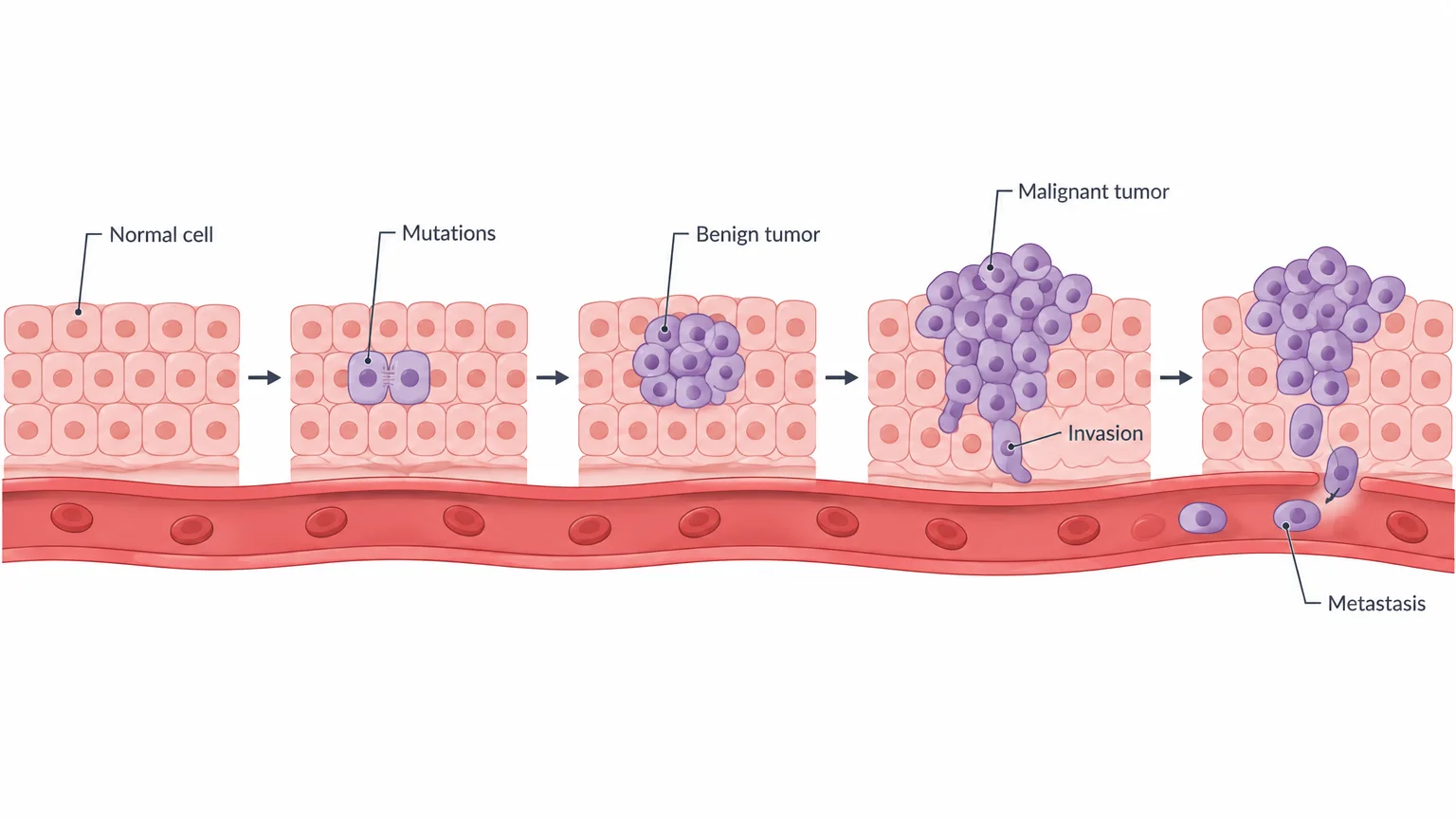
Every cancer begins with a single cell. That cell and its descendants, its lineage, acquire a series of mutations and other genetic changes, and each change can make the cells grow a little more abnormally.
- A few mutations make one cell divide more than it should.
- Its descendants form a benign tumor, an overgrowth of cells that stays in place and doesn’t invade nearby tissue.
- More genetic changes in some tumor cells disrupt growth control further, producing a malignant tumor. At this point the person has cancer.
- Malignant cells invade neighboring healthy tissue.
- Some malignant cells break away and travel through the bloodstream or other body fluids to new sites, a process called metastasis.
Left untreated, a malignant tumor will kill the organism.
| Growth | Invades nearby tissue? | Spreads? | Cancer? |
|---|---|---|---|
| Benign tumor | No | No | No |
| Malignant tumor | Yes | It can | Yes |
| Metastatic cancer | Yes | Yes | Yes |
Check yourselfA malignant tumor has invaded the tissue around it, but none of its cells have entered the blood or other body fluids. Has it metastasized?
Not yet. Metastasis means cells break away and travel through the bloodstream or other body fluids to start tumors at new sites. Invading nearby tissue comes first.
Two kinds of cancer genes
Researchers have found many genes that promote cancer when they mutate. Comparing each mutant gene with its normal version sorts them into two groups, based on what the mutation does.
An oncogene is a gene that has been mutated to be overactive: it is expressed too much, or it makes a protein that is too active. Its overactivity drives cells to divide.
A tumor-suppressor gene is a normal gene whose protein helps prevent cancer. A mutation that eliminates its function removes that protection, and cancer can follow.
So the two categories are opposites. Cancer-causing mutations in oncogenes create too much activity; cancer-causing mutations in tumor-suppressor genes cause a loss of activity.
Check yourselfA mutation destroys the function of a gene, and the cells carrying it start dividing out of control. Is it behaving like an oncogene or a tumor-suppressor gene?
A tumor-suppressor gene. Losing its function led to cancer, so its normal job must have been to hold division back. An oncogene, by contrast, causes cancer by becoming more active, not less.
Practice questions
1 of 3
Roughly 90% of human cancers arise from which kind of genetic change?
2 of 3
Most carcinogens, such as UV light and chemicals in cigarette smoke, are also mutagens. Why?
3 of 3
Which sequence shows the typical progression of cancer?