Repairing damaged DNA
Free radicals, chemicals, and sunlight damage DNA all the time, and replication adds its own errors. If every bit of damage became a permanent mutation, few species could survive. Every organism has repair systems that find damage and fix it before replication copies it into both strands.
Detect, then repair
Proofreading by DNA polymerase catches many mistakes as DNA is being copied. Repair systems are a separate defense: teams of proteins that patrol DNA and fix damage whenever it appears. Every repair system does two things in order. First, a protein detects something wrong with the DNA’s structure. Then the system fixes it.
Cells have several repair systems, each specialized for a different kind of problem.
| Repair system | Detects | Fix |
|---|---|---|
| Direct repair | A specific chemical change, such as an added alkyl group | An enzyme reverses the change in place, restoring the original base |
| Excision repair | An abnormal base or nucleotide, such as a thymine dimer | Cuts out a stretch of the damaged strand and rebuilds it |
| Mismatch repair | Two normal bases that are paired incorrectly | Removes a stretch of one strand around the mismatch and rebuilds it |
In direct repair, nothing is cut out. For example, an enzyme simply removes an ethyl group that a mutagen attached to a base. More often, though, the damaged section is removed and replaced. Excision repair comes in two forms, base excision repair and nucleotide excision repair, and mismatch repair (in full, methyl-directed mismatch repair) works the same way on mispaired bases.
The trick behind every removal system is that DNA has two complementary strands. When one strand is damaged, the other still carries the correct information and serves as a template for rebuilding the missing piece.
Check yourselfA mutagen attaches an ethyl group to a guanine, and an enzyme removes it without cutting the DNA. Which repair system is this?
Direct repair. The enzyme reverses the chemical change in place instead of removing and resynthesizing part of the strand.
Nucleotide excision repair
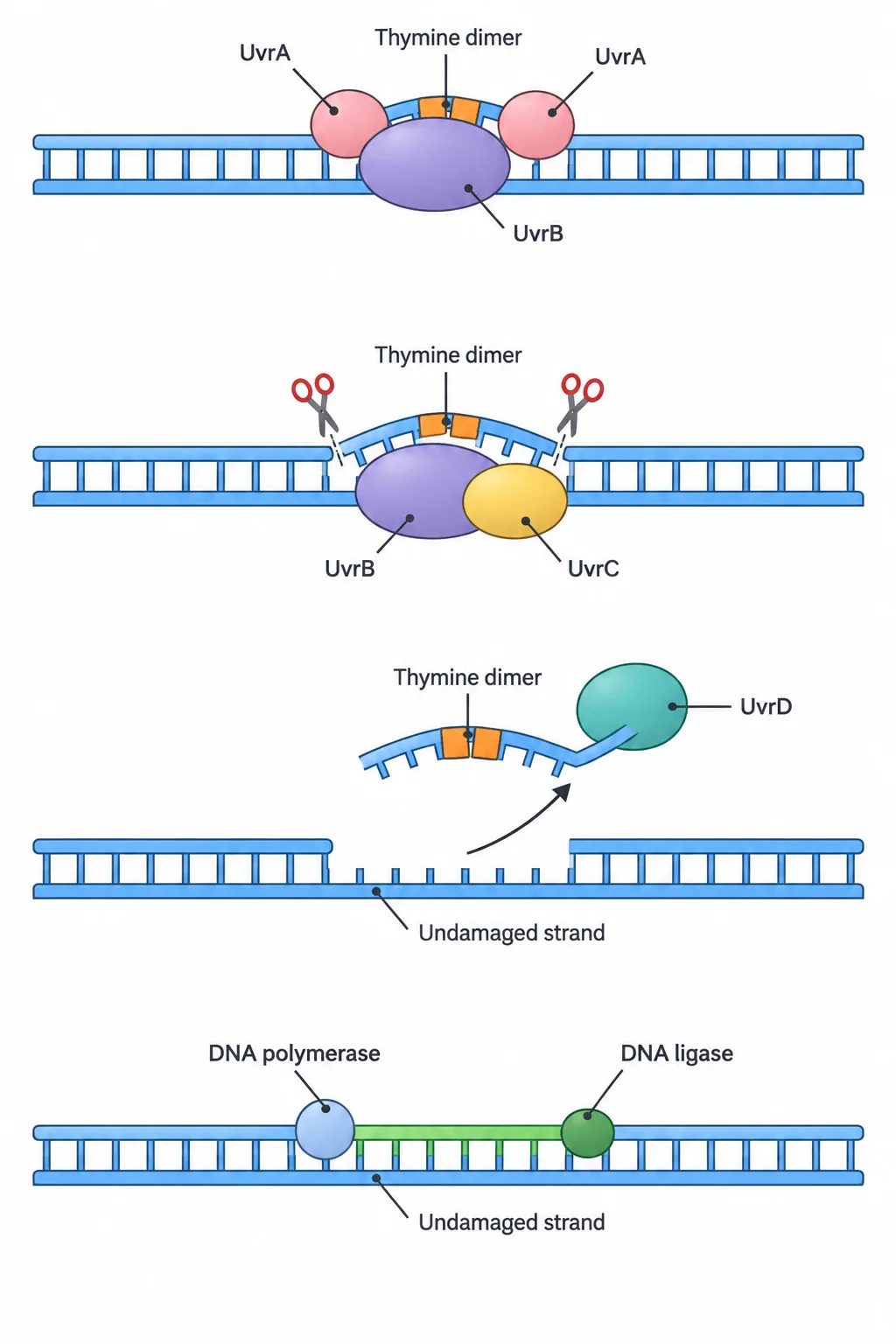
Nucleotide excision repair (NER) is found in all species. It removes a short stretch of several nucleotides around the damage and resynthesizes it, so it can fix many kinds of damage: thymine dimers, chemically modified bases, and missing bases. Its mechanism is best understood in bacteria, where four proteins named UvrA, UvrB, UvrC, and UvrD do the work, with help from DNA polymerase and DNA ligase.
- A complex of two UvrA proteins and one UvrB protein slides along the DNA, feeling for a distorted double helix.
- At a damaged site, the UvrA proteins leave and UvrC binds to UvrB.
- UvrC cuts the damaged strand on both sides of the damage.
- UvrD separates the strands, releasing the short piece of damaged DNA.
- DNA polymerase fills the gap, using the undamaged strand as a template.
- DNA ligase seals the new segment to the rest of the strand.
Check yourselfIn a mutant bacterium, UvrA and UvrB find a thymine dimer, but the damaged strand is never cut. Which protein is defective, and is the dimer removed?
When repair fails
In humans, the importance of NER is clearest in people whose repair system doesn’t work. Xeroderma pigmentosum (XP) is an inherited disease in which a protein needed for nucleotide excision repair is missing. People with XP can’t remove UV damage such as thymine dimers.
Because UV light reaches only the skin, that’s where the damage builds up. People with XP blister or freckle after brief sun exposure, and their risk of skin cancer can be up to 1,000 times normal. Avoiding sunlight greatly reduces the risk.
Practice questions
1 of 3
In nucleotide excision repair, which enzymes complete the job after the damaged stretch has been removed?
2 of 3
How do the proteins that scan DNA in nucleotide excision repair recognize a damaged site?
3 of 3
What is the main difference between the problems that mismatch repair and nucleotide excision repair fix?