What causes mutations
DNA polymerase proofreads its work, as Chapter 11 showed, but proofreading isn’t perfect, and DNA can be damaged after it’s made. Mutations come from mistakes inside the cell and from agents in the environment, and they arise at random.
Mutations are random
Experiments with bacteria showed that mutations happen at random, not because an organism needs them. An antibiotic doesn’t cause the mutations that let a few bacteria survive it; those mutations were already there by chance, and the antibiotic simply kills the cells that lack them. The environment selects mutations. It doesn’t create the useful ones.
Spontaneous or induced
A spontaneous mutation comes from an error in the cell’s own normal processes. An induced mutation is caused by an agent from the environment that enters the cell and alters DNA.
| Cause | Type | How it works |
|---|---|---|
| Replication errors | Spontaneous | DNA polymerase occasionally inserts the wrong nucleotide |
| Toxic metabolic products | Spontaneous | Normal metabolism makes reactive chemicals, such as free radicals, that alter DNA |
| Unstable nucleotides | Spontaneous | A base can change shape and mispair, or a purine can break off its sugar |
| Transposons | Spontaneous | A segment of DNA that can move to new sites inserts into a gene and disrupts it |
| Chemical agents | Induced | Chemicals, such as some in cigarette smoke, change DNA’s structure |
| Physical agents | Induced | Radiation, such as UV light and X-rays, damages DNA |
Spontaneous mutations are rare, and larger genes are hit more often than small ones. This steady trickle supplies the variation that evolution works on.
An agent that causes mutations is a mutagen. Mutagens push the mutation rate above the spontaneous rate. People worry about them for two reasons: most cancers involve mutagens, and a mutation in the germ line could harm future children.
Check yourselfWhich kind of mutation can you reduce by wearing sunscreen and not smoking, and which can’t you avoid?
Induced mutations can be reduced, because they come from environmental agents like UV light and cigarette smoke. Spontaneous mutations come from the cell’s own processes, such as replication errors, so they can’t be avoided. Either kind can be harmful.
Chemical mutagens
Chemical mutagens either alter the nucleotides in DNA or interfere with its replication. Most of them change a base so that it pairs with the wrong partner the next time the DNA is copied. None of them changes the genetic code itself: a codon still means the same amino acid, but the DNA now spells a different codon.
| Mutagen type | Effect on DNA |
|---|---|
| Deaminating agent | Removes an amino group (–NH₂) from a base, changing how it pairs |
| Base analogue | Resembles a normal base, gets built into DNA, and then pairs incorrectly |
| Alkylating agent | Attaches methyl or ethyl groups to bases, disrupting their pairing |
| Inserting agent | Slips between stacked base pairs and distorts the helix, causing additions or deletions |
Removing an amino group is deamination. Nitrous acid deaminates bases and can turn cytosine into uracil. A base analogue is a chemical shaped so much like a normal base that DNA polymerase builds it into a new strand, where it later mispairs. In alkylation, a mutagen attaches a methyl group (–CH₃) or ethyl group (–CH₂CH₃) to a base.
Benzo[a]pyrene, found in cigarette smoke, car exhaust, and charbroiled food, is an inserting agent. The body converts it into a compound that wedges between the bases of the double helix. When that DNA is copied, single nucleotides can be added or skipped in the new strand, which is a recipe for frameshifts.
Physical mutagens
Radiation damages DNA in two ways, depending on its energy.
Ionizing radiation, such as X-rays and gamma rays, has short wavelengths and high energy. It penetrates deep into the body and creates free radicals, which attack DNA. High doses delete bases and break one or both strands of the double helix.
UV light is nonionizing radiation: it carries less energy and penetrates only surface layers, such as the skin. Its signature damage is the thymine dimer, in which two thymines next to each other on the same strand become covalently bonded together. Less often, two adjacent cytosines are joined the same way.
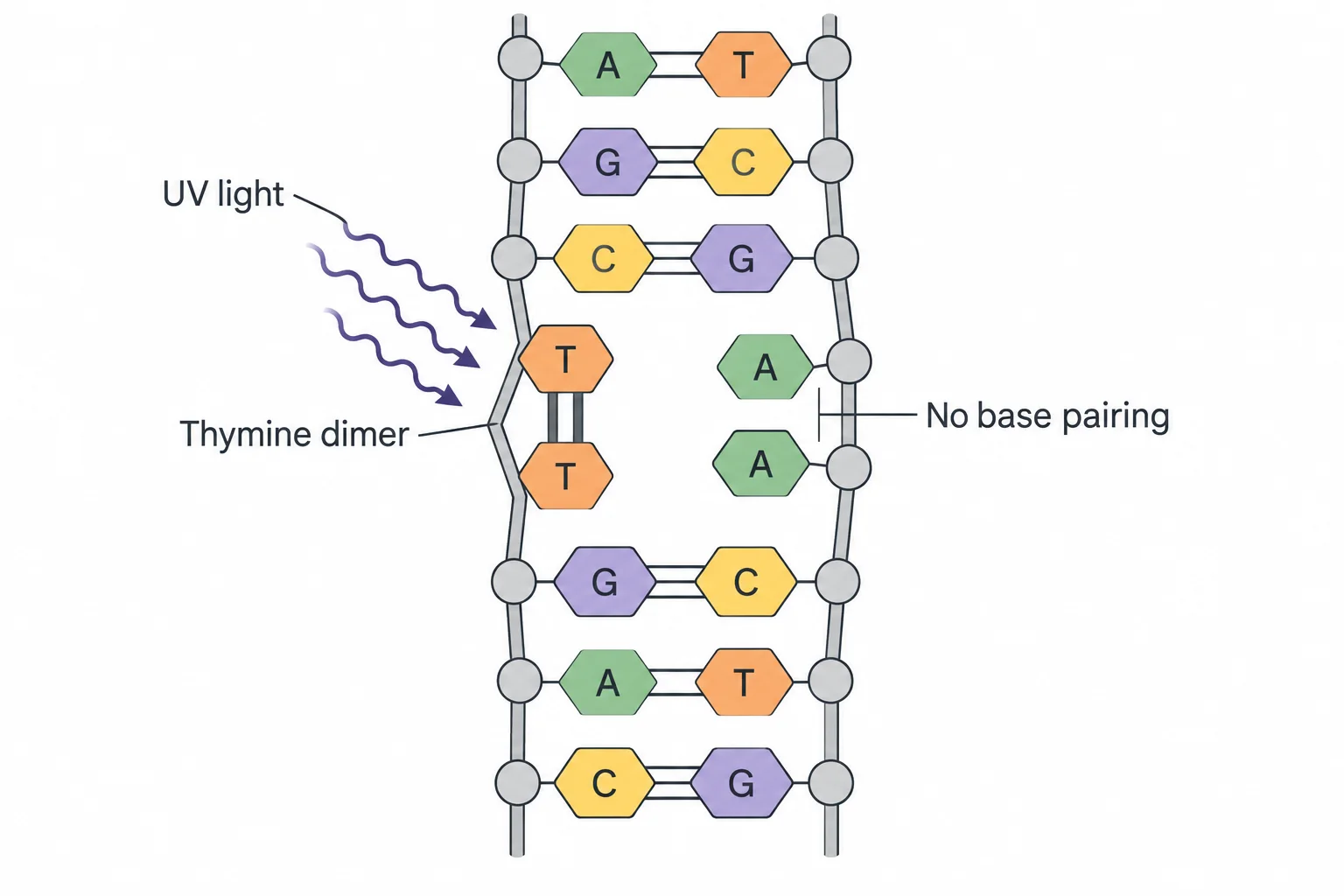
A thymine dimer is harmful because of what happens at replication. DNA polymerase can’t pair nucleotides correctly opposite the fused thymines, so it leaves gaps or inserts the wrong bases. Most dimers are repaired before that happens.
Check yourselfWhy does UV light mainly cause skin damage, while X-rays can damage DNA anywhere in the body?
UV light is nonionizing and has too little energy to penetrate beyond surface tissues. X-rays are ionizing radiation with high energy, so they pass deep into the body and create DNA-damaging free radicals there.
Testing for mutagens
Whether a chemical is a mutagen is checked with the Ames test. Bacteria that can’t make the amino acid histidine (his⁻), because of a point mutation, are exposed to the chemical and spread on a medium with no histidine. Only cells with a second mutation that restores histidine production (his⁺) can grow into colonies. If the exposed sample gives many more colonies than an unexposed control, the chemical is a mutagen.
Practice questions
1 of 4
Even a person who avoids every mutagen still acquires new mutations. Why?
2 of 4
Which of these is a physical mutagen rather than a chemical one?
3 of 4
A chemical shaped almost exactly like thymine gets built into a new DNA strand, then pairs with the wrong base the next time the DNA is copied. What kind of mutagen is it?
4 of 4
A mutagen removes the amino group from a cytosine in a C–G pair, turning the cytosine into uracil. The DNA is then copied twice without repair. Which base pair ends up in place of the original C–G in one of the descendant DNA molecules?