Regulating splicing and translation
Controlling transcription is powerful, but it has two limits: each gene gives one product, and the response is slow. Eukaryotes get around both by also regulating what happens to an RNA after it’s made.
Why regulate after transcription
Regulating RNA processing and translation gives eukaryotes two advantages:
- More products per gene. By splicing one pre-mRNA in different ways, a cell can make two or more polypeptides from a single gene, enlarging its proteome without enlarging its genome.
- Speed. Switching on a gene’s transcription takes minutes to hours: the chromatin has to open, the gene has to be transcribed, the RNA has to be processed and exported from the nucleus, and the protein has to be translated. Acting on an mRNA that already exists skips most of that wait.
Cells regulate mRNAs in several ways. Small non-coding RNAs can pair with particular mRNAs and silence them, a process called RNA interference. Proteins do this work too, by steering how a pre-mRNA is spliced or by blocking an mRNA’s translation.
Alternative splicing, regulated
Chapter 12 introduced alternative splicing: one pre-mRNA spliced in more than one way, so one gene codes more than one polypeptide. The exons of such a pre-mRNA fall into two groups, constitutive exons and alternative exons.
| Exon type | Kept in mRNA? | Likely role |
|---|---|---|
| Constitutive exon | Always, in every cell type | Parts needed for the protein’s basic structure and function |
| Alternative exon | In some mRNAs but not others | Parts that tune the protein to a particular cell type |
What decides which alternative exons are kept? Each cell type makes its own set of splicing factors, proteins that change how the spliceosome recognizes the boundaries between introns and exons. A different set of splicing factors means a different set of exons kept, and so a different version of the protein. Cells can use this to make different versions at different stages of development, in different cell types, or when conditions change.
Alternative splicing doesn’t happen in bacteria and is rare in single-celled eukaryotes such as yeast. It becomes more common as organisms become more complex. About 70% of human genes are alternatively spliced, so roughly 20,000 protein-coding genes give rise to well over 100,000 different polypeptides.
Check yourselfA cell type stops making one of its splicing factors. What could change in the proteins it makes?
The spliceosome would recognize some intron–exon boundaries differently, so some pre-mRNAs would keep or lose different alternative exons. The cell would make different versions of those proteins, while constitutive exons would still be included.
Controlling translation: iron and ferritin
Iron is a cofactor for many enzymes, but too much of it is toxic. To keep it safe, cells make ferritin, a protein that forms a hollow sphere and stores excess iron inside.
How much ferritin a cell makes is controlled at translation, by an RNA-binding protein, a protein that binds a specific sequence in an RNA. Here that protein is the iron regulatory protein (IRP). It binds a stretch of the ferritin mRNA called the iron regulatory element (IRE), also called the iron response element. The IRE sits in the 5′ untranslated region, between the 5′ cap and the start codon, and base pairing folds it into a stem-loop.
- When iron is low, IRP binds the IRE and blocks translation of the ferritin mRNA. The cell doesn’t need more storage.
- When iron is high, iron binds IRP directly and changes its shape, so IRP can’t bind the IRE. Ribosomes translate the ferritin mRNA, and the new ferritin locks away the extra iron.
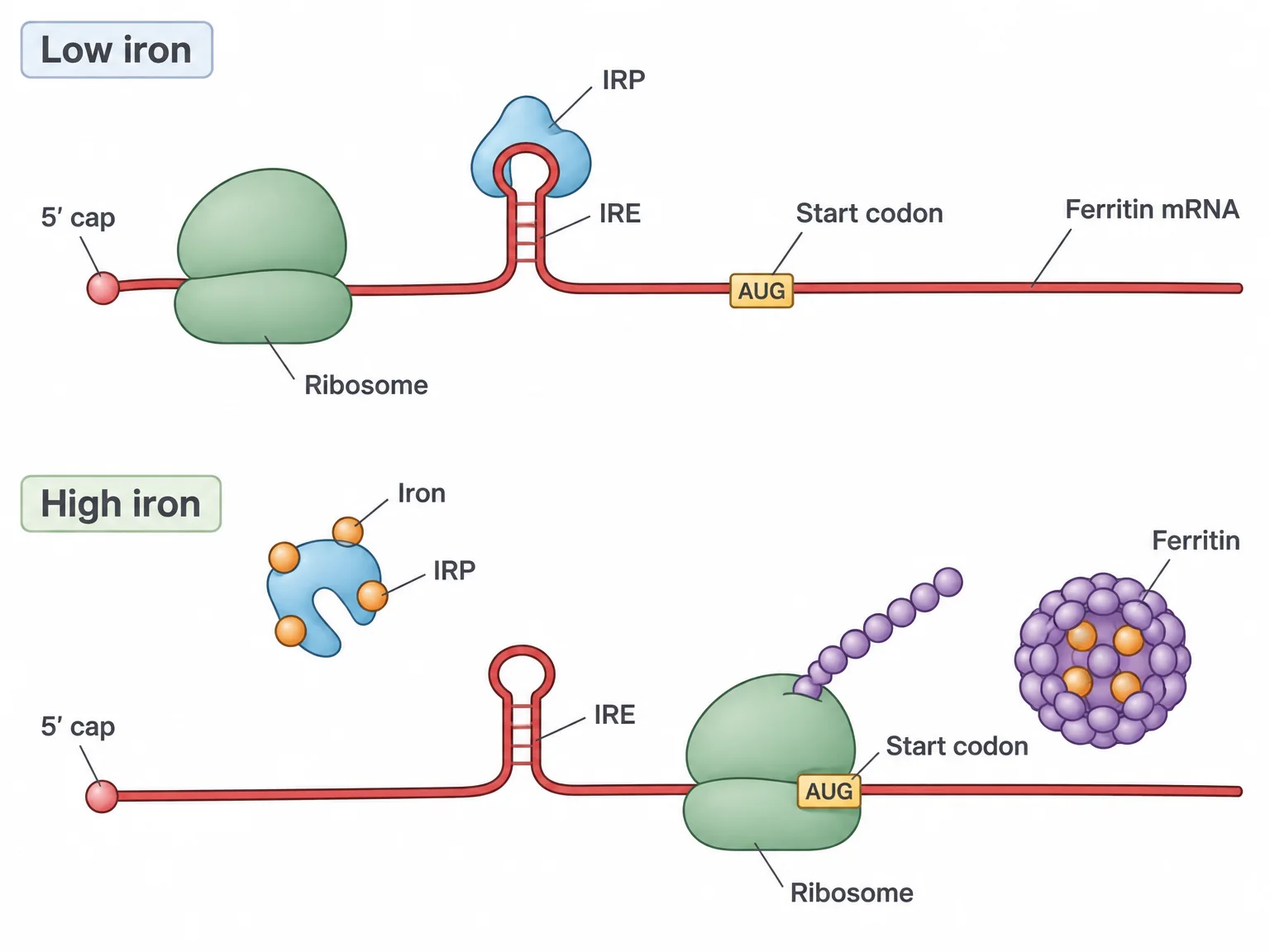
The payoff is speed. The ferritin mRNA is already waiting in the cytosol, so when iron rises the cell can make ferritin right away, instead of first activating and transcribing the ferritin gene.
Check yourselfIron levels in a cell fall. What happens to translation of ferritin mRNA, and why?
It drops. With little iron around, IRP binds the IRE and blocks translation, so the cell stops making storage it doesn’t need.
Practice questions
1 of 3
Which protein forms a hollow sphere that locks away excess iron inside a cell?
2 of 3
When iron is scarce in a cell, what does the iron regulatory protein (IRP) do?
3 of 3
What do splicing factors change?