Remodeling chromatin and modifying histones
In Chapter 11, DNA wrapped around histone octamers into nucleosomes and then packed even tighter. That packing fits a cell’s very long DNA into its nucleus, but it also hides genes from the proteins that need to read them.
Closed and open chromatin
Where the nucleosomes sit decides whether a gene can be read. When nucleosomes cover a gene’s promoter, the chromatin is in a closed conformation: GTFs and RNA polymerase II can’t reach the DNA, and transcription is difficult or impossible. Chromatin that leaves the promoter exposed is in an open conformation, and transcription can take place.
Turning a gene on therefore starts with converting its chromatin from closed to open. Cells do this in two main ways: by moving or changing nucleosomes and by chemically tagging histones.
Chromatin-remodeling complexes
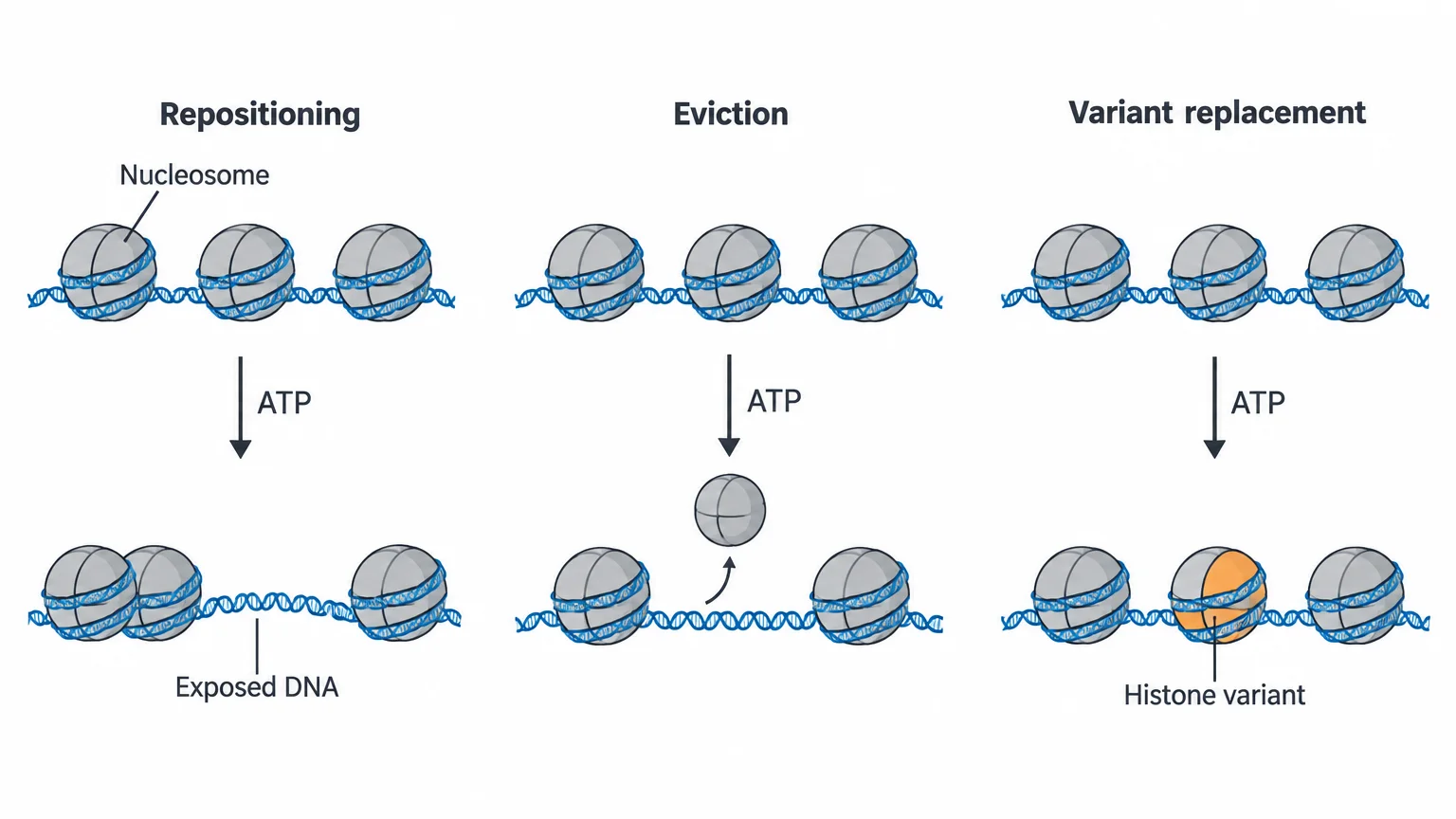
ATP-dependent chromatin-remodeling complexes are groups of proteins that use energy from ATP hydrolysis to change where nucleosomes sit or what they’re made of. Because they can make DNA either more or less accessible, they help both activate and repress genes. They can change nucleosomes in three ways:
| Change | What happens | Result |
|---|---|---|
| Repositioning | Nucleosomes slide to new spots, or their spacing changes over a long stretch | Exposes some stretches and covers others |
| Histone eviction | Histone octamers are removed from the DNA | Leaves gaps with no nucleosomes |
| Variant replacement | Standard histones in an octamer are swapped for histone variants | Can promote or inhibit transcription |
A histone variant is a histone whose amino acid sequence differs slightly from the standard histones (H2A, H2B, H3, and H4). Some variants promote transcription and others inhibit it.
Check yourselfA chromatin-remodeling complex evicts the nucleosomes covering a gene’s core promoter. How does that affect the gene?
It makes the gene easier to transcribe. With the promoter’s DNA exposed, GTFs and RNA polymerase II can bind and form a preinitiation complex.
Histone modifications
The amino-terminal tails that stick out of each histone, mentioned in Chapter 11, can be covalently tagged. Enzymes attach acetyl, methyl, and phosphate groups to particular amino acids in the tails, especially lysines. These tags can be removed again, so the changes are reversible.
The best-understood tag is the acetyl group. An enzyme called histone acetyltransferase attaches acetyl groups to lysines in histone tails. Acetylated histones hold the DNA less tightly, which makes transcription easier. Removing the acetyl groups (deacetylation) lets the histones grip the DNA tightly again.
Histone modifications work in two ways:
- They directly change how tightly histones hold the DNA and how closely neighboring nucleosomes pack together.
- They create binding sites for other proteins that recognize particular tags.
The histone code
Because many tags can be combined, a histone tail carries a pattern of them. The histone code is the idea that proteins read this pattern much like a language. One combination of tags attracts proteins that inhibit transcription. Another attracts proteins, such as chromatin-remodeling complexes, that promote it. The pattern helps decide which parts of the genome are accessible in a given cell.
Check yourselfA drug blocks the removal of acetyl groups from histones. Would you expect transcription to rise or fall?
Rise. The histones stay acetylated and hold the DNA loosely, so they’re easier to clear from the promoter for initiation and from the gene for elongation.
Practice questions
1 of 3
A remodeling complex swaps a standard histone in one nucleosome for a histone whose amino acid sequence differs slightly. What is the new histone called?
2 of 3
How does histone acetyltransferase usually affect transcription?
3 of 3
Proteins “read” the combination of acetyl, methyl, and phosphate tags on histone tails much like a language, and the pattern helps decide whether genes are transcribed. What is this idea called?