Repressors, activators, and the lac operon
Bacteria regulate most of their genes at transcription, by controlling how much mRNA is made. The control comes from proteins that bind the DNA near a gene’s promoter and make RNA polymerase’s job easier or harder.
Proteins that turn transcription up or down
A regulatory transcription factor is a protein that binds a regulatory sequence in the DNA, usually close to a promoter, and changes how fast one or more nearby genes are transcribed. They come in two kinds, named for their effect.
- A repressor binds the DNA and decreases transcription. Regulation by a repressor is negative control.
- An activator binds the DNA and increases transcription. Regulation by an activator is positive control.
Small effector molecules flip the switch
Whether a regulatory protein binds the DNA often depends on a small effector molecule. This small molecule binds the regulatory protein and causes a conformational change, and the new shape decides whether the protein can grip the DNA.
Here’s how that works with a repressor. When the effector is absent, the repressor binds the DNA and blocks transcription. When the effector is present, it binds the repressor and changes its shape, the repressor can no longer hold on to the DNA, and transcription goes ahead.
To work this way, the protein needs two domains: one that binds the DNA and one that binds the small effector molecule.
Check yourselfA small effector molecule binds a repressor and changes its shape so the repressor can no longer bind DNA. Does the effector raise or lower transcription of the gene?
It raises it. With the repressor unable to bind the DNA, nothing blocks RNA polymerase, so the gene is transcribed.
Operons: several genes, one switch
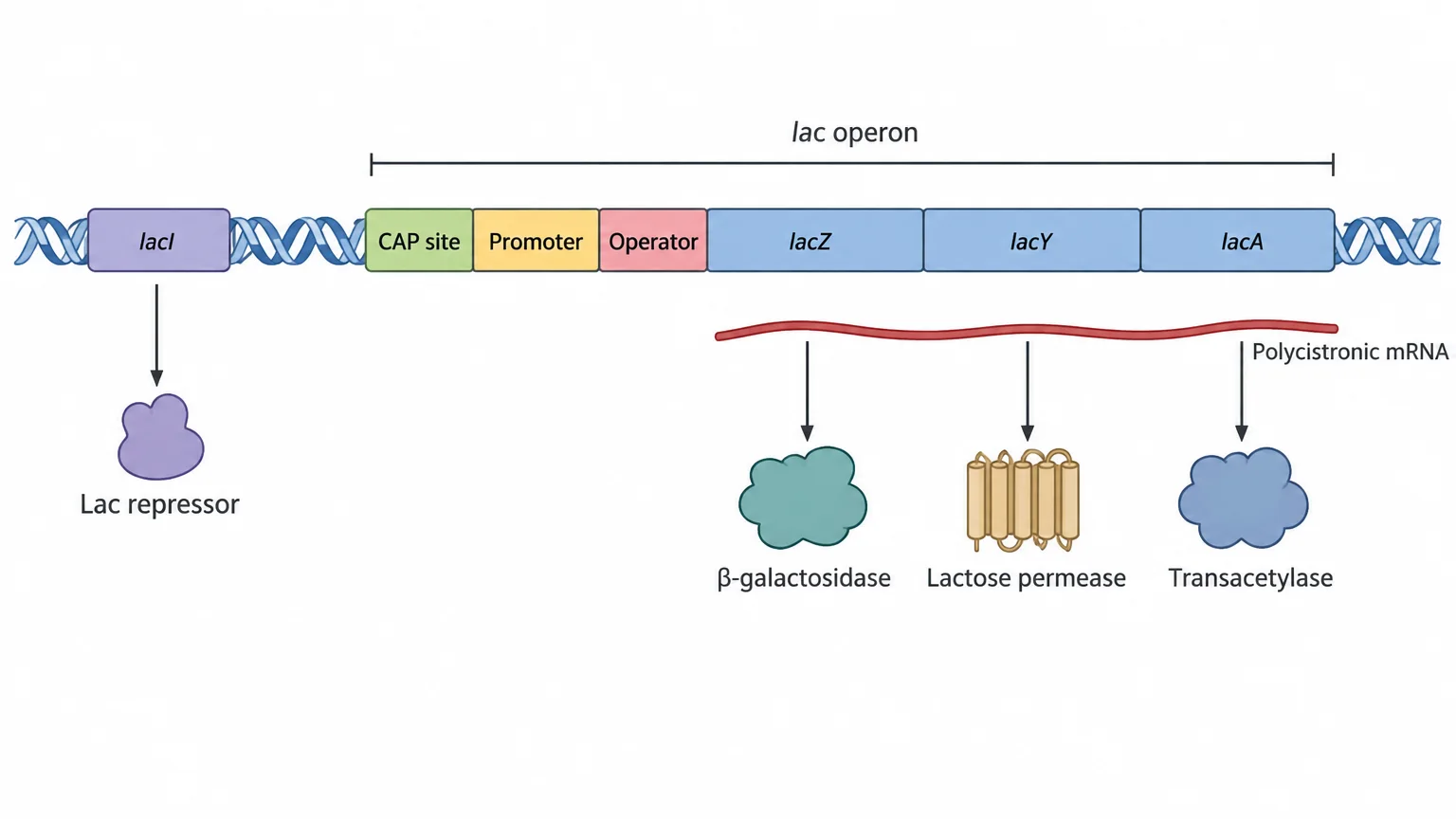
In bacteria, two or more genes whose proteins work in the same pathway are often lined up next to each other under a single promoter. This arrangement is an operon. RNA polymerase transcribes the whole operon as one unit, so it makes a single mRNA that codes several proteins, a polycistronic mRNA.
The payoff is coordination. One promoter and one set of regulatory sequences turn all the genes for a pathway on or off together.
The lac operon
E. coli keeps the genes it needs to use lactose in the lac operon. RNA polymerase binds the operon’s promoter, lacP, and transcribes three genes:
| Gene | Protein it codes | Job |
|---|---|---|
| lacZ | β-Galactosidase | Splits lactose into glucose and galactose, and converts a little lactose into allolactose |
| lacY | Lactose permease | A membrane transporter that brings lactose into the cell |
| lacA | Galactoside transacetylase | Adds acetyl groups to lactose-like molecules the cell can’t use, so they don’t build up |
Lactose permease is a symporter, the kind of transporter from Chapter 5: it uses the cell’s H⁺ gradient to pull lactose in along with H⁺.
Two regulatory sequences sit near the promoter. The operator (lacO) is the site where a repressor binds. The CAP site is where an activator binds.
Next to the operon, with its own promoter, is the lacI gene. It codes lac repressor, the protein that binds the operator. lacI is constitutive: it’s always expressed, at a fairly low level, so the cell always has some repressor on hand.
Practice questions
1 of 3
What is a cluster of bacterial genes that share one promoter and are transcribed together called?
2 of 3
Why does an E. coli cell always have some lac repressor, even when lactose is absent?
3 of 3
Which of these is a stretch of DNA rather than a protein?