General transcription factors and mediator
RNA polymerase II transcribes every eukaryotic protein-coding gene, but it can’t find a core promoter or start copying on its own. It works with two sets of helpers, and activators and repressors steer transcription by acting on those helpers.
The machinery at the core promoter
Three kinds of proteins are needed to start transcription of a protein-coding gene:
- RNA polymerase II, the enzyme that makes the RNA.
- Six general transcription factors (GTFs), the transcription factors from Chapter 12 that help RNA polymerase II bind the core promoter.
- Mediator, a large complex of many proteins.
The GTFs and RNA polymerase II assemble at the TATA box into the preinitiation complex. One GTF starts the assembly: transcription factor II D (TFIID) recognizes and binds the TATA box, and the other GTFs and RNA polymerase II gather around it.
Mediator wraps partway around RNA polymerase II and the GTFs. It gets its name from the job it does: it passes messages between the preinitiation complex and the activators and repressors bound at enhancers. Mediator decides whether RNA polymerase II is allowed to move on to elongation and actually make RNA.
Check yourselfA mutation leaves TFIID unable to bind the TATA box. What happens to transcription of genes with TATA boxes?
It fails to start. TFIID begins the assembly of the preinitiation complex, so without it the other GTFs and RNA polymerase II can’t gather at the core promoter.
How activators and repressors reach RNA polymerase II
Activators and repressors bind enhancers, often far from the core promoter, yet they control RNA polymerase II. They do it in three ways. Two act through the machinery above:
| Target | Activator effect | Repressor effect |
|---|---|---|
| TFIID | Recruits TFIID to the TATA box, speeding assembly of the preinitiation complex | Keeps TFIID off the TATA box or stops it assembling the other GTFs |
| Mediator | Stimulates mediator, so RNA polymerase II moves on to elongation | Inhibits mediator, so RNA polymerase II can’t begin elongation |
The third way is to recruit proteins that loosen the chromatin around the promoter, which the next segment covers.
Activators that work through mediator often bring a partner. A coactivator is a protein that increases the rate of transcription but doesn’t bind the DNA itself; it binds the activator instead. The activator–coactivator complex is what stimulates mediator.
When the enhancer lies far from the core promoter, the DNA between them bends into a loop. That loop brings the activator–coactivator complex right up against mediator.
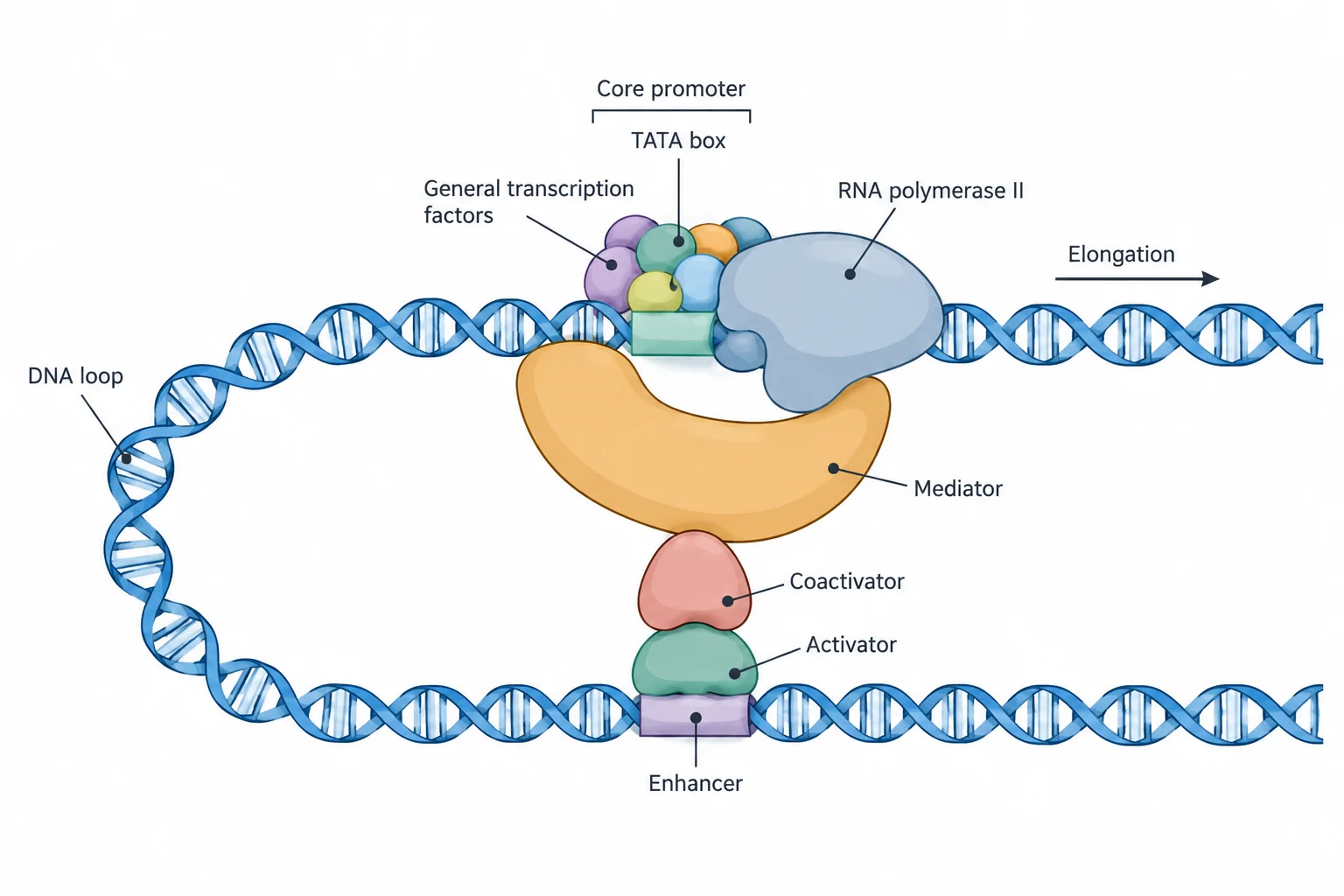
Besides RNA polymerase II, five kinds of protein take part in starting transcription, and one quick way to tell them apart is whether they bind the DNA.
| Protein | Binds DNA? | Job |
|---|---|---|
| General transcription factors | TFIID does, at the TATA box | Assemble with RNA polymerase II into the preinitiation complex |
| Mediator | No; wraps around RNA polymerase II | Relays signals from regulators and permits elongation |
| Activator | Yes, at an enhancer | Raises the rate of transcription |
| Repressor | Yes, at an enhancer | Lowers the rate of transcription |
| Coactivator | No; binds an activator | Raises the rate of transcription with the activator |
Check yourselfAn activator binds its enhancer normally but can’t hold its coactivator. What happens to RNA polymerase II at that gene?
It isn’t signaled to move on to elongation. The activator needs its coactivator to stimulate mediator, so transcription stays low.
Practice questions
1 of 2
What is the completed assembly of general transcription factors and RNA polymerase II at the TATA box called?
2 of 2
An activator bound to an enhancer 50,000 base pairs from a gene’s core promoter still stimulates mediator. How does it reach mediator?