The trp operon and predicting mutations
The lac operon codes enzymes that break a food down. Operons for building molecules use the same parts, a repressor, an operator, and a small effector molecule, wired to the opposite logic.
Making tryptophan only when it’s scarce
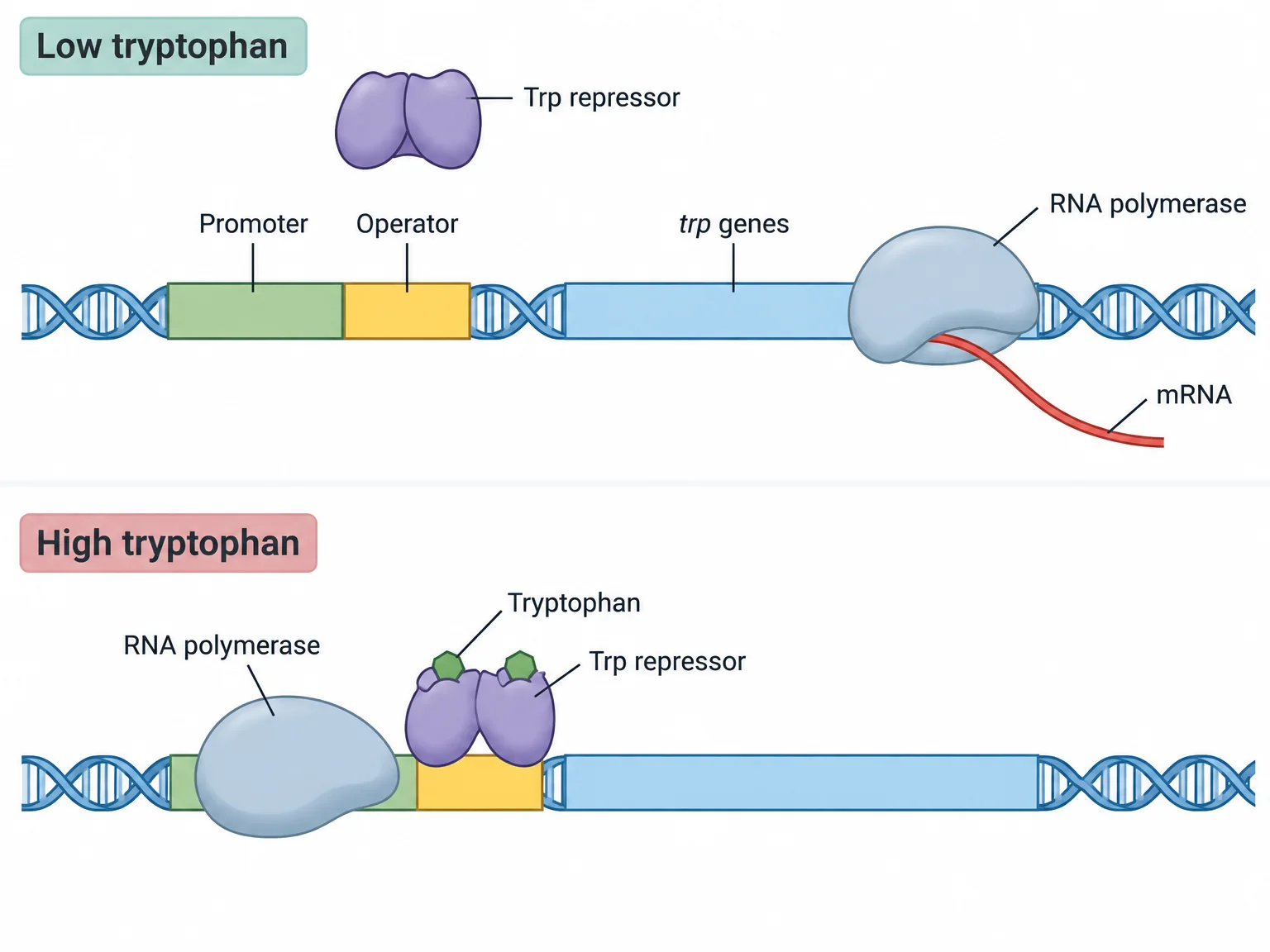
E. coli’s trp operon holds five genes for the enzymes that make the amino acid tryptophan. A separate gene, trpR, codes trp repressor, which can bind the trp operator and block transcription. Whether it binds depends on tryptophan itself, the end product of the pathway the operon’s enzymes carry out.
- When tryptophan is low, trp repressor can’t bind the operator on its own. RNA polymerase transcribes the operon, and the cell makes the enzymes it needs to build tryptophan.
- When tryptophan is high, tryptophan binds trp repressor and changes the repressor’s shape so that it can bind the operator. Transcription stops, and the cell doesn’t waste energy making something it already has plenty of.
A small effector molecule that binds a repressor and lets it shut down transcription is a corepressor. Tryptophan is the corepressor of the trp operon. An operon that its small effector turns off is a repressible operon.
Check yourselfA bacterium is moved into a medium rich in tryptophan. What happens to transcription of the trp operon, and why?
It stops. Tryptophan enters the cell and binds trp repressor as a corepressor, which lets the repressor bind the operator and block RNA polymerase.
Inducible vs. repressible operons
The two operons use their small effector molecules in opposite ways. Lac repressor binds its operator when its effector is absent; trp repressor binds its operator only when its effector is present.
| Feature | lac operon | trp operon |
|---|---|---|
| Enzymes’ job | Break down lactose | Build tryptophan |
| Small effector molecule | Allolactose | Tryptophan |
| Effector’s role | Inducer | Corepressor |
| Repressor binds the operator when | Effector is absent | Effector is present |
| Type of operon | Inducible | Repressible |
| Control | Negative and positive | Negative |
Predicting what a mutation does
Exam questions often break one part of an operon and ask what happens. Work it out from what the broken part normally does.
| Mutation | Result | Why |
|---|---|---|
| lacI makes no working repressor | lac operon on with or without lactose, but low when glucose is present | Nothing binds the operator, but CAP still needs low glucose |
| Operator changed so the repressor can’t bind | lac operon on with or without lactose, but low when glucose is present | The repressor has nowhere to bind, but CAP still needs low glucose |
| Lac repressor can’t bind allolactose | lac operon off, even with lactose | The repressor never lets go of the operator |
| CAP can’t bind cAMP | lac operon low, even with lactose and no glucose | The activator never helps RNA polymerase bind |
| Trp repressor can’t bind tryptophan | trp operon on, even with plenty of tryptophan | The repressor never gets the shape that binds the operator |
An operon that’s expressed whether or not its inducer is present is said to be constitutively expressed, like a housekeeping gene. The first two mutations above both do this, and they can be told apart because the parts work differently. Lac repressor is a protein that diffuses through the cell, so a working copy of lacI anywhere in the cell can supply repressor to every lac operator. The operator is a stretch of DNA, so it controls only the genes right next to it.
Check yourselfA working lacI gene is added to a cell whose own lacI gene is broken. Would it restore normal regulation? Would it help a cell whose operator is broken instead?
Practice questions
1 of 2
A mutant trp repressor can’t bind tryptophan. What happens to the trp operon when bacteria with this mutation grow in tryptophan-rich broth?
2 of 2
The lac operon’s small effector switches its genes on, while the trp operon’s small effector switches its genes off. How are the two operons classified?