Eukaryotic promoters and enhancers
Eukaryotes regulate transcription with some of the same tools as bacteria: activators, repressors, and small effector molecules. But their genes are almost never grouped into operons. Each gene has its own promoter and its own set of controls, and a multicellular eukaryote has many cell types and developmental stages to manage, so the controls pile up.
Combinatorial control
Most eukaryotic genes, especially in multicellular species, respond to many factors at once, and the combination decides how much the gene is expressed. This is combinatorial control. At the level of transcription, the factors include:
- One or more activators that help RNA polymerase start transcription.
- One or more repressors that hinder it.
- Changes to those activators and repressors, through small effector molecules, protein-protein interactions, or covalent modifications such as phosphorylation.
- Changes in chromatin structure around the gene, which activators bring about, so that RNA polymerase can reach the DNA.
- DNA methylation, which usually inhibits transcription.
A given gene may be controlled by all five or by only three or four of them. Most of this regulation is aimed at one moment: the start of transcription at the promoter.
The core promoter
A typical eukaryotic protein-coding gene starts with a promoter that has several standard parts. Two of them form its center:
- The transcriptional start site is the spot in the DNA where transcription actually begins, the first nucleotide copied into RNA.
- The TATA box, with the sequence 5′–TATAAA–3′, sits about 25 base pairs upstream of the start site. (Upstream means before the start site, opposite the direction RNA polymerase travels; downstream means after it.) The TATA box fixes the precise starting point. Without it, transcription can begin at a variety of spots.
Together, the TATA box and the transcriptional start site make up the core promoter. Not every eukaryotic gene has a TATA box, but most promoters share this layout.
The core promoter on its own supports only a low level of transcription, called basal transcription. Many promoters also have one or more downstream promoter elements (DPEs), short sequences usually found just downstream of the core promoter.
Check yourselfA mutation deletes a gene’s TATA box but leaves its start site intact. What changes?
RNA polymerase loses the signal that fixes the precise starting point, so transcription may begin at a variety of different locations.
Enhancers
Regulatory sequences (also called regulatory elements) control how much a gene is transcribed beyond that basal level. They’re grouped into enhancers, DNA segments usually 50 to 1000 base pairs long that each contain one or more regulatory elements.
Enhancers are where regulatory transcription factors bind:
- Activators bind an enhancer and raise the rate of transcription. Without them, most eukaryotic genes stay at a low basal level.
- Repressors also bind enhancers, and they lower the rate of transcription.
A common spot for an enhancer is 50 to 100 base pairs upstream of the start site, but enhancers turn up nearly anywhere. They can sit downstream of the promoter, inside an intron, or as far as 100,000 base pairs away, and still have a strong effect on transcription. Distant enhancers are very common.
| Element | Usual location | Role |
|---|---|---|
| Transcriptional start site | Where the gene’s RNA begins | The first nucleotide transcribed |
| TATA box | About 25 bp upstream of the start site | Sets the precise starting point |
| Downstream promoter element | Just downstream of the core promoter | Part of many eukaryotic promoters |
| Enhancer | Near the promoter or far away, either side | Binds activators and repressors that set the rate |
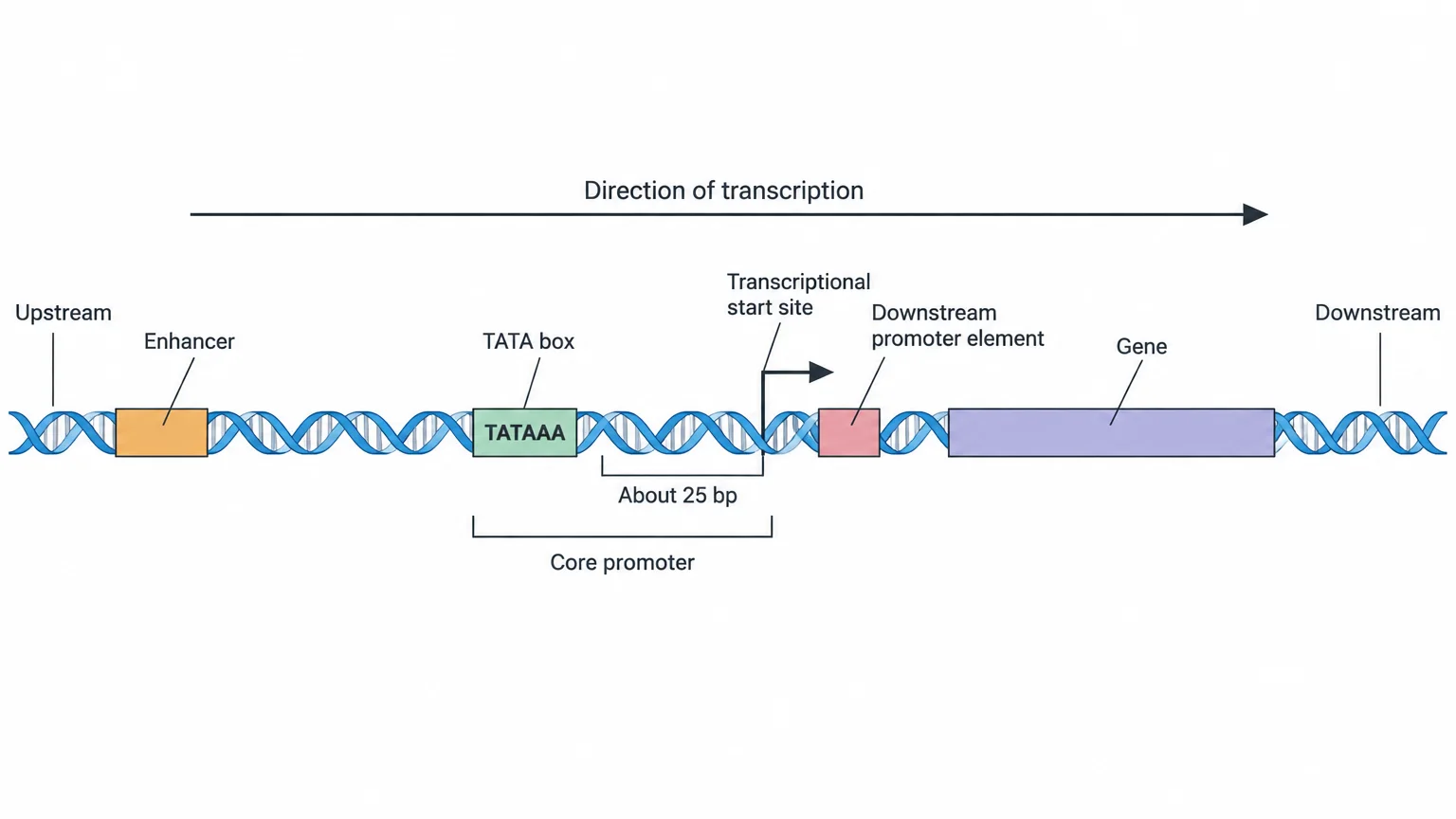
Check yourselfA gene’s only enhancer is deleted, but its core promoter is intact. How much transcription would you expect?
Only a low, basal level. The core promoter still lets transcription start, but no activators can bind to raise the rate.
Practice questions
1 of 2
How are eukaryotic protein-coding genes usually organized, compared with bacterial genes?
2 of 2
Which statement about enhancers is accurate?