Why be multicellular, and what holds the body together
A bacterium is a whole organism in one cell. A tree or a person is trillions of cells that have to stick together, stay organized, and share the work. This chapter is about the equipment that makes that possible: the material cells build around themselves, the connections between neighboring cells, and the groups of cells that form tissues.
Many cells, many jobs
An organism made of more than one cell is multicellular. Plants and animals are always multicellular. Most fungi are too, and so are some protists (a varied group of mostly single-celled organisms that includes algae and amoebas).
The big payoff is a division of labor. Instead of every cell doing everything, different cells specialize. The cells lining your intestine and the cells in a plant’s roots are built for taking up nutrients, while other cells handle jobs such as reproduction.
In animals, this split shows up in two broad groups of cells:
- Somatic cells are nearly all the cells of the body. They handle growth, development, and keeping the organism alive.
- Gametes are the specialized cells used in sexual reproduction (sperm and eggs).
Bigger genomes, more proteins
Running a team of specialized cells takes more instructions. Multicellular species usually have much larger genomes (an organism’s complete set of genetic material) than single-celled species. A bigger genome means a bigger proteome, the full set of proteins an organism can make.
Those extra proteins serve three general purposes:
| Need | Why multicellular organisms need more proteins for it |
|---|---|
| Cell communication | Cells must coordinate with each other, so many more signaling proteins are made. |
| Cell arrangement and attachment | Cells must be placed correctly and stuck to one another, which takes a wider variety of proteins. |
| Cell specialization | Each cell type needs its own set of proteins, plus proteins that regulate genes so each protein is made only in the right cell types. |
The material outside the cells
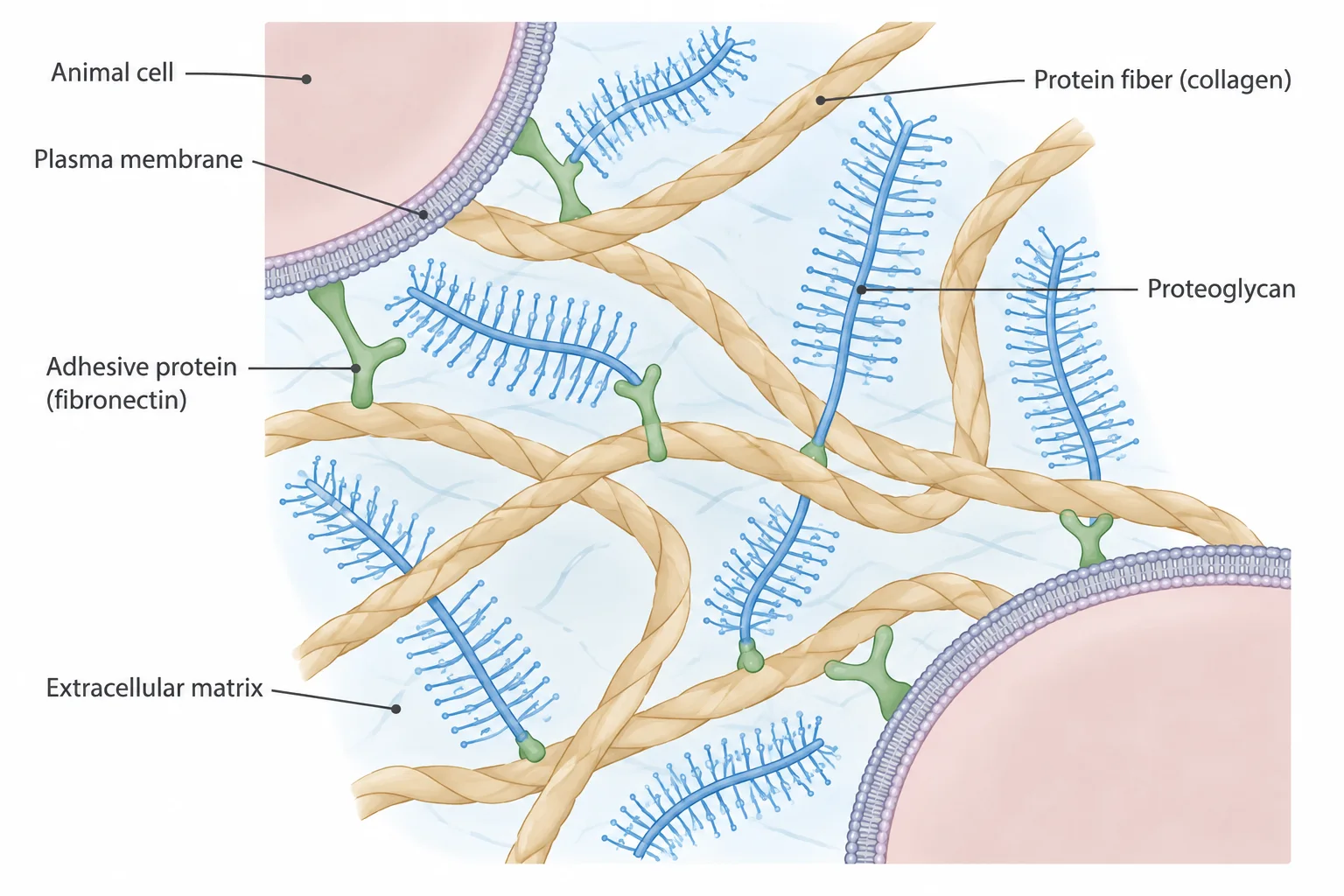
Organisms are not just piles of cells. Cells secrete (release to the outside) a meshwork of material that fills the spaces around them. In animals this meshwork is the extracellular matrix, or ECM (“extracellular” means outside the cell). In plants, each cell is surrounded instead by a cell wall, a protective layer built just outside the plasma membrane.
This outside material can make up most of a body part. Bone and cartilage are mostly ECM. Wood is mostly cell walls: the cells inside wood eventually die, but the walls they built keep holding the plant up for years or even centuries.
Bacteria, archaea, fungi, and plants all have rigid cell walls. Animal cells don’t. The ECM is how animal cells get support and organization without a rigid wall. Some animal cells are completely buried in ECM, while others touch it on only one side.
What the ECM is made of
The ECM is built from two kinds of large molecules:
- Proteins. The most abundant ones form long, strong fibers.
- Polysaccharides, long chains of sugar units. They attract water, which gives the ECM a gel-like texture.
Some polysaccharides are attached to proteins, forming combined molecules called proteoglycans. Other proteins act as glue, binding the fibers and gels to each other and to the cells.
Four jobs of the ECM
The ECM in animals does four main things.
- Strength. It’s the tough stuff of the body. It keeps skin from tearing, lets cartilage resist being squeezed so joints are protected, and shields soft internal organs.
- Structural support. Bones are mostly ECM. A skeleton holds the body up and, with attached muscles, makes movement possible.
- Organization. Cells attach to the ECM, which keeps them arranged in the right places. The ECM also binds body parts together, such as tendons to bones.
- Cell signaling. Cells sense their surroundings partly through changes in the ECM, so the matrix also carries information.
Check yourselfWhy does a multicellular organism need more kinds of proteins than a single-celled one?
Practice questions
1 of 4
Multicellular species usually have much larger genomes, and so make many more kinds of proteins, than single-celled species. What are those extra proteins mainly for?
2 of 4
The extracellular matrix (ECM) of animals is built mainly from which two kinds of large molecules?
3 of 4
Which example shows the extracellular matrix taking part in cell signaling?
4 of 4
The ECM in skin keeps it from tearing, and the ECM in cartilage resists being squeezed, which protects the joints. Which of the four ECM functions do these examples show?