How plant cells connect
Every plant cell sits inside a rigid wall, so its plasma membrane can’t press up against its neighbor’s the way animal cells do. Plants still need to hold cells together and let them share material, but they do both jobs differently: they glue the walls together, and they run passageways through them.
The middle lamella glues walls together
Animal junctions are built from membrane proteins. Plant cells instead make a layer of polysaccharide between their walls called the middle lamella (plural, lamellae). It sits between most neighboring plant cells.
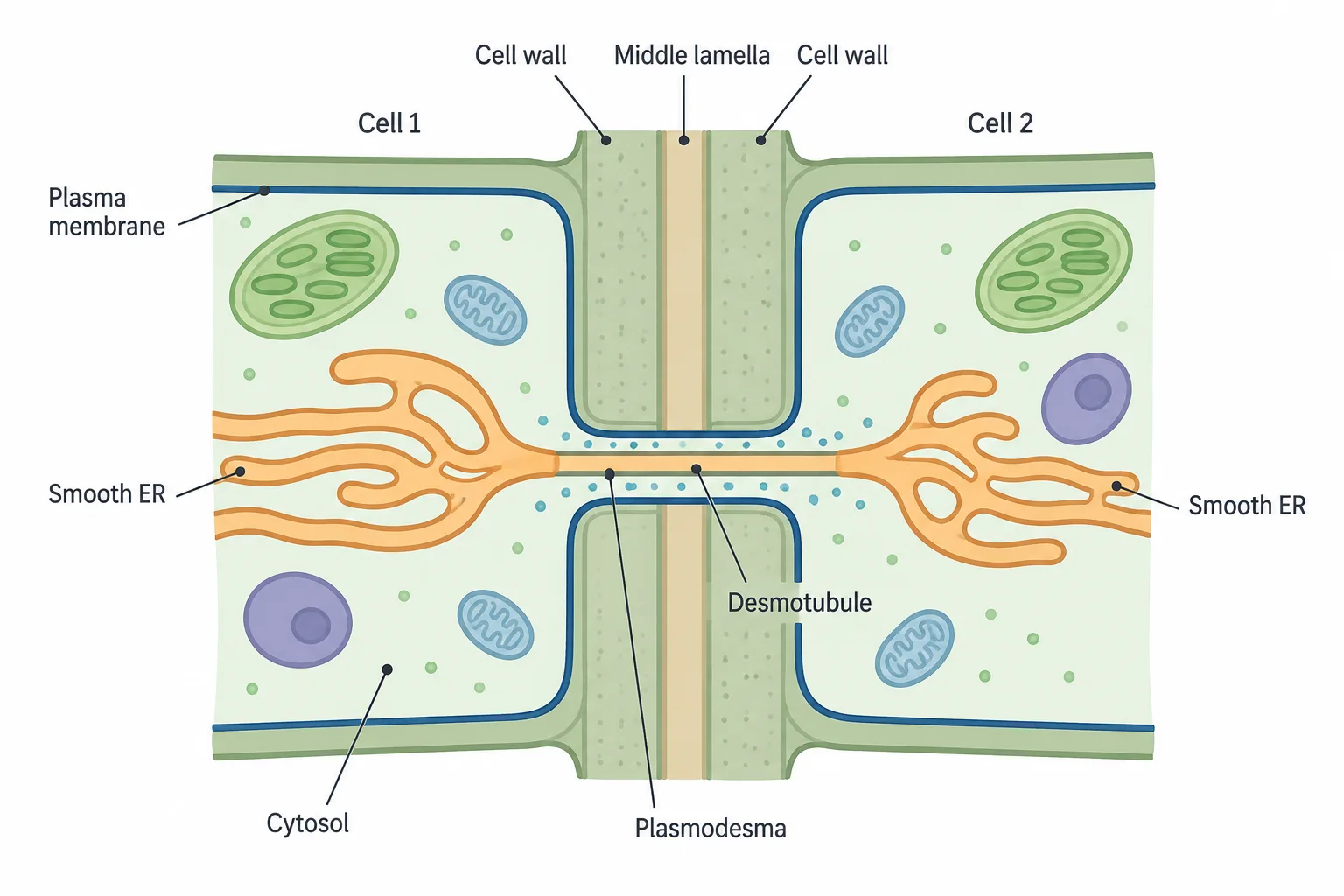
When a plant cell divides, the middle lamella is the first layer to form between the two new cells. Each cell then builds its primary cell wall on its own side of it. So, moving from one cell to the next, you pass through: plasma membrane, primary wall, middle lamella, primary wall, plasma membrane.
The middle lamella is rich in pectins, the negatively charged polysaccharides also found in the primary wall. Pectins attract water and form a gel. Calcium (Ca²⁺) and magnesium (Mg²⁺) ions, each carrying two positive charges, bind to the negative charges on pectins from both sides, cementing the walls of neighboring cells together.
Why ripe fruit is soft
An unripe green tomato is firm because its cells’ walls are tightly cemented together. As the fruit ripens, its cells release pectinases, enzymes that break down pectins in both the middle lamella and the primary wall. The cells come loose from each other and the walls soften, so a ripe red tomato is much softer.
Plasmodesmata link the cytosols
Plants also have passageways that let material flow from one cell’s interior into the next: plasmodesmata (singular, plasmodesma). These are channels through the cell walls connecting the cytosols of neighboring cells.
Their function resembles gap junctions: both let ions and small molecules move directly between cells. Their structure is completely different:
- In a plasmodesma, the plasma membrane of one cell runs continuously through the wall and becomes the plasma membrane of the next cell. The two cells share one unbroken membrane, which lines a pore that molecules diffuse through from cytosol to cytosol.
- Running down the middle of the pore is a narrow tube, the desmotubule, which connects the smooth endoplasmic reticulum (ER) of the two cells.
Closed, open, or dilated
Plant cells can change how wide their plasmodesmata are. A plasmodesma can be in one of three states.
| State | What passes | When it matters |
|---|---|---|
| Closed | Nothing | When neighboring cells differ greatly in pressure, as after wounding |
| Open | Water, ions, and small molecules such as sugars and cAMP | Everyday sharing, similar to gap junctions |
| Dilated (widened) | Water, ions, small molecules, and macromolecules such as proteins and mRNA, and even viruses | Plant development; also how viruses spread from cell to cell |
Closing protects the plant. Healthy plant cells are pressurized by the water inside them, pushing out against their walls; this push is called turgor pressure. Damaged cells lose it. The big pressure difference between a damaged cell and its healthy neighbor causes the plasmodesmata between them to close, so water and nutrients don’t drain out through the wound.
Dilation is something gap junctions can’t do. Gap junctions never pass proteins or RNA, but a dilated plasmodesma can.
Check yourselfHow are middle lamellae similar to desmosomes, and how are they different?
Both hold neighboring cells together. Desmosomes do it with proteins (cadherins) linked to the cytoskeleton, while middle lamellae do it with negatively charged pectins cemented by Ca²⁺ and Mg²⁺.
Practice questions
1 of 2
A firm green pear softens over several days as it ripens. Which change inside the fruit best explains this?
2 of 2
Which of these can pass through a dilated plasmodesma but never through a gap junction?