From cells to tissues, and the four animal tissues
So far you’ve seen how cells surround themselves with matrix and wall, and how they connect to their neighbors. Put cells, matrix, and junctions together, and you get the working units of a body: tissues.
Cells, tissues, organs
Humans have over 200 different cell types, but they fall into a few broad groups. A tissue is a group of cells with a similar structure and function. Your heart muscle cells, your biceps muscle cells, and the muscle cells wrapped around your arteries look somewhat different and do different jobs, but they are all similar enough to count as one kind of tissue: muscle tissue.
Tissues in turn build organs. An organ is a collection of two or more tissues that together carry out a specific function or set of functions. Your heart is an organ; so is a plant’s leaf.
Six processes that build tissues
An adult human has somewhere between 10 and 100 trillion cells. To end up with tissues and organs of the right shape, size, and arrangement, cells go through six processes. These control how many cells there are, what they look like, and where they sit.
| Process | What happens |
|---|---|
| 1. Division | Cells progress through the cell cycle and split into two. |
| 2. Growth | After dividing, cells take in nutrients and usually get bigger. Division plus growth is how tissues, organs, and organisms get larger. |
| 3. Differentiation | Through gene regulation (turning particular genes on or off), cells become specialized cell types. |
| 4. Migration | Animal cells move to their proper positions in the embryo; in adults, some cells move into damaged areas. Plant cells do not migrate during development. |
| 5. Apoptosis | Programmed cell death removes cells to sculpt body parts. In developing mammals, the cells between the future fingers and toes die off, separating them. |
| 6. Formation of connections | Cells build ECM or cell walls and form cell junctions, which organize cells, shape tissues, and let cells stay in contact and communicate. |
The four animal tissues
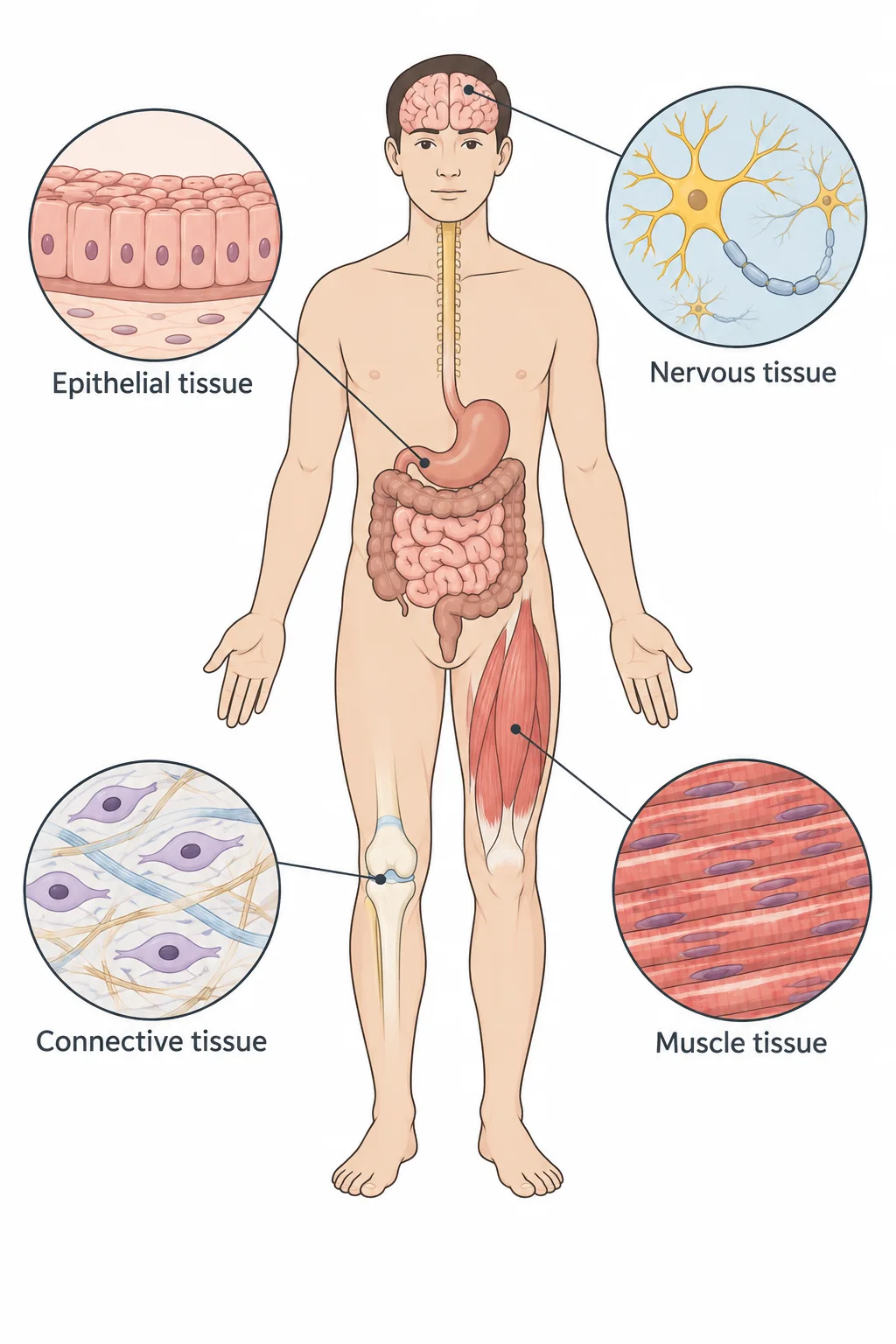
The animal body is built from four general types of tissue, each with a very different purpose.
| Tissue | Main function | Key features and examples |
|---|---|---|
| Epithelial | Covers and lines body surfaces | Cells joined by tight junctions into continuous sheets; lines the lungs and digestive tract and forms the outer layer of skin |
| Connective | Supports the body and connects tissues to each other | Rich in ECM; cartilage, tendons, bone, fat, the inner layers of skin, and blood |
| Nervous | Receives, generates, and conducts electrical signals | Brain, spinal cord, nerves |
| Muscle | Generates force for movement | Skeletal muscle for walking; heart muscle pumps blood; smooth muscle moves food through the gut |
Epithelial tissue
Epithelial tissue is made of cells joined by tight junctions into continuous sheets. It covers or lines every surface of the body, inside and out: the lining of the lungs and digestive tract, and the protective outer layer of your skin. The intestinal lining you met with tight junctions is epithelial tissue.
Connective tissue
Connective tissue mostly supports the body or connects other tissues together. Its defining feature is a large amount of ECM; of the four tissues, it has the most extensive matrix. Blood counts as connective tissue because it provides a liquid connection among all parts of the body.
Cartilage shows just how much of a connective tissue can be matrix. Its only cells are chondrocytes, which sit in small cavities called lacunae (singular, lacuna). In some cartilage, chondrocytes are only 1–2% of the tissue’s volume. Yet they make all of it: the collagen fibers, the GAGs, and the proteoglycans.
So if a mutation made someone’s joints unusually flexible, connective tissue is the place to look, because joints depend on cartilage, ligaments, and tendons. A likely suspect is a collagen gene whose altered version makes less rigid fibers.
Nervous and muscle tissue
Nervous tissue receives, generates, and conducts electrical signals. In vertebrates, the brain integrates these signals and sends them down the spinal cord to the rest of the body.
Muscle tissue generates force for movement. That includes moving the whole body, as in running, and moving materials inside it: heart muscle pushes blood around the body, and smooth muscle in the gut pushes food along.
Check yourselfWhich of the four animal tissues has the most extensive ECM, and what is one example of it?
Connective tissue. Cartilage is a good example: its matrix makes up nearly all of its volume, and its chondrocytes are only a small fraction.
Practice questions
1 of 4
In a developing mammal, the cells in the webbing between the future fingers die on schedule, separating the fingers. Which tissue-building process is this?
2 of 4
Which of the six tissue-building processes takes place during animal development but not during plant development?
3 of 4
A leaf has a covering layer, a photosynthetic middle layer, and strands that carry water and sugar, all working together. At what level of organization is the whole leaf?
4 of 4
Members of a family inherit a mutation that makes their ligaments and tendons unusually loose and their joints overly flexible. In which tissue is the mutated gene most likely active?