Matrix gels and plant cell walls
Protein fibers handle pulling. Bodies also get squeezed, by every step you take and every load a plant stem holds up. Resisting that squeeze is the job of water-loving polysaccharides in animals, and of the cell wall in plants.
Polysaccharides that hold water
A polysaccharide is a long chain of simple sugars linked together. The most abundant polysaccharides in the ECM of vertebrates (animals with backbones) are glycosaminoglycans, or GAGs. A GAG is a long, unbranched chain built from one two-sugar unit (a disaccharide) repeated over and over.
GAGs carry many negative charges. Opposite charges attract, so GAGs pull in positively charged ions, and water comes along with them. Most GAGs in the ECM are attached to a core protein, forming a proteoglycan: a long, straight protein with many GAG chains sticking out from it like the bristles of a bottlebrush.
Two GAGs to recognize:
- Chondroitin sulfate, a major part of cartilage.
- Hyaluronic acid, found in skin, eyes, and joint fluid. Purified, it is injected to smooth wrinkles.
Chitin in invertebrates
Many invertebrates (animals without backbones) use a different polysaccharide. Chitin is a nitrogen-containing polysaccharide that forms the hard outer covering, or exoskeleton, of insects such as crickets and of crustaceans such as lobsters and shrimp. Because the exoskeleton can’t grow, the animal periodically sheds it and secretes a bigger one, a process called molting.
The plant cell wall
Plant cells also need protection from pulling and squeezing, but their solution is sturdier. The cell wall is a protective layer outside the plasma membrane, usually thicker, stronger, and more rigid than animal ECM. It does several jobs:
- Gives rigid mechanical support to the plant.
- Maintains the cell’s shape and steers the direction in which the cell grows.
- Keeps the cell from bursting when water rushes in. Without a wall, too much incoming water would swell and rupture the cell, which is called osmotic lysis.
Cellulose
The main molecule of the plant cell wall is cellulose, a polysaccharide made of glucose units linked end to end. Many of these glucose chains lie side by side and stick to each other through hydrogen bonds (weak attractions that add up when there are many of them). The bundles they form are microfibrils, which have great tensile strength.
Cellulose is probably the most abundant organic molecule on Earth. Wood is mostly cellulose, and cotton and paper are almost pure cellulose.
Primary and secondary walls
A plant cell wall can have two parts, named by when they are made: the primary wall comes first, the secondary wall second.
The primary cell wall forms between the two new cells during cell division. It is thin and flexible, so the young cell can still grow. Its main ingredient is cellulose, along with three other polysaccharides:
| Component | Structure | Role in the wall |
|---|---|---|
| Cellulose | Straight chains of glucose | Microfibrils provide tensile strength |
| Hemicellulose | Straight chains like cellulose, but with other sugars besides glucose | Forms thinner microfibrils |
| Crosslinking glycans | Branched polysaccharides | Bind cellulose and organize the microfibrils |
| Pectins | Highly negatively charged polysaccharides | Attract water, forming a gel that resists compression |
Notice that pectins play the same role in the plant wall that GAGs play in the animal ECM: a charged, water-holding gel.
The secondary cell wall is made only after the cell has matured and stopped growing. It is laid down in successive layers between the plasma membrane and the primary wall, so the newest layer is always closest to the cell.
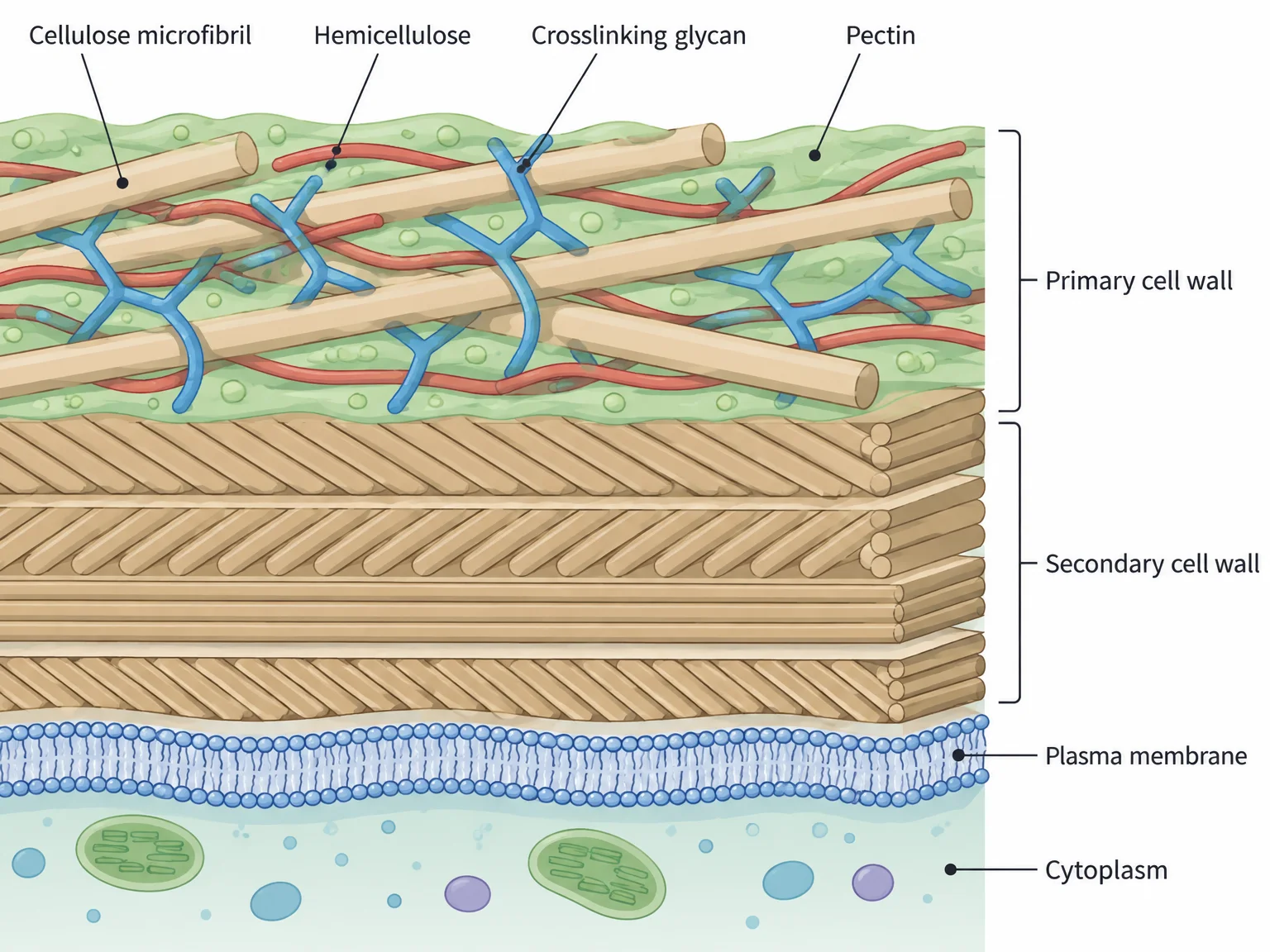
Secondary walls vary much more than primary walls. Some cells have none: photosynthetic leaf cells skip them, which lets light in more easily. When a secondary wall is present, it often contains lignin, a very hard compound found in the woody parts of plants that gives the wall great strength.
The same logic lets you predict what goes wrong if the timing is off. A drug that made cells build their secondary walls too soon would stop the cells from reaching full size, and the plant would end up shorter than normal.
Check yourselfA mouse strain makes less GAG and proteoglycan in its skin. How would its skin differ from normal skin?
It would be more easily compressed, because GAGs and proteoglycans hold the water that makes the ECM resist squeezing. Its tensile strength would be about the same, since that comes mainly from collagen.
Practice questions
1 of 4
Chitin is a nitrogen-containing polysaccharide. Where does it form an important part of an animal’s extracellular matrix?
2 of 4
Which plant cell wall molecule consists of glucose units linked end to end in chains that hydrogen-bond into strong microfibrils?
3 of 4
How does the plant cell wall generally compare with the extracellular matrix of animals?
4 of 4
A mutant plant starts building lignin-rich secondary walls in its young stem cells while those cells are still enlarging. What would you predict about the plant?