The three plant tissues
Plants sort their tissues differently from animals. Instead of four types, most plants have three: one that covers, one that fills, and one that carries water and food.
Simple and complex tissues
Plant biologists first sort tissues by how many cell types they contain.
- A simple tissue is made of one cell type, or possibly two.
- A complex tissue is made of two or more cell types, but without the organization that would make it an organ.
The three general plant tissues are dermal, ground, and vascular tissue, each with a structure suited to its jobs. Dermal and vascular tissue are complex tissues, while ground tissue is made up of three simple tissues.
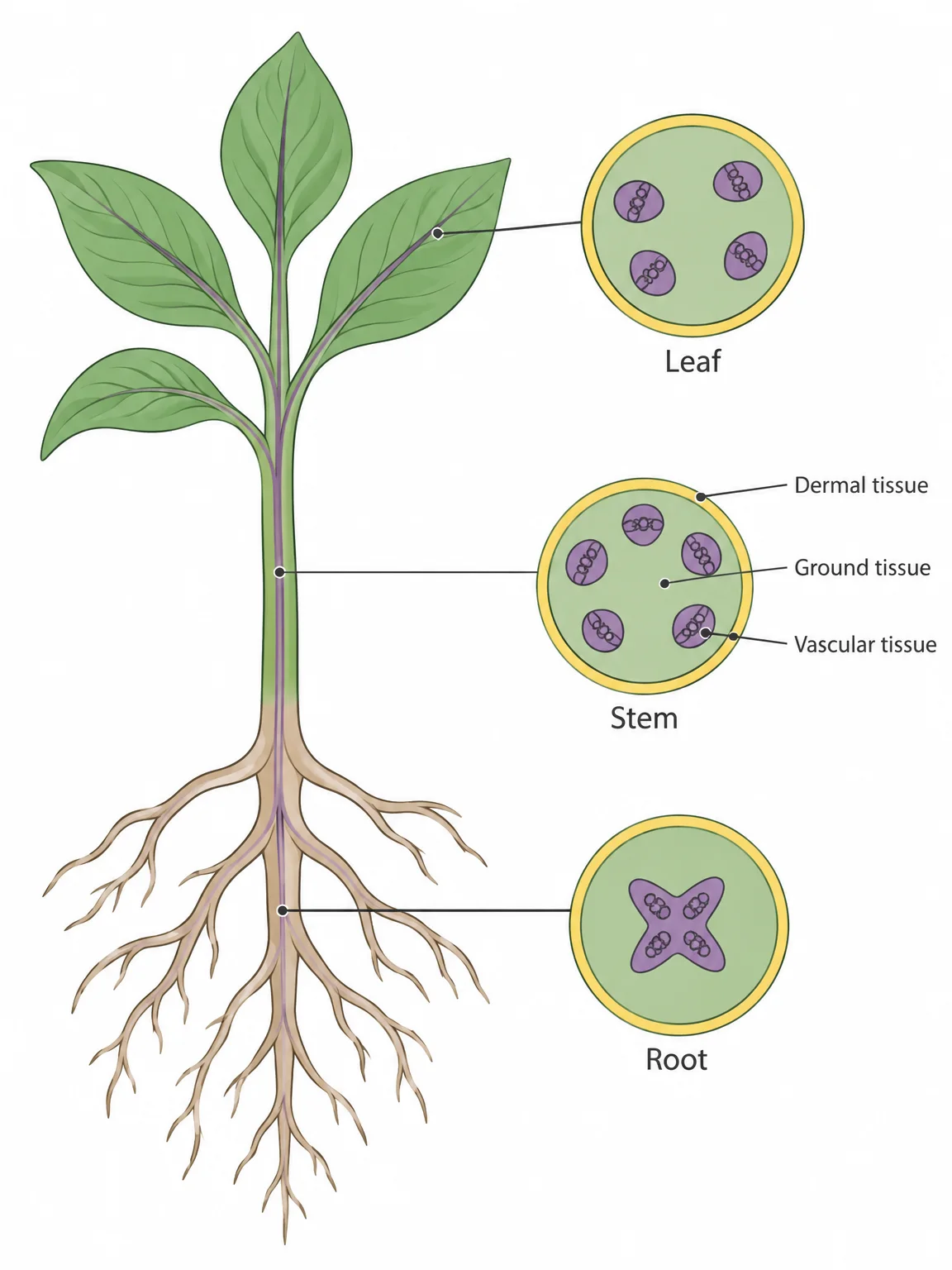
Dermal tissue covers the plant
Dermal tissue is a complex tissue that forms a covering over the plant. Newly made dermal tissue on the surfaces of leaves, stems, and roots is called the epidermis. Epidermal cells have thick primary walls and are tightly interlocked by their middle lamellae, so they hold together closely, much like the epithelial sheets of animals.
The epidermis is specialized differently in leaves and roots:
| Feature | Where | What it does |
|---|---|---|
| Waxy cuticle | Leaf epidermis | A waterproof coating, secreted by epidermal cells, that prevents water loss |
| Trichomes | Leaf epidermis | Hairs made of specialized epidermal cells; can secrete oils and protect the leaf |
| Guard cells and stomata | Leaf epidermis | Pairs of guard cells form pores (stomata; singular, stoma) that allow gas exchange |
| No cuticle | Root epidermis | The root absorbs water and nutrients, and wax would block that |
Ground tissue fills the plant
Most of a plant’s body is ground tissue. Its jobs include photosynthesis, storing carbohydrates, and support. It comes in three simple tissues that differ mainly in their cell walls.
| Ground tissue | Main role | Cell walls |
|---|---|---|
| Parenchyma | Metabolically active: photosynthesis (the mesophyll, the leaf’s photosynthetic middle layer, is parenchyma) and carbohydrate storage | Usually no secondary wall |
| Collenchyma | Flexible support in growing regions, such as the outer parts of stems and leaves | Thick secondary walls with little lignin, so they can bend and stretch |
| Sclerenchyma | Rigid support in parts that have stopped growing, such as woody stems | Secondary walls full of lignin; cells are often dead at maturity, but their walls keep supporting the plant |
Notice the pattern in the cell walls: the more lignin, the stiffer the support. Parenchyma usually skips the secondary wall, collenchyma’s secondary wall has little lignin, and sclerenchyma’s is packed with it.
Vascular tissue carries water and food
Some plants, such as certain mosses, are nonvascular: they have no conducting vessels, so they stay small and live in damp, shady places. Most plants today, including ferns and seed plants, are vascular plants.
In vascular plants, vascular tissue is a complex tissue of interconnected cells that form tubes for moving water and nutrients. It has two types:
- Xylem carries water and mineral ions up from the roots to the rest of the plant.
- Phloem distributes the sugars made in photosynthesis, plus other nutrients, throughout the plant.
Comparing plant and animal tissues
Plant and animal tissues line up in some ways but not others.
- Dermal ≈ epithelial. Both cover the organism, and both hold their cells tightly together (middle lamellae in plants, tight junctions in animals), limiting what passes between cells.
- Ground ≈ connective. Both provide structural support, and both contain a lot of material outside the cells: thick cell walls in plants, abundant ECM in animals.
- Vascular ≠ nervous. Vascular tissue moves water and nutrients; it doesn’t carry electrical signals the way nervous tissue does. If anything, it’s closer to an animal’s blood vessels.
Check yourselfWhich plant tissue is the closest counterpart to animal connective tissue, and why?
Ground tissue. Like connective tissue, it gives the body structural support, and it has a large amount of material outside the cells, in its case thick cell walls (especially in collenchyma and sclerenchyma).
Practice questions
1 of 3
Leaf epidermis is coated with a waxy cuticle, but root epidermis is not. What explains the difference?
2 of 3
Sugar made in a plant’s leaves must reach its growing roots. Which tissue carries it there?
3 of 3
A plant’s dermal tissue is often compared with an animal’s epithelial tissue. What do the two have in common?