Water's special properties
The hydrogen bonds between water molecules do more than help water dissolve things. They explain why ice floats, why water is slow to heat up, and how insects can stand on a pond.
Ice, liquid water, and water vapor
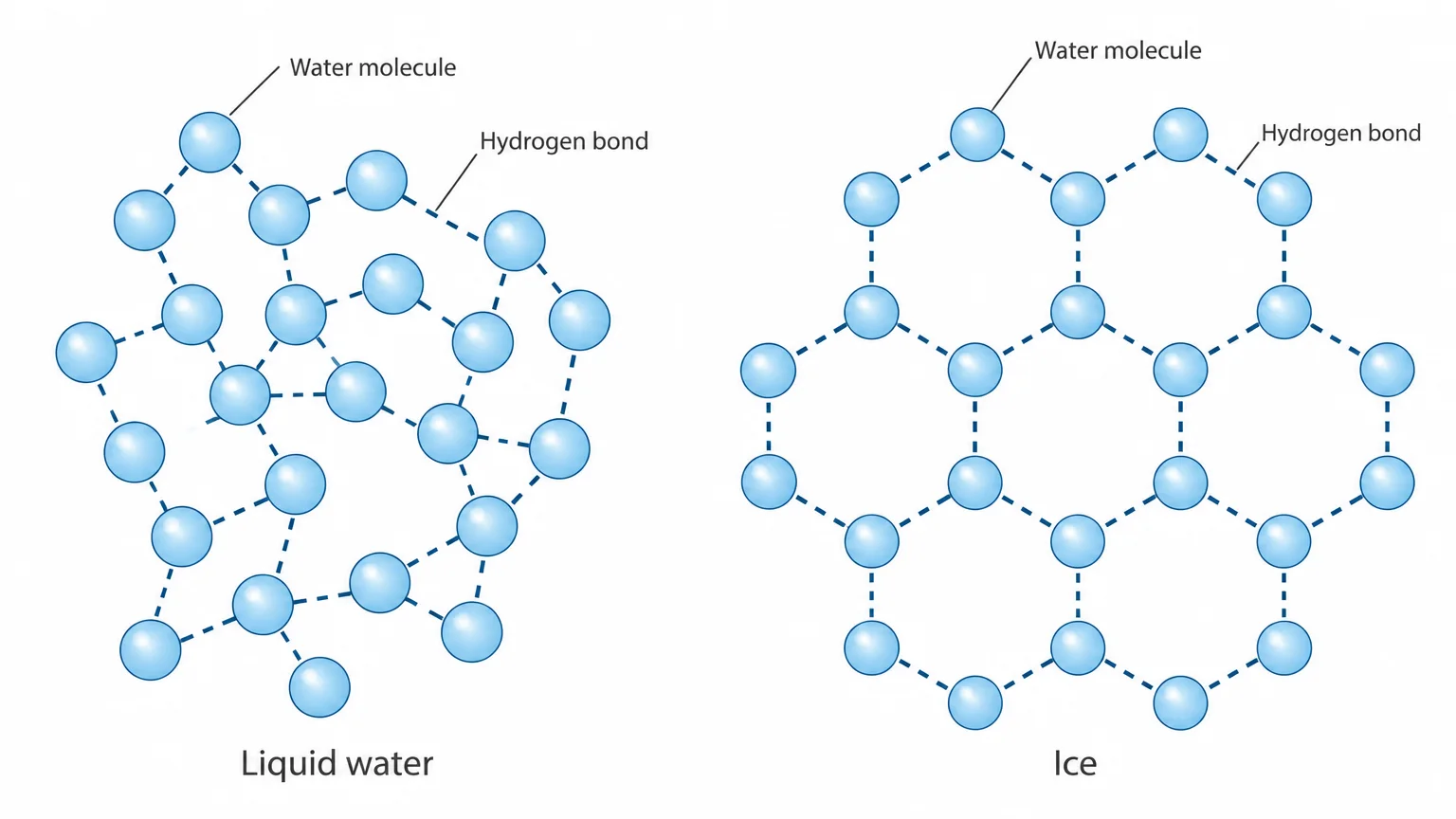
H₂O exists in all three states of matter: solid (ice), liquid (water), and gas (water vapor). At the temperatures found over most of Earth, it’s a liquid, in which hydrogen bonds between molecules constantly break and re-form.
- Heating makes hydrogen bonds break more often, and some molecules escape into the air as water vapor.
- Cooling makes them break less often, so molecules cling together in larger and larger clusters. At 0 °C, water freezes into a crystal: ice.
In ice, the hydrogen bonds hold the molecules in an orderly, open framework, with more space between molecules than in liquid water. So a block of ice has less mass than the same volume of liquid water. In other words, ice has a lower density (mass packed into a given space), and that’s why it floats. Ice is also less likely than liquid water to take part in chemical reactions.
Water holds steady as a liquid
Changing from one state to another takes in or gives off energy, and water’s many hydrogen bonds make these amounts large.
- To boil away, water must break the hydrogen bonds between its molecules. The heat needed to turn 1 mole of a liquid into a gas at its boiling point is its heat of vaporization. Water’s is very high: turning boiling water into vapor takes more than five times as much heat as warming the same water all the way from 0 °C to 100 °C.
- Freezing runs the other way, with heat given off. The heat a liquid must lose to become a solid is its heat of fusion, and water’s is also high.
- Even warming water takes a lot of heat. The heat needed to raise the temperature of 1 g of a substance by 1 °C (or lost when it cools by 1 °C) is its specific heat, and water’s is very high.
Thanks to its high heats of vaporization and fusion and its high specific heat, water holds steady as a liquid. That’s why large lakes and oceans change temperature slowly and keep nearby land milder. Life has evolved to work best at the temperatures where water stays liquid.
Dissolved solutes widen that liquid range. Pure water freezes at 0 °C and boils at 100 °C, but adding solutes lowers the freezing point and raises the boiling point. Properties like these, which depend only on the number of dissolved solute particles and not on what kind they are, are colligative properties. Antifreeze keeps the water in a car’s radiator from freezing in winter, dissolved salts help keep oceans liquid below 0 °C, and dissolved solutes act as antifreeze in some organisms, too.
Water’s jobs in living things
Water doesn’t just surround reactions; it takes part in them. In a hydrolysis reaction, water is used to break apart another molecule:
R₁–R₂ + H–O–H → R₁–OH + H–R₂
Here R₁ and R₂ stand for two groups of atoms joined by a covalent bond. That bond breaks, and so does one of water’s bonds: the OH from water attaches to one group and the H to the other. (Hydro means water, and lysis means to break apart.) Cells break many large molecules into smaller units this way.
Water’s other jobs follow from its properties:
- Support. Water is incompressible: its volume barely shrinks under pressure. That’s how water keeps plants stiff, and why a plant without enough water wilts.
- Waste removal. Waste products dissolve in water. In mammals, the kidneys filter them out of the blood into urine.
- Cooling. Water turns into vapor even at ordinary temperatures, a process called evaporation. The most energetic molecules break their hydrogen bonds and escape, carrying heat away with them, which is how sweating cools you.
- Moving water through plants. Water molecules attract one another, which is cohesion, and they’re also attracted to other kinds of molecules, which is adhesion. Both help water travel up through a plant’s vessels, the tubes that carry it from roots to leaves.
- Lubrication. Adhesion lets water coat surfaces, so saliva helps food slide down the digestive tract.
- A surface that holds weight. Water molecules at the surface pull on one another, drawing the water into a shape with as little surface exposed to air as possible. This attraction between molecules at a liquid’s surface is surface tension. It rounds water into droplets, makes a slightly overfilled glass bulge above its rim, and lets insects called water striders walk on a pond.
Check yourselfWhy does ice float on liquid water?
In ice, hydrogen bonds lock the molecules into an orderly, open lattice with more space between them than in liquid water. That makes ice less dense than liquid water, so it floats.
Practice questions
1 of 2
In winter, ice forms on the surface of a pond and floats instead of sinking. Why is ice less dense than liquid water?
2 of 2
Why does sweat evaporating from your skin cool you down?