Ions and chemical reactions
When one atom pulls on electrons much harder than another, it doesn’t just hog them: it takes them. Both atoms end up charged, and they cling to each other. Moving electrons and making or breaking bonds like this is also the basis of every chemical reaction.
Ions: atoms that gain or lose electrons
A neutral atom has equal numbers of protons and electrons. If an atom or molecule gains or loses one or more electrons, the numbers no longer match, and it carries a net charge. It has become an ion.
- A sodium atom (Na) has 11 protons and 11 electrons. If it loses 1 electron, it becomes a sodium ion (Na⁺), with 11 protons but only 10 electrons, so it’s positive. A positive ion is a cation.
- A chlorine atom (Cl) has 17 protons and 17 electrons. If it gains 1 electron, it becomes a chloride ion (Cl⁻), with 18 electrons, so it’s negative. A negative ion is an anion.
The superscript (the small raised symbol) shows the ion’s net charge. A calcium atom, with 20 electrons, loses 2 to become Ca²⁺. Electrons don’t float around on their own: an electron that leaves one atom goes to another.
Ions like these are stable because their outer shells are full. Sodium has a single electron in its third shell; losing it leaves the full second shell on the outside. Chlorine has 7 outer electrons, and gaining one completes a set of 8. Hydrogen, along with most mineral and trace elements, forms ions easily.
| Ion | Symbol | Electrons gained or lost |
|---|---|---|
| Calcium ion | Ca²⁺ | 2 lost |
| Chloride ion | Cl⁻ | 1 gained |
| Hydrogen ion | H⁺ | 1 lost |
| Magnesium ion | Mg²⁺ | 2 lost |
| Potassium ion | K⁺ | 1 lost |
| Sodium ion | Na⁺ | 1 lost |
Ionic bonds
Opposite charges attract, so a cation and an anion cling together. That attraction is an ionic bond. Ionic bonds form between atoms whose electronegativities differ greatly (by more than about 1.8), such as sodium (0.93) and chlorine (3.16): sodium gives up an electron, chlorine takes it, and the resulting Na⁺ and Cl⁻ attract.
Table salt (NaCl) is a crystal of sodium and chloride ions arranged in a regular, repeating pattern. In the dry crystal the ionic bonds are strong, but in water they break easily and the ions separate, which is why salt dissolves. Substances held together by ionic bonds are ionic compounds, while substances whose atoms are joined by covalent bonds, such as O₂, are molecules.
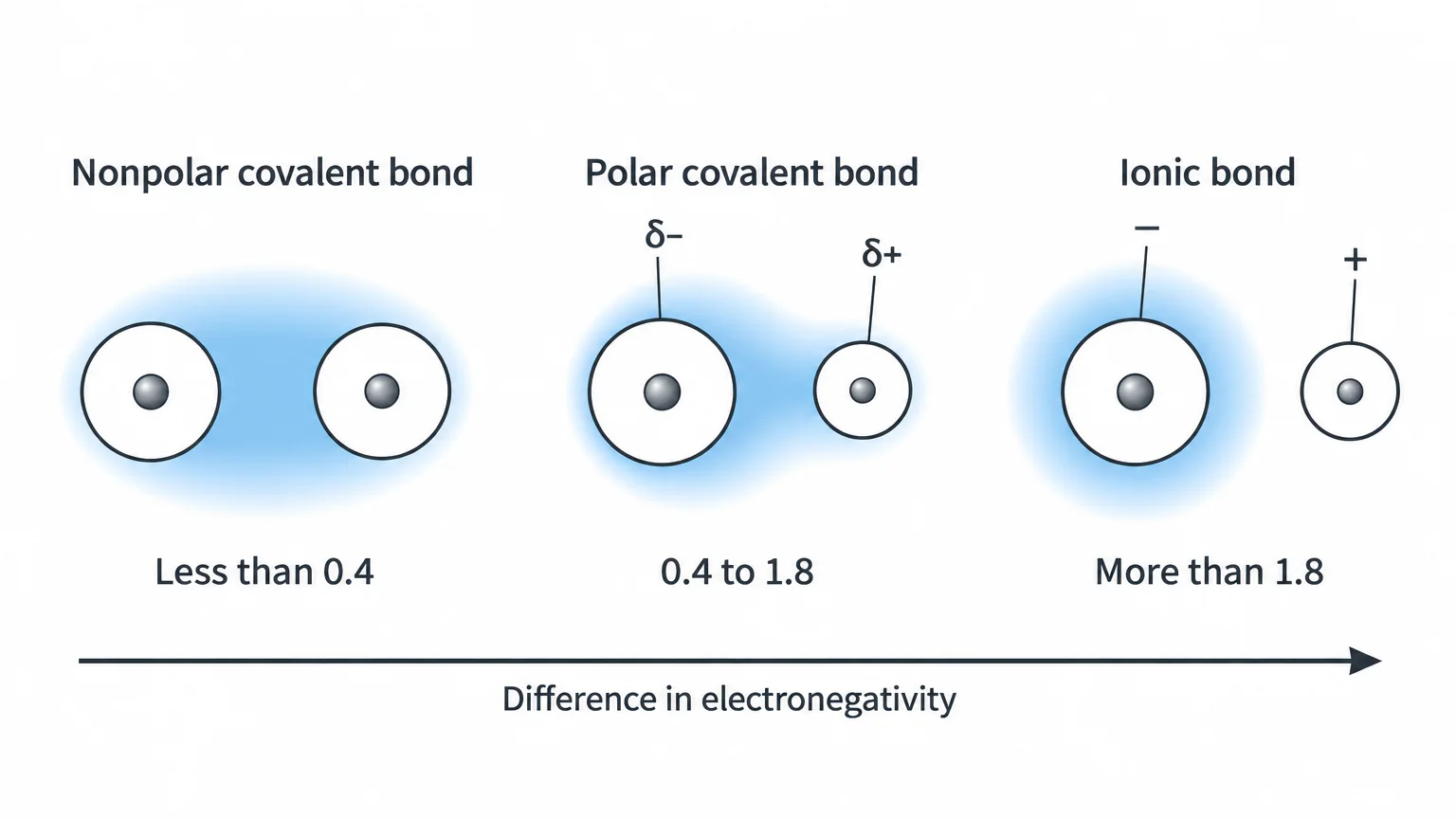
Here is every kind of bond and attraction covered so far, side by side:
| Bond or attraction | What the electrons do | Strength | Example |
|---|---|---|---|
| Nonpolar covalent | Shared equally | Strong | C–C, C–H |
| Polar covalent | Shared unequally, creating δ⁺ and δ⁻ | Strong | O–H in water |
| Ionic | Transferred; the ions attract | Strong in a crystal, easily broken in water | Na⁺ and Cl⁻ in salt |
| Hydrogen bond | None shared; a δ⁺ H is attracted to a δ⁻ O or N | Weak alone, strong in large numbers | Between water molecules; between DNA strands |
| Van der Waals dispersion | Bunch up briefly at random | Weak and fleeting alone, strong in large numbers | Between nonpolar molecules |
Chemical reactions
When one or more substances change into different substances, by making or breaking chemical bonds or by adding or removing electrons, that’s a chemical reaction. Atoms get rearranged, but none is split, and no nucleus changes. Burning methane, the main ingredient of natural gas, is an example:
The numbers in front count molecules: one methane molecule and two oxygen molecules become one carbon dioxide molecule and two water molecules. The starting materials are the reactants, and the substances made are the products. The two-way arrow means the reaction can run in either direction.
Reactions share a few features:
- They need energy. Atoms and molecules must move and collide to react. Heat supplies part of that energy by making them vibrate and move about, which is called Brownian motion. At absolute zero, the complete absence of heat, they would stand still.
- Many need a catalyst. A catalyst speeds up a reaction. In cells, most reactions are catalyzed by enzymes.
- They head toward equilibrium. A reaction tends to run in one direction but eventually reaches chemical equilibrium, where products form as fast as they turn back into reactants, so the amounts of each stop changing. Picture a store with shoppers entering and leaving at the same rate: people keep moving, but the crowd inside stays the same size.
- Most happen in water. In living things, reactants and products are usually dissolved in water.
Burning methane runs almost entirely forward and releases a lot of heat, which is why natural gas heats homes; it reaches equilibrium only when nearly all the reactants have become products. In a cell, though, a second reaction often turns the product into something else the moment it forms. With its product constantly carried off, the first reaction never reaches equilibrium and keeps going until its reactants run out.
Check yourselfWhy can a reaction in a cell keep running until its reactants are used up instead of stopping at equilibrium?
Practice questions
1 of 2
When sodium and chlorine atoms react to form table salt, what happens to their electrons?
2 of 2
An atom that loses an electron and ends up with a net positive charge is called what?