Polar bonds and weak attractions
In a covalent bond, two atoms share electrons, but they don’t always share them equally. Whether the sharing is even or lopsided affects how a molecule behaves in water and how it sticks to other molecules.
Electronegativity: a tug-of-war over electrons
Some atoms pull shared electrons toward themselves more strongly than others do. A measure of how strongly an atom attracts the electrons in a bond is its electronegativity. The higher the value, the stronger the pull.
| Atom | Na | H | C | N | Cl | O |
|---|---|---|---|---|---|---|
| Electronegativity | 0.93 | 2.20 | 2.55 | 3.04 | 3.16 | 3.44 |
Nonpolar and polar covalent bonds
The difference between two atoms’ electronegativities predicts how they share electrons.
- If the difference is less than 0.4, the electrons are shared about equally. That’s a nonpolar covalent bond. Bonds between two carbons (C–C) or between carbon and hydrogen (C–H, a difference of 0.35) are nonpolar.
- If the difference is 0.4 to 1.8, the shared electrons stay closer to the more electronegative atom. That’s a polar covalent bond. O–H bonds (a difference of 1.24) and N–H bonds (0.84) are polar.
In a polar bond, the atom that hogs the electrons takes on a slight negative charge, called a partial negative charge and written δ⁻ (the Greek letter delta stands for “partial”). The other atom is left with a partial positive charge, δ⁺. This separation of charge is called polarity.
Water is the classic example. Oxygen pulls the shared electrons away from both hydrogens, so the oxygen end of the molecule is δ⁻ and each hydrogen is δ⁺.
Molecules with polar bonds, like water, are usually polar molecules, while molecules whose bonds are mostly nonpolar are nonpolar molecules. A large molecule can have both polar and nonpolar regions. The two kinds behave very differently, especially in whether they dissolve in water.
Hydrogen bonds
Partial charges let polar molecules attract one another. When a δ⁺ hydrogen atom in one polar molecule is drawn to an electronegative atom, such as oxygen or nitrogen, in another polar molecule, the attraction is a hydrogen bond. Diagrams show hydrogen bonds as dashed or dotted lines to set them apart from covalent bonds.
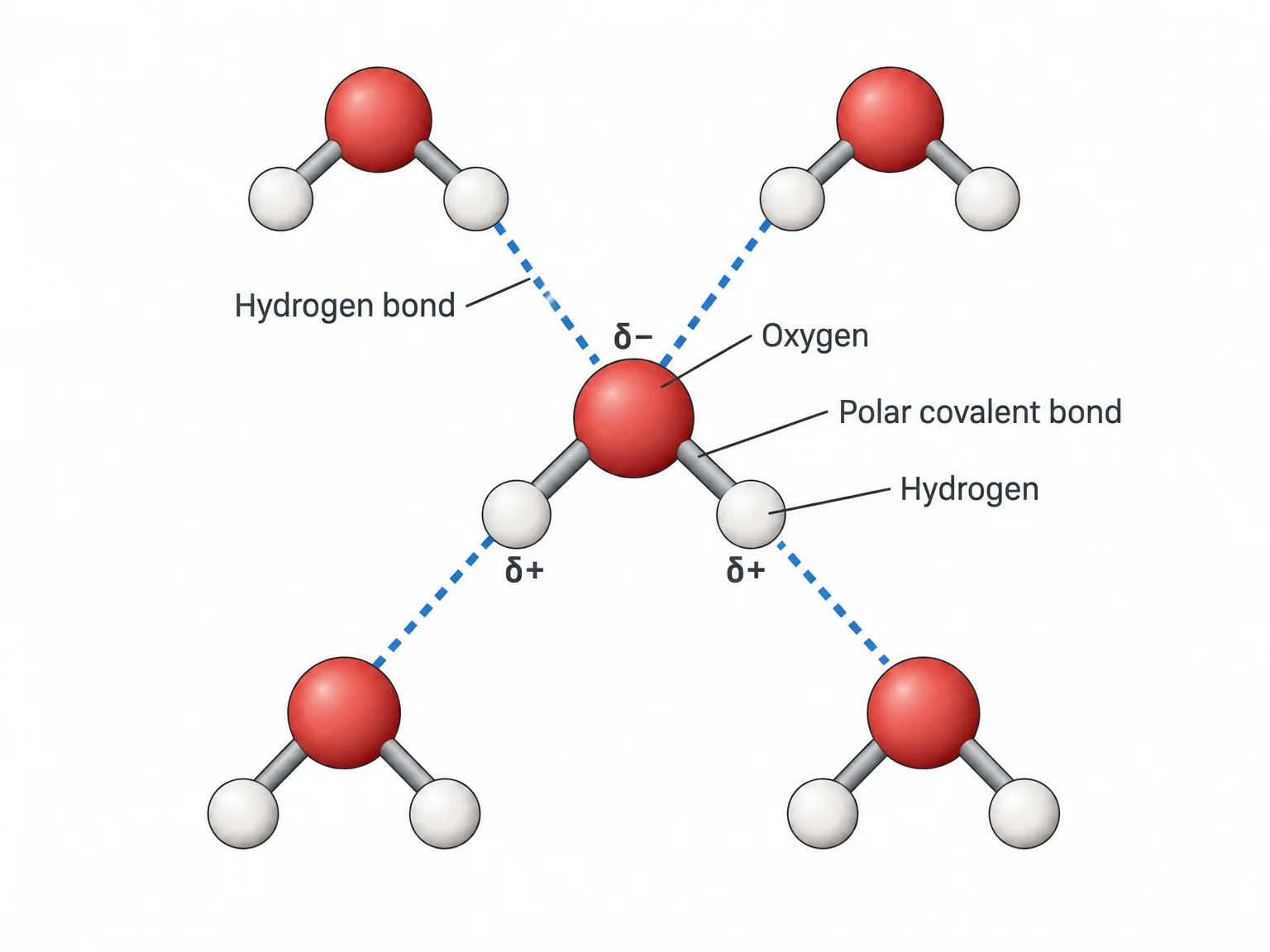
A single hydrogen bond is weak, only a small fraction as strong as the covalent bond between oxygen and hydrogen within a water molecule. Yet hydrogen bonds matter in two opposite ways:
- Many together are strong. A large molecule can hold many hydrogen bonds between its parts, and together they help keep it in its three-dimensional shape. The two long strands of DNA, the molecule that carries genetic information, are held together along their length partly by hydrogen bonds, so pulling the strands apart takes considerable energy.
- A few are easy to break. An interaction held by only a few hydrogen bonds comes apart easily, so molecules can bind and then let go. Small molecules, for example, can attach to enzymes (proteins that speed up chemical changes in cells) by hydrogen bonds and later be released.
Van der Waals dispersion forces
Even nonpolar molecules attract each other a little. Electrons move randomly within their orbitals, so at any instant the electrons of a molecule may happen to bunch up on one side. That creates a brief, uneven charge that attracts nearby molecules.
These fleeting attractions are van der Waals dispersion forces. Each is weak and short-lived, but many acting together can be quite strong. A gecko can cling to a wall largely because millions of tiny hairs on its toes are drawn to the surface by these forces.
Shape decides what a molecule can bind
Covalent bonds form at specific angles, which gives each molecule a specific three-dimensional shape. In water, the two O–H bonds meet at an angle of about 104.5°, so the molecule is bent rather than straight.
Molecules aren’t rigid, though. Atoms joined by a single covalent bond can rotate around it, like a wheel turning on an axle, so a molecule can change shape without breaking any covalent bonds.
Shape matters because molecules recognize each other by fit, somewhat like a key fitting a lock, and weak attractions such as hydrogen bonds hold them together once they meet. You can smell food because odor molecules fit into receptors in your nose, proteins shaped to recognize particular molecules. When an odor molecule binds, the receptor changes shape, and shape changes like this are a common way one molecule alters another’s activity. A molecule’s structure determines its function.
Check yourselfHydrogen bonds are weak, yet separating the two strands of DNA takes a lot of energy. Why?
The strands are held together by a very large number of hydrogen bonds. Each one is weak, but together they add up to a considerable force, so breaking them all takes considerable energy.
Practice questions
1 of 3
Electronegativity values are H = 2.20, C = 2.55, N = 3.04, and O = 3.44. Which of these bonds is nonpolar covalent?
2 of 3
The two strands of a DNA molecule are held together by hydrogen bonds, which are individually weak. Why does separating the strands still take considerable energy?
3 of 3
You can smell coffee because its odor molecules bind to receptor proteins in your nose. What mainly determines whether an odor molecule binds to a particular receptor?