Water as a solvent
Life is soaked in water. Most cells are filled with it and surrounded by it, water makes up 60–70% of a human’s body weight, and nearly all of life’s chemical reactions happen in it, both inside cells and in the fluid around them. Water’s talent for dissolving things comes from the polarity of its molecules.
Solutions, and why salt dissolves
Stir sugar into tea and the sugar disappears into the liquid. The substance that dissolves is the solute, the liquid it dissolves in is the solvent, and the mixture they form is a solution.
When the solvent is water, the mixture is an aqueous solution. Water is the most abundant solvent in nature and the solvent for nearly all chemical reactions in living things. Dissolving frees atoms and molecules to drift around and meet, so they can interact in ways that undissolved substances can’t.
To dissolve in water, a substance must be electrically attracted to water molecules. Recall that water is polar: its oxygen carries a partial negative charge (δ⁻), and each hydrogen carries a partial positive charge (δ⁺).
In a crystal of table salt, strong ionic bonds hold sodium ions (Na⁺) and chloride ions (Cl⁻) together. In water, the water molecules turn to face the ions: their δ⁻ oxygens point toward each Na⁺, and their δ⁺ hydrogens point toward each Cl⁻. Clusters of water molecules surround each ion, pulling it away from the crystal and into the water. That’s dissolving.
Water-loving and water-fearing molecules
Substances with ionic bonds or polar covalent bonds generally dissolve in water, because water’s partial charges attract them. Such substances are called polar or hydrophilic, meaning “water-loving.” Salt and sugar are examples.
Molecules made mostly of carbon and hydrogen are different. Their C–C and C–H bonds are nonpolar, so they have few or no partial charges, and water isn’t attracted to them. They’re called nonpolar or hydrophobic, meaning “water-fearing,” and they dissolve poorly in water. Oils are made of hydrophobic molecules, which is why vegetable oil shaken with water separates back into its own layer.
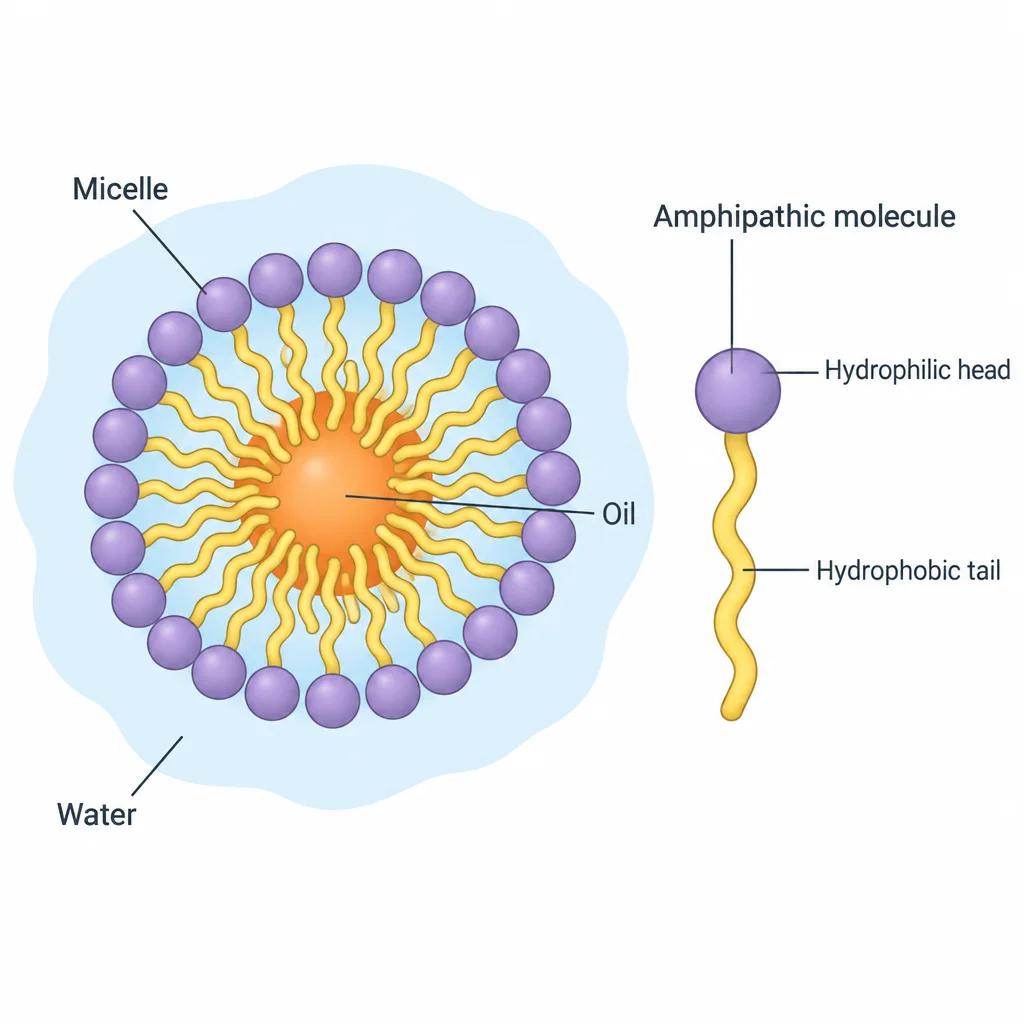
Some molecules have hydrophilic regions in one place and hydrophobic regions in another. They’re amphipathic (also called amphiphilic, “both-loving”). In water, long amphipathic molecules can cluster into tiny spheres called micelles. Their polar ends form the surface, in contact with the water, and their nonpolar ends point inward, away from it.
Nonpolar substances can dissolve in that nonpolar core, so micelles can carry far more of them in water than would ever dissolve on their own. That’s how soap works. Detergent molecules are amphipathic, and oil from your skin dissolves in the core of detergent micelles, whose polar surfaces let them, oil and all, rinse away with water. It’s a clear case of structure determining function: a nonpolar core inside a polar shell is what lets a micelle carry oil through water.
Amphipathic molecules can also form a double layer, or bilayer, with hydrophilic surfaces facing the water on both sides and a hydrophobic interior. Bilayers form the basic structure of cell membranes, the thin boundaries that enclose cells.
Measuring what’s dissolved
The amount of a solute dissolved in a given volume of solution is its concentration. Dissolve 1 g of glucose in enough water to make 1 liter (L) of solution, and the concentration is 1 g/L.
Grams per liter don’t tell you how many molecules are present, though. A glucose molecule has less mass than a molecule of sucrose (table sugar), so 10 g of glucose contains more molecules than 10 g of sucrose. To compare numbers of molecules, scientists use moles, and that starts with a molecule’s mass.
The sum of the atomic masses of all the atoms in a molecule is its molecular mass. For glucose, C₆H₁₂O₆, that’s (6 × 12) + (12 × 1) + (6 × 16) = 180, so 1 mol of glucose has a mass of 180 g. You can find the mass of an ionic compound the same way, going by its formula. With atomic masses from the periodic table, here are five compounds ranked from lowest to highest mass:
| Compound | Atomic masses added | Mass (Da) |
|---|---|---|
| H₂O | (2 × 1) + 16 | 18 |
| NaCl | 23 + 35.5 | 58.5 |
| MgCl₂ | 24 + (2 × 35.5) | 95 |
| CaCl₂ | 40 + (2 × 35.5) | 111 |
| C₆H₁₂O₆ | As above | 180 |
Molarity
The number of moles of solute in 1 L of solution is its molarity, written M (for “molar”). So 180 g of glucose in enough water to make 1 L is a 1 M solution, and 90 g in 1 L is 0.5 M.
Solute concentrations in living things are usually far below 1 M, so smaller units are common: millimolar (1 mM = 0.001 M, or 10⁻³ M), micromolar (1 µM = 10⁻⁶ M), nanomolar (1 nM = 10⁻⁹ M), and picomolar (1 pM = 10⁻¹² M). Blood glucose, for instance, is about 5 mM.
Practice questions
1 of 2
One liter of solution contains 10 g of glucose (molecular mass 180), and another liter contains 10 g of sucrose (molecular mass 342). Which solution contains more dissolved sugar molecules?
2 of 2
Using the atomic masses H = 1, O = 16, Na = 23, Mg = 24, Cl = 35.5, and Ca = 40, which 1-mole sample has the greatest mass?