Inside an atom
Your body, the air you breathe, and the salt on your fries are all made of the same basic stuff, just arranged differently. Living things run on chemistry, and chemistry starts with atoms.
Matter, atoms, and elements
Anything that takes up space and has mass (how much stuff it’s made of) is matter. In living things, matter exists as solids, liquids, and gases.
Cut a piece of matter into smaller and smaller bits and you eventually reach units that ordinary chemical or physical methods can’t break down any further. These units are atoms, the smallest functional units of matter, and every chemical substance is built from them. They’re tiny: a hydrogen atom, the simplest kind, is about 0.1 nm across (a nanometer is a billionth of a meter), so a million of them in a row would barely span a human hair.
Atoms come in different kinds, such as hydrogen, carbon, and oxygen. A pure substance made of only one kind of atom is an element. Atoms can also link up, and two or more atoms joined together form a molecule.
Three smaller particles
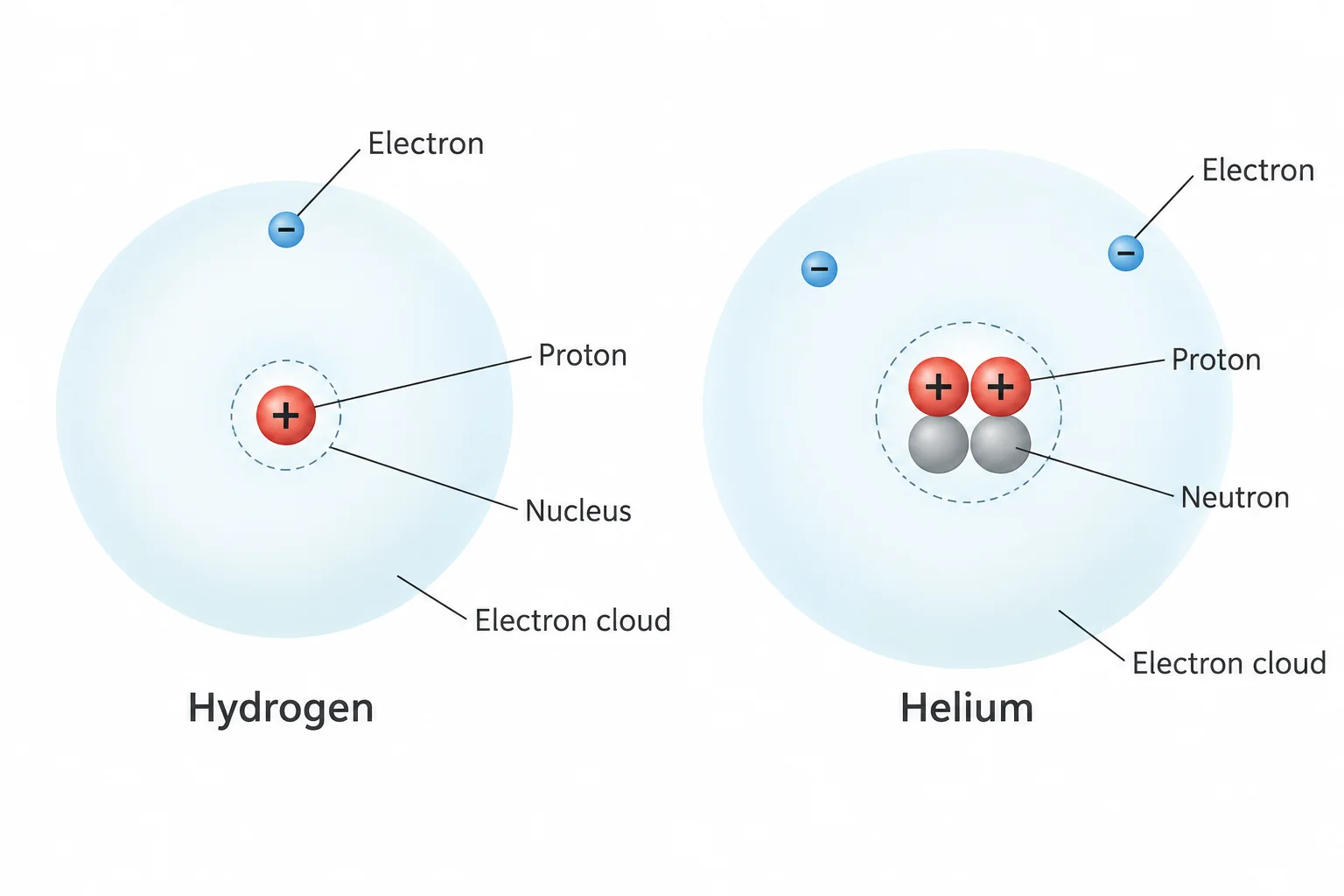
Atoms are built from three kinds of smaller particles that differ in electric charge, a property that makes particles push or pull on one another. Charge comes in two kinds, positive and negative. Like charges (two of the same kind) push each other away, or repel, while opposite charges attract.
- Protons each carry one unit of positive charge (p⁺).
- Neutrons carry no charge (n⁰).
- Electrons each carry one unit of negative charge (e⁻).
Protons and neutrons are packed together in a tiny, dense center called the atomic nucleus. Electrons occupy the space around it, held close by the positive nucleus’s pull. Hydrogen is the exception: its nucleus is a single proton, with no neutrons.
| Particle | Location | Charge | Mass compared with an electron |
|---|---|---|---|
| Proton | Nucleus | +1 | 1,836 |
| Neutron | Nucleus | 0 | 1,839 |
| Electron | Around the nucleus | −1 | 1 |
Protons and neutrons each have more than 1,800 times the mass of an electron, so almost all of an atom’s mass sits in its nucleus.
Atomic number: protons name the element
Each element has its own number of protons in the nucleus, and that number is its atomic number. Hydrogen’s is 1, carbon’s is 6, nitrogen’s is 7, oxygen’s is 8, and magnesium’s is 12.
In most atoms, electrons equal protons in number, so their charges cancel and the atom is neutral, with no net charge. The atomic number therefore also gives the number of electrons. Neutron numbers, by contrast, can vary among atoms of the same element.
An atom is mostly empty space
The evidence came from Ernest Rutherford’s gold foil experiment. At the time, scientists pictured an atom’s positive charge spread evenly through it. If that were so, the tiny, positively charged alpha particles (two protons and two neutrons each) that Rutherford’s team fired at thin gold foil should mostly have been nudged a little off course, since like charges repel.
That’s not what happened:
- More than 98% passed straight through, as if the foil weren’t there.
- Fewer than 2% were slightly deflected.
- About 0.01% (1 in 10,000) bounced back sharply.
Two conclusions followed. First, most of an atom is empty space, which is why nearly every particle sailed through. Second, the atom’s positive charge is packed into a tiny, dense center, the nucleus, and a particle bounced back only on the rare occasions it hit one head-on.
The nucleus spans only about 1/10,000 of an atom’s diameter, so more than 99.99% of an atom’s volume lies outside it. If an atom were the size of a football stadium, its nucleus would be a marble at the center of the field.
The elements of living things
Just four elements (oxygen, carbon, hydrogen, and nitrogen) make up about 95% of the mass of living things.
| Element | Symbol | % of human body mass | % of atoms in the body |
|---|---|---|---|
| Oxygen | O | 65 | 25.5 |
| Carbon | C | 18 | 9.5 |
| Hydrogen | H | 9 | 63.0 |
| Nitrogen | N | 3 | 1.4 |
Much of the oxygen and hydrogen is in water, which makes up about 60% of most animals’ mass and 95% or more of some plants. Carbon is a major building block of living matter, and nitrogen is found in every protein and nucleic acid, the large molecules that do most of a cell’s work and carry its genetic information. Hydrogen supplies 63% of your atoms but only 9% of your mass, because hydrogen atoms are the lightest of all.
Other required elements are present in smaller but still significant amounts, usually under 1% of total mass. These are the mineral elements: calcium, phosphorus, potassium, sodium, chlorine, magnesium, and sulfur. Calcium and phosphorus are building materials for bones and shells, and potassium and sodium help control the flow of water and electric current across cell surfaces.
Elements needed in even tinier amounts, less than 0.01% of body mass, are trace elements. They include iron, copper, zinc, and iodine, and they’re still essential: iron, for example, is part of the molecule that carries oxygen in your blood.
Check yourselfIn the gold foil experiment, what did the few particles that bounced straight back reveal?
Practice questions
1 of 2
In Rutherford’s gold foil experiment, more than 98% of the positively charged alpha particles passed straight through the foil. What did this show about atoms?
2 of 2
Which four elements together make up about 95% of the mass of living organisms?