Covalent bonds and molecules
Atoms with unfilled outer shells rarely stay single. They link up with other atoms through chemical bonds, and inside the molecules of living things, most of those links are covalent bonds.
Molecules, compounds, and formulas
Two or more atoms bonded together form a molecule. Two oxygen atoms, for instance, make one oxygen molecule, written O₂. That shorthand is a molecular formula: the symbol for each kind of atom, followed by a small lowered number (a subscript) giving how many of that atom there are. No subscript means one.
A substance made of two or more different elements is a compound. Water (H₂O) contains two hydrogen atoms and one oxygen atom, and the sugar glucose (C₆H₁₂O₆) contains 6 carbon, 12 hydrogen, and 6 oxygen atoms. O₂ is a molecule but not a compound, since it contains only one element.
A compound can behave nothing like the elements that make it up. Sodium is a soft, silvery metal that reacts violently with water, and chlorine is a poisonous yellow-green gas. Together they form table salt (NaCl), hard white crystals that dissolve in water. Properties that arise from a combination and differ from those of its separate parts are emergent properties.
Covalent bonds: sharing electrons
One principle drives most bonding:
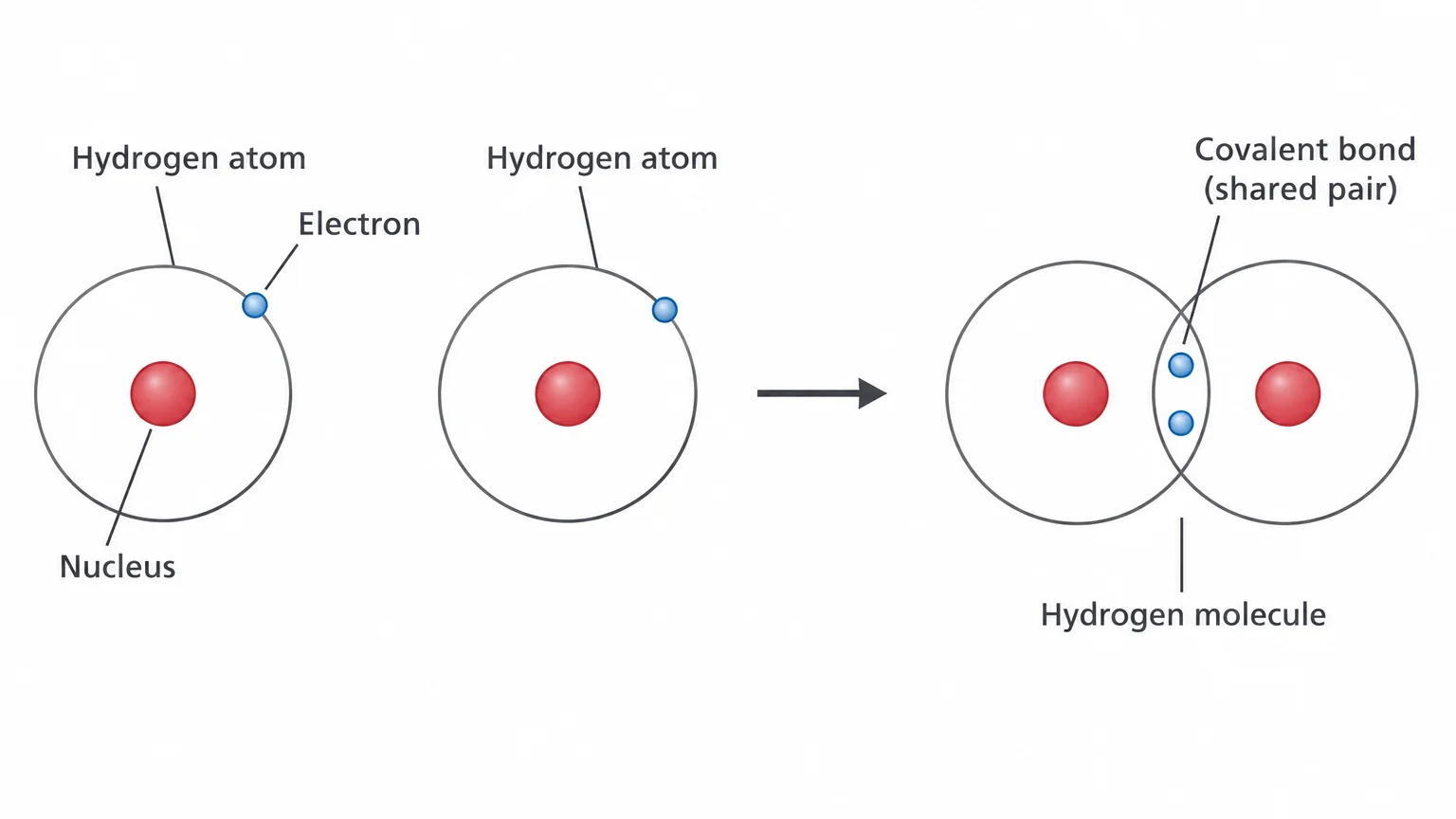
An atom with an unfilled outer shell can fill it by sharing electrons with a neighbor. Two atoms that share a pair of electrons are joined by a covalent bond. The shared electrons spend time in the outer shells of both atoms, so each atom counts them toward filling its own shell.
The simplest case joins two hydrogen atoms. Each has one electron, and hydrogen’s only shell is full with two, so when the atoms share their electrons as a pair, both shells fill. Hydrogen fluoride (HF) forms the same way: fluorine has 7 electrons in an outer shell that holds 8, so one shared pair completes both atoms’ shells. Because each atom holds the shared pair as though it were its own, covalent bonds are strong.
How many bonds? The octet rule
Many atoms are most stable with eight electrons, a set called an octet, in their outer shell. That’s the octet rule, and it applies to most atoms in living things, including oxygen, nitrogen, carbon, phosphorus, and sulfur. Hydrogen is the main exception, because its only shell is full with two.
An atom forms as many covalent bonds as the number of electrons it needs to fill its outer shell:
| Atom | Valence electrons | Electrons needed | Covalent bonds formed |
|---|---|---|---|
| Hydrogen (H) | 1 | 1 | 1 |
| Oxygen (O) | 6 | 2 | 2 |
| Nitrogen (N) | 5 | 3 | 3 |
| Carbon (C) | 4 | 4 | 4 |
Carbon’s four bonds let it connect to as many as four other atoms at once, one reason it forms the backbone of so many biological molecules.
Drawing bonds: structural formulas
Chemists often draw a molecule with each covalent bond as a line, where each line stands for one shared pair of electrons. That drawing is a structural formula. Hydrogen fluoride is H–F. Water is H–O–H, which shows that the oxygen is bonded to both hydrogens.
Sometimes two atoms share two pairs of electrons (four electrons in all). That’s a double bond, drawn as two lines. Each oxygen atom needs two more electrons, so the two atoms of O₂ share two pairs: O=O. In carbon dioxide, carbon needs four bonds and each oxygen needs two, so carbon forms a double bond with each oxygen: O=C=O.
Two carbons may be joined by a single bond or a double bond, depending on how many other atoms each carbon is bonded to. Rarely, they share three pairs, forming a triple bond.
Free radicals: an electron left unpaired
An atom is most stable when each of its orbitals holds a full pair of electrons. A molecule containing an atom with a single, unpaired electron in its outer shell is a free radical. Free radicals are highly reactive: they grab an electron from another molecule to complete the pair, which can turn that molecule into a new free radical and set off a chain reaction.
Radiation and toxins can create free radicals, which are written with a dot for the unpaired electron. They can be neutral, like the hydroxyl radical (·OH), or charged, like superoxide (·O₂⁻, where the ⁻ marks a negative charge). Free radicals can burst cells and damage genetic material, although some animal cells make them on purpose to kill invading bacteria.
Most free radicals must be made harmless before they hurt healthy cells. Some molecules can hand a free radical the electron it’s missing without becoming dangerously reactive themselves; these protective molecules are antioxidants. Vitamins C and E and the plant compounds called flavonoids are antioxidants, one reason a diet rich in fruits and vegetables is good for you.
Check yourselfAmmonia is NH₃. Use the octet rule to explain how its atoms are bonded.
Nitrogen has 5 valence electrons and needs 3 more, so it forms 3 covalent bonds, a single bond to each hydrogen. Each hydrogen needs 1 more electron and forms 1 bond. Every atom ends up with a full outer shell.
Practice questions
1 of 2
Which of these substances is a compound?
2 of 2
How many covalent bonds does a carbon atom usually form?