Electron shells and the periodic table
Protons decide which element an atom is. Electrons decide how it behaves, including whether it links up with other atoms and which ones. To predict that, you need to know where an atom’s electrons are.
Electrons live in clouds, not orbits
Diagrams often show electrons circling the nucleus like planets around the Sun. That picture is handy for drawing on paper, but it isn’t how electrons behave. No one can pin down exactly where a given electron is at a given moment. What you can describe is the region around the nucleus where an electron is likely to be found, and that region is an orbital.
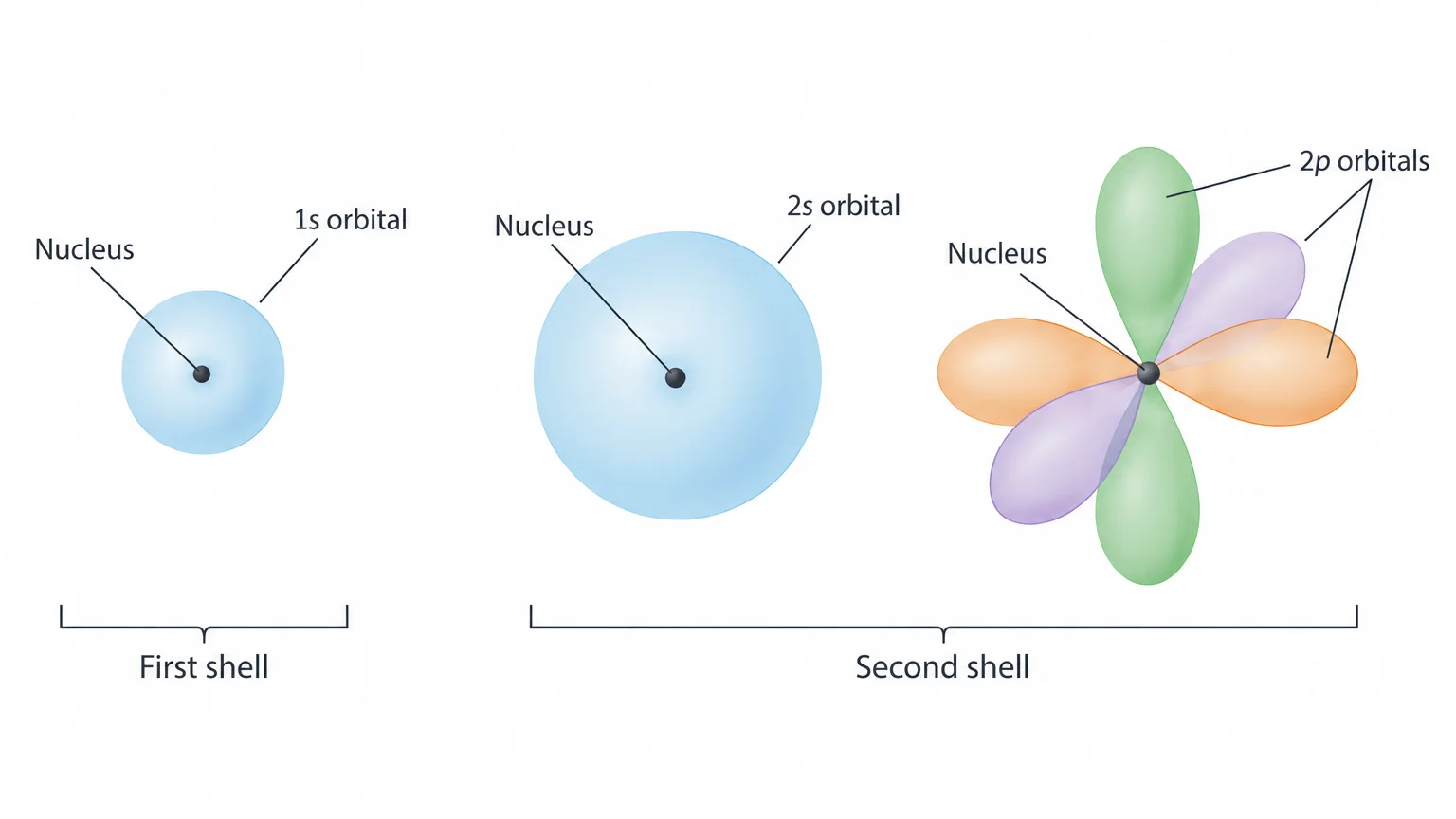
Each orbital holds at most two electrons, so an atom with more than two electrons needs more than one orbital. Orbitals come in different shapes: an s orbital is a sphere around the nucleus, and a p orbital is shaped like a dumbbell or propeller.
Shells are energy levels
Orbitals are grouped into layers by energy. The capacity to do work (such as moving an object) or to cause some other change is energy. Electrons are always moving, so they have kinetic energy, the energy of motion, and some electrons have more of it than others.
Electrons with different amounts of energy occupy different electron shells, or energy levels. The shells are numbered outward from the nucleus, and each contains one or more orbitals.
- The first shell has a single s orbital (1s), so it holds at most 2 electrons.
- The second shell has one s orbital (2s) and three p orbitals (2p). Four orbitals with two electrons apiece means it holds up to 8 electrons.
- Larger atoms have more shells; the heaviest elements have seven.
Shells fill from the inside out. The first shell holds the lowest-energy electrons and fills first, then the second, and so on. Within the second shell, the 2s orbital has slightly less energy, so it fills before the 2p orbitals. The three 2p orbitals then each take one electron before any of them takes a second.
Valence electrons
The electrons in an atom’s outermost shell are its valence electrons. In most atoms, the outer shell isn’t full. Atoms with unfilled outer shells tend to share, give up, or gain electrons until they’re left with a full outer shell, and doing so joins them to other atoms to make a new substance. The link that holds two atoms together is a chemical bond, and valence electrons are the ones that form it.
Reading the periodic table
Chemists arrange all the known elements in one chart, in order of atomic number and organized by their electron shells. That chart is the periodic table of the elements. Each element has a one- or two-letter symbol: H for hydrogen, C for carbon, O for oxygen. A few symbols come from Latin names, such as Na for sodium (natrium).
- Each row is a period. The row number equals the number of electron shells: hydrogen (row 1) has one shell, lithium (row 2) has two, and sodium (row 3) has three.
- Each column is a group. In the first three rows, each step to the right adds one electron to the outer shell: lithium has 1, beryllium 2, boron 3, and so on.
Elements in the same group have the same number of valence electrons, so they form bonds in similar ways and share similar chemical properties.
| Element | Symbol | Atomic number | Shells | Valence electrons |
|---|---|---|---|---|
| Hydrogen | H | 1 | 1 | 1 |
| Carbon | C | 6 | 2 | 4 |
| Nitrogen | N | 7 | 2 | 5 |
| Oxygen | O | 8 | 2 | 6 |
| Sodium | Na | 11 | 3 | 1 |
| Chlorine | Cl | 17 | 3 | 7 |
Hydrogen and sodium each have one valence electron, which is why they sit in the same column.
Check yourselfWhat’s the difference between an electron shell and an orbital?
Practice questions
1 of 2
Diagrams often show electrons circling the nucleus in fixed paths, like planets around the Sun. Why is that picture misleading?
2 of 2
Elements in the same column (group) of the periodic table have similar chemical properties. What do their atoms have in common?