Transfer RNA and the enzymes that load it
Transcription needs just one enzyme, RNA polymerase, to copy a DNA strand into RNA. Translation has a harder job: turning a sequence of codons into a sequence of amino acids. No single molecule can do that, so many proteins and RNAs work together.
The translation toolkit
Four kinds of components take part in every round of translation:
| Component | Job |
|---|---|
| mRNA | Carries the codons that spell out the polypeptide |
| tRNA | Pairs with a codon and carries the matching amino acid |
| Ribosome | Holds mRNA and tRNAs together and links the amino acids |
| Translation factors | Proteins that help translation start, continue, and finish |
The translation factors come in three groups, one for each stage of translation: initiation factors, elongation factors, and release factors. Making and running all of this machinery is costly. Translation uses a large share of a cell’s energy, and in a fast-growing bacterium it uses most of it.
The shape of a tRNA
A tRNA is a single, short RNA strand folded back on itself. Wherever two parts of the strand have complementary bases, they pair into a double-stranded stem. Where they don’t, the strand bulges into a loop.
Drawn flat, a tRNA looks like a cloverleaf: three stem-loops plus a fourth stem that ends in a short single-stranded tail. In the cell, this cloverleaf folds further into a compact L shape. Two sites on it do the work:
- The anticodon sits in the loop of the middle stem-loop, where it can pair with a codon.
- The 3′ single-stranded region at the end of the fourth stem is where the amino acid attaches.
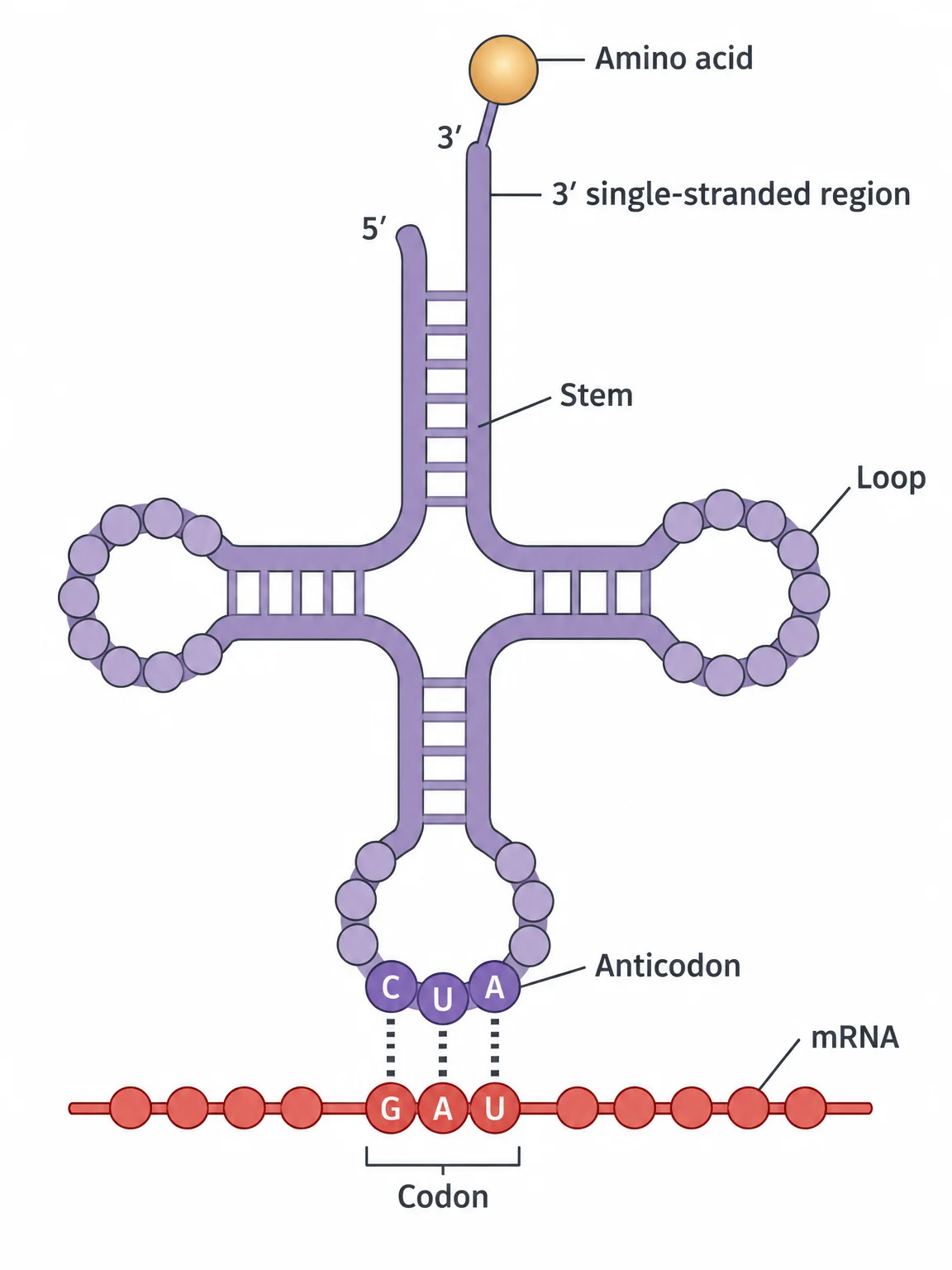
Each cell makes many different tRNAs, each coded by its own gene. A tRNA is named for the amino acid it carries: tRNAˢᵉʳ carries serine. Because serine has six codons, a cell makes more than one kind of tRNAˢᵉʳ.
Check yourselfA mutation changes the three bases in the loop of a tRNA’s middle stem-loop. Which of the tRNA’s jobs is most likely affected?
Loading tRNAs with amino acids
Before a tRNA can work, the right amino acid must be attached to its 3′ end. That’s the job of the aminoacyl-tRNA synthetases. A cell has 20 kinds, one for each amino acid, and each attaches its amino acid to every tRNA meant to carry it. The synthetase for alanine, for example, loads all of the alanine tRNAs.
Each synthetase uses energy from ATP to do this:
- A specific amino acid and an ATP bind to the enzyme.
- The amino acid is activated: AMP (ATP stripped down to one phosphate) is attached to it, and pyrophosphate is released.
- The amino acid is transferred to the 3′ end of the tRNA, and the AMP is released.
- The tRNA with its amino acid, now a charged tRNA (or aminoacyl tRNA), leaves the enzyme.
A synthetase recognizes the right tRNAs mainly by their anticodons, along with bases in other parts of the molecule. It almost never makes a mistake, and it has to be this accurate: matching amino acids to tRNAs is sometimes called the second genetic code.
Check yourselfSuppose a synthetase attached the wrong amino acid to some of its tRNAs. What would happen in the polypeptides the cell makes?
The wrong amino acid would be inserted wherever those tRNAs pair with their codons. The ribosome doesn’t check the amino acid, so the polypeptides would have errors in their sequence.
Practice questions
1 of 3
Translation factors are proteins that help translation along. Which list names their three groups?
2 of 3
How many kinds of aminoacyl-tRNA synthetase does a cell make?
3 of 3
Why does a cell make more than one kind of tRNA that carries serine?