Genes, proteins, and the central dogma
Chapter 11 showed how a cell copies its DNA before dividing. Storing and copying instructions is only half of the job, though. This chapter follows how a cell reads a gene and uses it to build a protein.
Genes carry the instructions for enzymes
The first clue to what genes do came from inherited diseases. Recall that a metabolic pathway is a chain of reactions, each step run by its own enzyme. In several inherited diseases, a mutation disables one enzyme in a pathway, so the molecule that enzyme should convert piles up in the body.
Phenylketonuria (PKU) is a familiar case. The enzyme that turns the amino acid phenylalanine into tyrosine doesn’t work, so phenylalanine builds up to harmful levels. That’s why diet sodas carry a warning for people with PKU.
Studies of mutants that couldn’t make a nutrient pointed the same way. Each mutant lacked one enzyme in the pathway, and it grew normally once it was fed a molecule made after the broken step. The conclusion was the one-gene/one-enzyme hypothesis: each gene carries the information to make one enzyme.
Check yourselfA mutant can’t make molecule D in the pathway A → B → C → D. It grows when given D, but not when given B or C. Which enzyme is missing?
One gene, one polypeptide
Later work kept the core of the hypothesis but revised it in four ways:
- Genes hold the information for all proteins, and many proteins aren’t enzymes at all.
- Some proteins are built from two or more different polypeptides. Hemoglobin, which carries oxygen in red blood cells, has two α-globin and two β-globin chains, so making it takes two genes.
- Some genes make more than one polypeptide, because their RNA can be cut and rejoined in different ways (alternative splicing, later in this chapter).
- Some genes never make a polypeptide. Their final product is an RNA molecule.
Check yourselfHemoglobin is built from two α-globin and two β-globin chains. How many genes does a cell need to make it, and why doesn’t it fit “one gene, one enzyme”?
Two genes, one for each kind of polypeptide. Hemoglobin breaks the old rule twice: one protein needs two genes, and it carries oxygen rather than acting as an enzyme.
The central dogma
Using the information in a gene to make a product is gene expression. For most genes it happens in two steps. First, the cell copies the gene’s DNA into RNA, a process called transcription. That copy is messenger RNA (mRNA), named for its job: carrying the gene’s message to the ribosomes, the polypeptide-building machines from Chapter 4.
Second, a ribosome reads the mRNA and links amino acids together in the order it spells out. Building a polypeptide from the information in mRNA is translation, the process Chapter 4 introduced.
The flow of information from DNA to RNA to protein is the central dogma of gene expression. It holds in bacteria, archaea, and eukaryotes alike. It is the usual direction rather than a law, though: some viruses, for example, use RNA as a template to make DNA.
Where each step happens
In bacteria, which have no nucleus, transcription and translation both take place in the cytoplasm. Eukaryotes keep their DNA in the nucleus, which separates the two steps and adds a third one between them. The first RNA a eukaryotic gene produces is a pre-mRNA, and it must be processed before it can be used. That processing is RNA modification.
- Transcription: in the nucleus, a gene is copied into pre-mRNA.
- RNA modification: still in the nucleus, the pre-mRNA is processed into a finished mRNA.
- Export: the mRNA leaves the nucleus through a nuclear pore.
- Translation: in the cytosol, ribosomes use the mRNA to build a polypeptide.
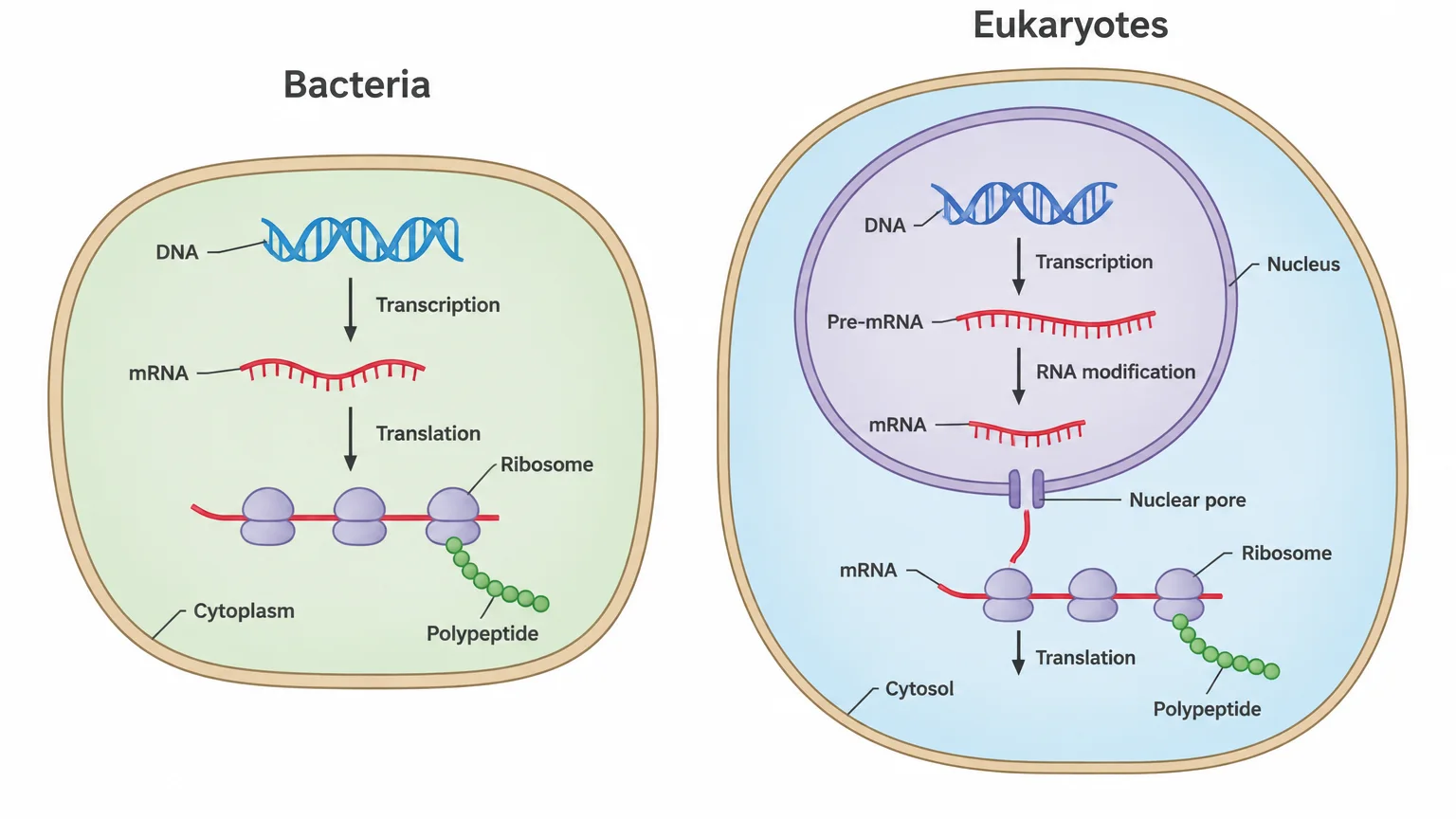
Check yourselfIn a eukaryotic cell, which steps of gene expression happen in the nucleus, and which happen in the cytosol?
Transcription and RNA modification happen in the nucleus. The finished mRNA then exits through a nuclear pore, and translation happens in the cytosol.
Proteins shape traits
Proteins do most of a cell’s work. They build its structures, speed up its reactions, carry signals, and move materials across membranes. So the set of proteins a cell makes largely decides what the cell is like, and the activity of cells decides an organism’s traits.
A typical bacterium makes a few thousand kinds of proteins, and a human makes tens of thousands. Each must be made in the right cells, at the right time, and in the right amounts. Controlling that is gene regulation, the subject of a later chapter.
Practice questions
1 of 3
Some viruses use an RNA molecule as a template to build DNA. How does this relate to the central dogma?
2 of 3
Hemoglobin is built from two α-globin and two β-globin chains, and each kind of chain is coded by a different gene. Which revision of the one-gene/one-enzyme idea does it show?
3 of 3
A mold makes nutrient Z through the pathway W → X → Y → Z, with a different enzyme for each step. A mutant mold grows when given Y or Z, but not when given W or X. Which step is blocked?