Eukaryotic transcription and the ends of mRNA
Eukaryotes transcribe their genes in the same three stages as bacteria: initiation, elongation, and termination. The differences are in the crew. More proteins are needed to start, and the RNA that comes off a protein-coding gene needs finishing work before it can leave the nucleus.
Three RNA polymerases
A bacterium has a single RNA polymerase that transcribes all of its genes. Many bacterial species do have several sigma factors, though, each recognizing a different set of promoters.
Eukaryotes divide the work among three RNA polymerases, numbered I, II, and III:
- RNA polymerase II transcribes protein-coding genes, so it makes every pre-mRNA.
- RNA polymerases I and III transcribe the genes for non-coding RNAs, such as tRNAs and rRNAs.
Transcription factors replace sigma factor
Eukaryotes have no sigma factor. Instead, RNA polymerase II relies on transcription factors, the proteins from Chapter 9 that control whether a gene is transcribed. Six of them are needed to start transcription at a protein-coding gene.
The six transcription factors and RNA polymerase II assemble at the promoter into a large preinitiation complex. Once it has formed, the complex unwinds a short stretch of DNA into an open complex, and elongation proceeds as in bacteria.
| Feature | Bacteria | Eukaryotes |
|---|---|---|
| Where it happens | Cytoplasm | Nucleus |
| RNA polymerases | One | Three (I, II, III) |
| Finding the promoter | Sigma factor | Six transcription factors |
| Stages | Initiation, elongation, termination | The same three |
Check yourselfIn eukaryotes, what does the job that sigma factor does in bacteria?
Transcription factors. Six of them assemble with RNA polymerase II at the promoter into a preinitiation complex, which positions the polymerase to begin transcription.
Finishing the pre-mRNA
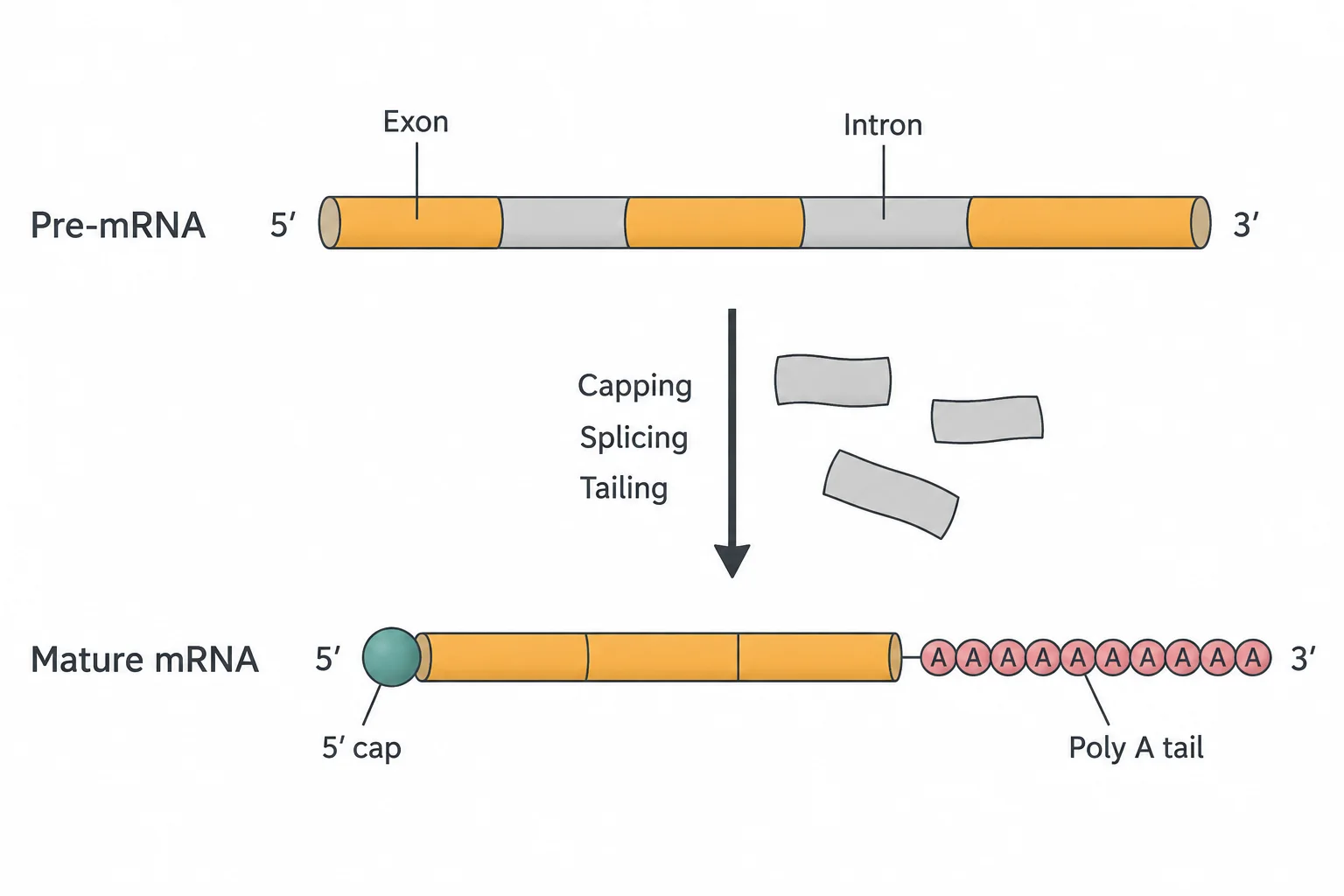
The RNA that RNA polymerase II makes is a pre-mRNA, and it isn’t ready to use. Three modifications, all made in the nucleus, turn it into a mature mRNA, which then leaves for the cytosol.
| Change | Where | What happens |
|---|---|---|
| Capping | 5′ end | A modified guanine nucleotide is attached |
| Tailing | 3′ end | A long string of adenine nucleotides is added |
| Splicing | Middle | Internal pieces are cut out, and the rest is joined |
The 5′ cap
Capping happens early, while RNA polymerase is still transcribing. An enzyme attaches a guanine nucleotide, modified with a methyl group, to the 5′ end of the RNA. This 7-methylguanosine is the 5′ cap. Proteins called cap-binding proteins recognize it, and through them the cap does three jobs:
- It lets the mRNA exit the nucleus properly.
- It protects the mRNA from being broken down once it’s in the cytosol.
- It lets the mRNA bind to a ribosome so it can be translated.
Check yourselfAn uncapped mRNA is injected straight into the cytosol of a eukaryotic cell. Will it be translated normally?
No. Without a cap, cap-binding proteins can’t bring the mRNA to a ribosome, and the mRNA would also be broken down faster.
The poly A tail
Most mature mRNAs end in a string of 100–200 adenine nucleotides at their 3′ end, the poly A tail. The tail isn’t spelled out in the gene. An enzyme adds the adenines one after another once the pre-mRNA has been fully transcribed, without reading any template.
The poly A tail has two jobs. It helps the mRNA leave the nucleus, and it stabilizes the mRNA so that it lasts longer in the cytosol.
Check yourselfCompare a mature mRNA with the DNA of its gene. What at the mRNA’s 3′ end has no match in the gene?
The poly A tail. An enzyme adds its adenines to the pre-mRNA after transcription, without a template, so the gene never codes them.
Practice questions
1 of 2
What two jobs does the poly A tail do for a eukaryotic mRNA?
2 of 2
Which feature of transcription is the same in bacteria and eukaryotes?