The genetic code
An mRNA spells its message with four bases, but a polypeptide is built from 20 kinds of amino acids. Translation needs a rule for converting one into the other, and that rule is the same in nearly every living thing.
Reading in threes
A ribosome reads mRNA three bases at a time. Each group of three is a codon, and most codons stand for one particular amino acid: CCC means proline, and GGC means glycine. The full set of rules linking codons to amino acids is the genetic code.
Features of the code
With 64 codons and only 20 amino acids, most amino acids have more than one codon. Glycine, for example, is coded by GGU, GGC, GGA, and GGG. Because several codons can mean the same thing, the code is called degenerate. Usually the codons for one amino acid differ only in their third base.
The code is also nearly universal. Bacteria, plants, fungi, and people all read codons the same way, so AUG means methionine in all of them. Only a few rare exceptions are known.
Three kinds of codons control translation:
| Codon kind | Codons | Meaning |
|---|---|---|
| Start | AUG | Methionine, and the place translation begins |
| Stop | UAA, UAG, UGA | End of translation; no amino acid |
| All others | 60 codons | One amino acid each |
The start codon, AUG, does double duty: it begins every polypeptide and also codes methionine wherever it appears later in the message. The three stop codons, also called termination codons, code no amino acid at all.
Check yourselfOf the 64 codons, how many specify an amino acid?
- All 64 codons minus the three stop codons, which code no amino acid. AUG counts among the 61 because it codes methionine.
How an mRNA is laid out
A bacterial mRNA has four regions that matter for translation, in this order from its 5′ end:
- The ribosomal-binding site, near the 5′ end, where the ribosome attaches to the mRNA.
- The start codon, usually just a few nucleotides past the ribosomal-binding site.
- The coding sequence, the run of codons from the start codon onward that specifies the whole polypeptide. A typical polypeptide is a few hundred amino acids long.
- A stop codon, which ends translation.
The stretches before the start codon and after the stop codon are never translated. They are the 5′ and 3′ untranslated regions (UTRs).
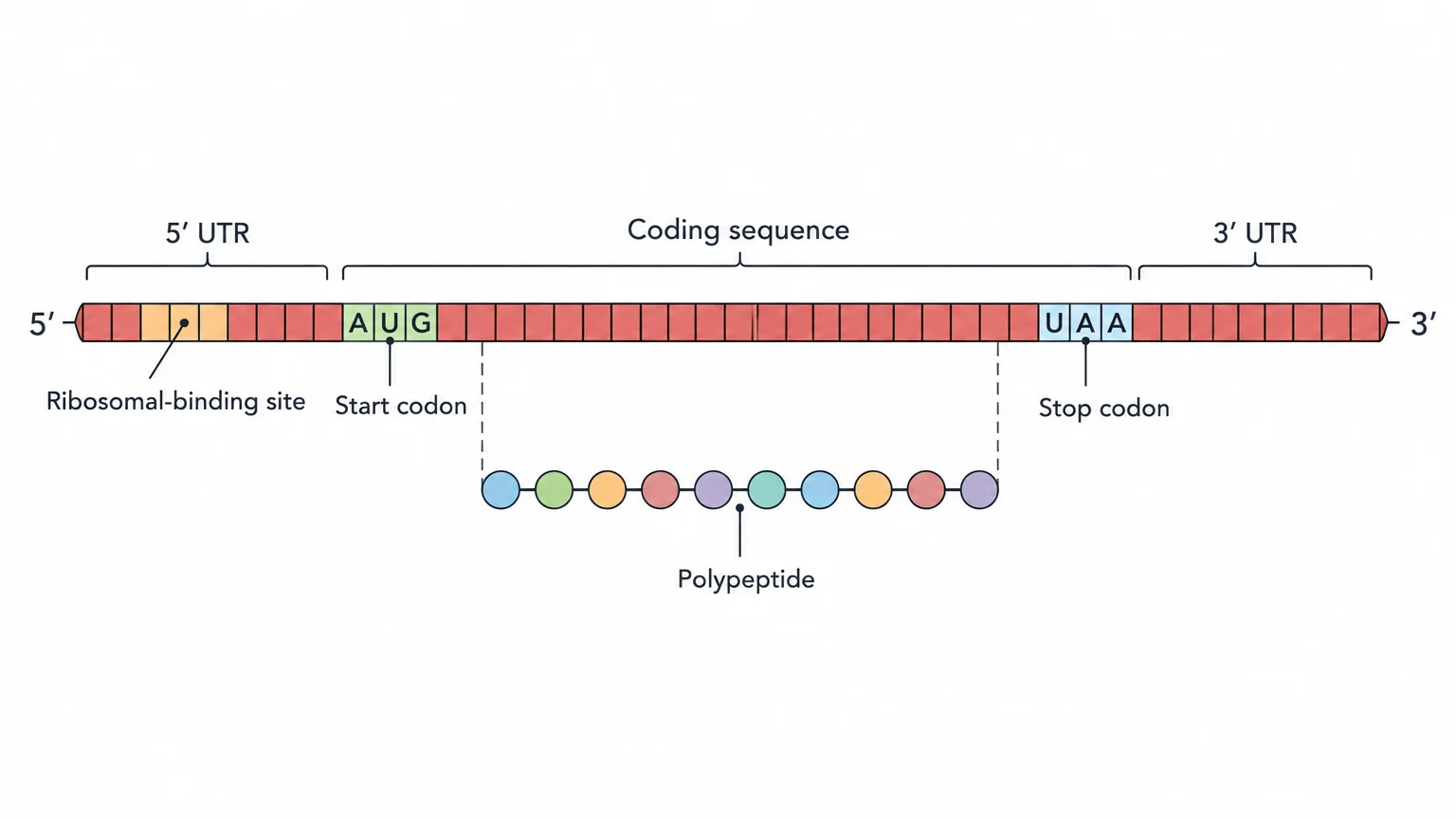
Start and stop signals for transcription and for translation are easy to mix up, because each process has its own pair.
| Signal | Found in | Marks |
|---|---|---|
| Promoter | DNA | Where transcription starts |
| Terminator | DNA | Where transcription ends |
| Start codon | mRNA | Where translation starts |
| Stop codon | mRNA | Where translation ends |
Check yourselfA mutation turns the 40th codon of a gene into UAG. Is the gene still transcribed, and how long is the polypeptide?
Transcription is unaffected: the whole gene is still copied into mRNA. Translation stops at the new stop codon, so the polypeptide is only 39 amino acids long.
The reading frame
The start codon also sets the reading frame, the way the message is divided into codons. From AUG onward, the ribosome reads one triplet after another in the 5′ → 3′ direction. The frame doesn’t overlap: each base belongs to exactly one codon.
Because the frame is fixed at the start, adding or removing a single base shifts every codon after it.
Practice questions
1 of 4
Why couldn’t the genetic code use codons only two bases long?
2 of 4
Of the 64 codons in the genetic code, how many specify an amino acid?
3 of 4
Which part of an mRNA sets its reading frame, the way the message is divided into codons?
4 of 4
Which amino acid does the start codon, AUG, specify?