The ribosome
The ribosome is where mRNA and charged tRNAs meet and amino acids are linked into a chain. It is often called a molecular machine, and it is built from both RNA and protein.
Two subunits of RNA and protein
Every ribosome is made of two ribosomal subunits, one small and one large. The word “subunit” undersells them: each is itself assembled from many different proteins and one or more rRNA molecules. The rRNA forms a scaffold that the ribosomal proteins bind to. When a ribosome isn’t translating, its two subunits drift apart.
Bacteria have a single kind of ribosome, which translates every mRNA in the cytoplasm. Eukaryotic cells have more than one kind. Most of their ribosomes work in the cytosol, but mitochondria have their own ribosomes, and so do the chloroplasts of plants and algae. “Eukaryotic ribosome” here means the cytosolic kind.
Where ribosomes are built also differs:
- In bacteria, ribosomal proteins and rRNAs are made in the cytoplasm, and the subunits are assembled there.
- In eukaryotes, rRNAs are made in the nucleolus. Ribosomal proteins are made in the cytosol and imported into the nucleus, where they join the rRNAs in the nucleolus to form the two subunits. The subunits are exported separately to the cytosol and come together only when they start translating an mRNA.
Check yourselfIn a eukaryotic cell, where are the ribosomal subunits assembled, and where do the two subunits come together?
They’re assembled in the nucleolus, inside the nucleus. They’re exported to the cytosol separately and join into a complete ribosome there, when translation begins.
Bacterial and eukaryotic ribosomes
Ribosomes and their subunits are named by how fast they settle when spun in a centrifuge, measured in Svedberg units (S). A larger number means a bigger, faster-settling particle. Eukaryotic ribosomes are a bit larger than bacterial ones.
| Part | Bacteria | Eukaryotes |
|---|---|---|
| Small subunit | 30S, one rRNA (16S) | 40S, one rRNA (18S) |
| Large subunit | 50S, two rRNAs (5S, 23S) | 60S, three rRNAs (5S, 5.8S, 28S) |
| Whole ribosome | 70S | 80S |
Three sites for tRNA
During translation, the mRNA lies on the small subunit, in the space between the two subunits. The growing polypeptide leaves through a tunnel in the large subunit. Between them, the ribosome has three pockets where tRNAs bind, lined up along the mRNA:
| Site | Full name | Holds |
|---|---|---|
| A site | Aminoacyl site | A charged tRNA bringing the next amino acid |
| P site | Peptidyl site | The tRNA attached to the growing polypeptide |
| E site | Exit site | An empty tRNA on its way out of the ribosome |
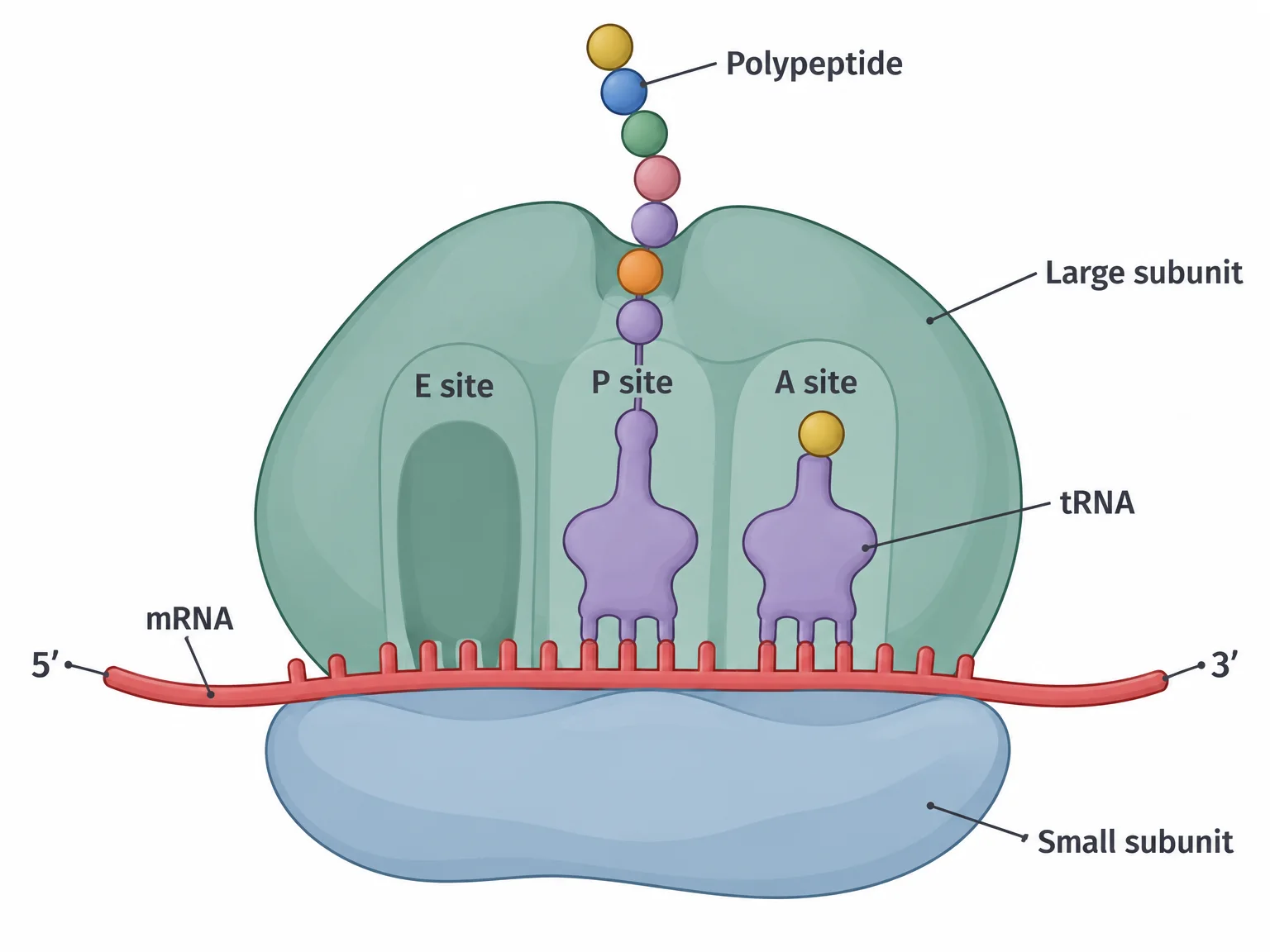
Check yourselfWhich ribosomal site does a newly arriving charged tRNA enter, and which site does an empty tRNA leave from?
A record of shared ancestry
The machinery of translation arose very early in the history of life, so every living species has related versions of it. The gene for the small subunit’s rRNA is found in all organisms. Comparing its sequence between species reveals how closely they are related: the more similar the sequences, the more recently the species shared an ancestor.
Practice questions
1 of 4
What are the small and large ribosomal subunits each made of?
2 of 4
Where in a eukaryotic cell are rRNAs made and joined with ribosomal proteins to form the two subunits?
3 of 4
From which ribosomal site does an empty tRNA leave the ribosome?
4 of 4
Why is the gene for small subunit rRNA useful for comparing species as different as people and bacteria?