Codons meet anticodons
The genetic code says which amino acid each codon stands for, but a ribosome can’t look anything up in a table. The match is made physically, by base pairing between the mRNA and a set of small adapter molecules, the tRNAs.
From gene to polypeptide
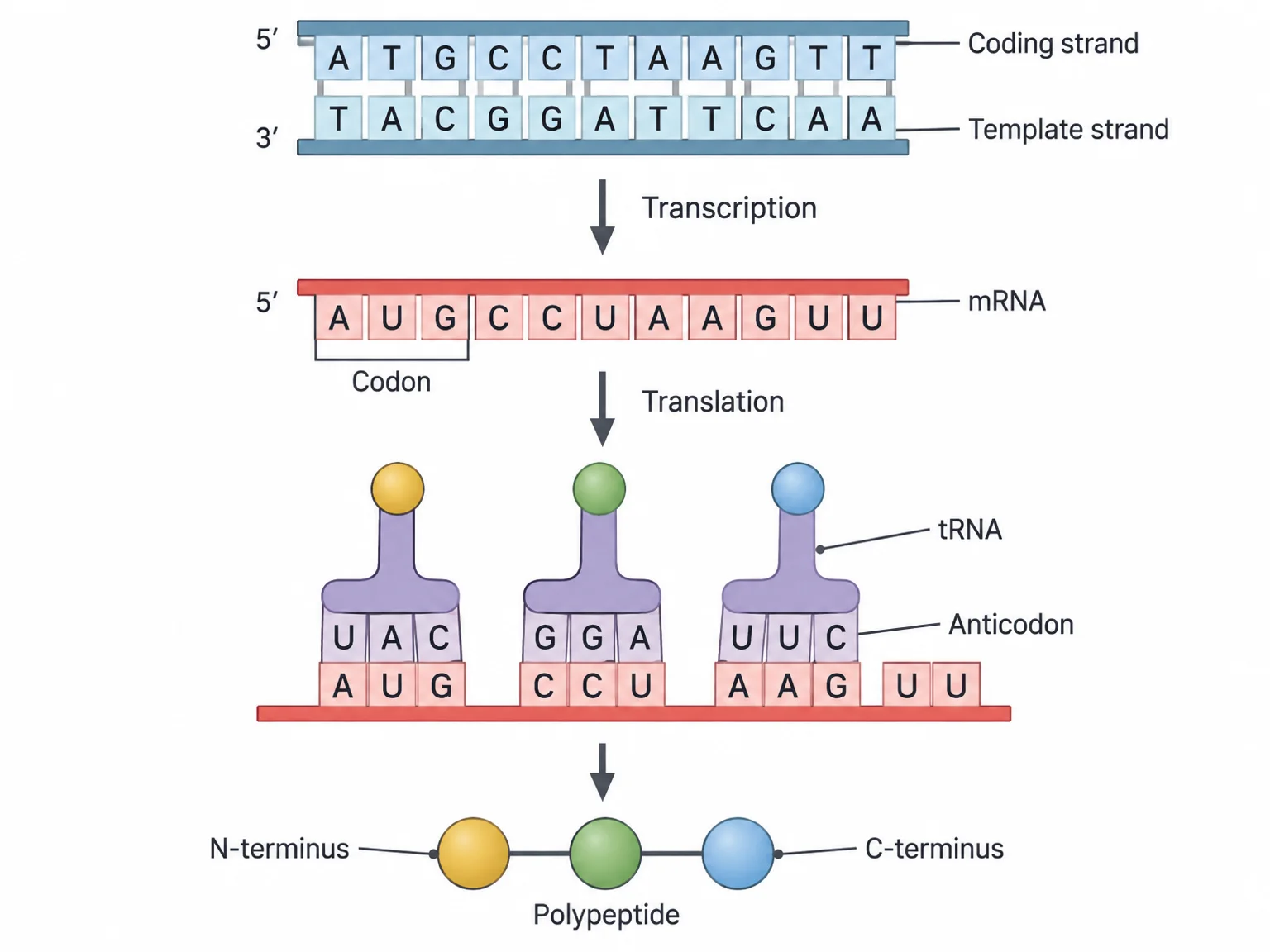
DNA is the long-term store of a gene’s information. The mRNA is a temporary working copy, and it is the copy the cell uses directly to build a polypeptide.
The template strand of the gene is used to make the mRNA, so the mRNA has the same sequence as the coding strand, with U in place of T. At each end of the mRNA is an untranslated region. In between lies the series of codons, and each codon is matched by a tRNA that brings one amino acid.
Anticodons
Each tRNA has a three-base sequence, the anticodon, that is complementary to one codon. Because they’re complementary, the anticodon and codon base-pair with each other, and like the two strands of DNA they pair antiparallel.
The anticodon also determines which amino acid the tRNA should carry. A tRNA whose anticodon pairs with a UUC codon carries phenylalanine, because UUC codes phenylalanine. So each time a tRNA pairs with a codon, it delivers the amino acid that codon specifies.
Check yourselfA mutant tRNA still carries glutamine, but its anticodon now pairs with the stop codon UAG. What happens to polypeptides whose genes end in UAG?
They don’t always stop there. The mutant tRNA can insert glutamine at UAG, so some polypeptides keep growing past their normal end. The ribosome checks only the codon–anticodon pairing, not the amino acid.
The direction of a polypeptide
A polypeptide is built in the same order that the mRNA is read, 5′ → 3′. Recall from Chapter 3 that a polypeptide’s two ends differ: the N-terminus has a free amino group, and the C-terminus has a free carboxyl group. The first amino acid, coded by the codon nearest the mRNA’s 5′ end, sits at the N-terminus. Each new amino acid is joined to the carboxyl group of the chain, so the last one sits at the C-terminus.
Check yourselfOne codon sits near an mRNA’s 5′ end and another near its 3′ end. Which one’s amino acid ends up nearer the C-terminus?
The codon near the 3′ end. Translation reads 5′ → 3′ and adds each new amino acid to the carboxyl end of the chain, so later codons land nearer the C-terminus.
Practice questions
1 of 3
What is the three-base sequence on a tRNA that pairs with a codon in mRNA called?
2 of 3
An anticodon is written 5′–GCC–3′. Which codon does it pair with?
3 of 3
In a finished polypeptide, where is the amino acid coded by the last codon before the stop codon?