The four stages at a glance
Cells don’t break down glucose in a single reaction. They pass it through four linked pathways, each in a particular part of the cell, and each stage hands its products to the next.
Where respiration happens
In eukaryotic cells (cells with a nucleus, like yours), the first stage takes place in the cytosol, the fluid that fills the cell around its organelles. The other three take place in mitochondria (singular, mitochondrion), the organelles that make most of the cell’s ATP.
A mitochondrion has two membranes. The outer membrane is smooth. The inner membrane folds back and forth into projections called cristae (singular, crista). The folds pack far more inner membrane into the same space, and since the final stage of respiration runs on that membrane, more membrane means more ATP.
The two membranes create two compartments:
- the intermembrane space, the narrow gap between the outer and inner membranes
- the mitochondrial matrix, the fluid-filled space enclosed by the inner membrane
Bacteria and archaea have no mitochondria. They run the final stage on their plasma membrane, the membrane that surrounds the whole cell.
Four stages in order
Each stage is a metabolic pathway, a series of chemical reactions in which each step is run by its own enzyme (a protein that speeds up one specific reaction).
- Glycolysis (cytosol). Glucose, a sugar with six carbons, is split into two molecules of pyruvate, with three carbons each. Net gain: 2 ATP and 2 NADH.
- Breakdown of pyruvate (mitochondrial matrix). Each pyruvate loses one carbon as CO₂. The two-carbon piece that remains, an acetyl group, is attached to a carrier molecule. Each pyruvate also yields 1 NADH.
- Citric acid cycle (mitochondrial matrix). Each acetyl group enters a loop of reactions that releases two carbons as CO₂ and loads electrons onto NADH and FADH₂. Each turn of the loop also makes 1 ATP.
- Oxidative phosphorylation (inner mitochondrial membrane). NADH and FADH₂ hand over their high-energy electrons, and the energy released drives the production of most of the cell’s ATP, up to 30–34 per glucose.
Notice the division of labor. The first three stages take glucose apart and collect its electrons on NADH and FADH₂; the fourth spends those electrons to make ATP.
Two ways to make ATP
The stages make ATP in two different ways.
In substrate-level phosphorylation, an enzyme moves a phosphate group directly from an organic molecule onto ADP, making ATP in a single reaction. (A substrate is a molecule an enzyme acts on; here, both the phosphate donor and ADP are substrates.) Glycolysis and the citric acid cycle make their ATP this way.
Oxidative phosphorylation is indirect, and it makes far more ATP. It has two parts:
- Electrons from NADH and FADH₂ pass along the electron transport chain, a series of proteins and small molecules in the inner mitochondrial membrane. The energy they release is used to pump hydrogen ions (H⁺) across the membrane, crowding them onto one side. The result is an H⁺ electrochemical gradient, a difference in both H⁺ concentration and electric charge across the membrane.
- The H⁺ ions flow back across the membrane through an enzyme, ATP synthase, that captures their energy to make ATP from ADP and Pᵢ. Making ATP with the energy of an H⁺ gradient is called chemiosmosis.
The name describes both parts: NADH and FADH₂ are oxidized (they lose electrons), and ADP is phosphorylated (it gains a phosphate).
Adding up one glucose
| Stage | Where (eukaryotes) | Starts with | Produces, per glucose |
|---|---|---|---|
| Glycolysis | Cytosol | 1 glucose | 2 pyruvate, 2 ATP (net), 2 NADH |
| Breakdown of pyruvate | Mitochondrial matrix | 2 pyruvate | 2 acetyl groups, 2 CO₂, 2 NADH |
| Citric acid cycle | Mitochondrial matrix | 2 acetyl groups | 4 CO₂, 2 ATP, 6 NADH, 2 FADH₂ |
| Oxidative phosphorylation | Inner mitochondrial membrane | 10 NADH, 2 FADH₂, O₂ | Up to 30–34 ATP, H₂O |
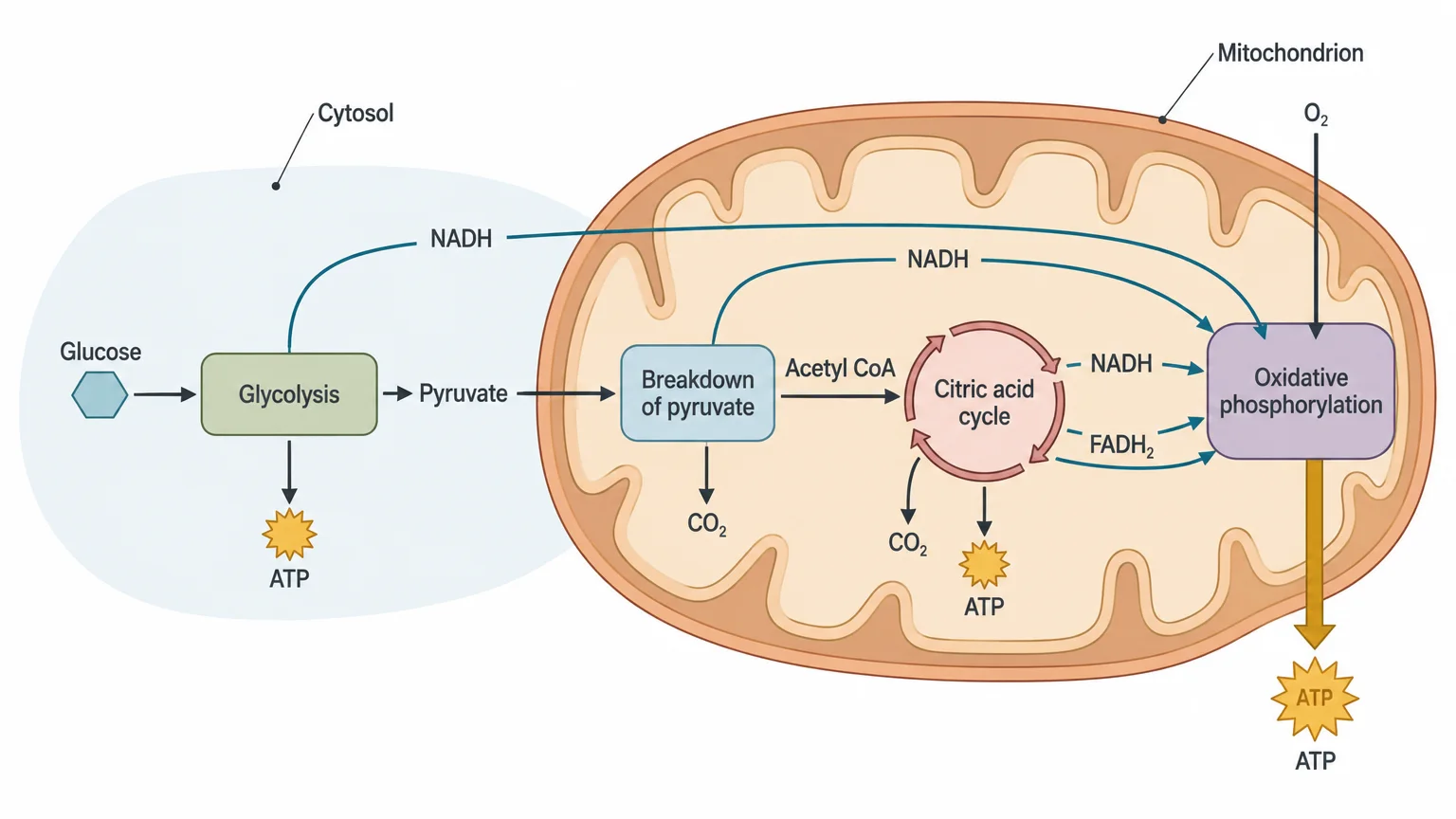
By the end of the first three stages, all six carbons of glucose have left as 6 CO₂. The cell has only 4 ATP to show for it, but it has loaded 10 NADH and 2 FADH₂ with high-energy electrons. The final stage cashes those in.
Check yourselfWhich stage makes the most ATP, and where does it happen?
Oxidative phosphorylation, which can make 30–34 ATP per glucose. In eukaryotes it happens along the inner mitochondrial membrane; in bacteria and archaea, along the plasma membrane.
Practice questions
1 of 2
The inner mitochondrial membrane is folded into many cristae. How do these folds help a mitochondrion make more ATP?
2 of 2
Bacteria have no mitochondria. Where do they carry out oxidative phosphorylation?