Proteins and fats as fuel
A meal contains more than glucose. Its proteins and fats are fuel too, and cells break them down using the same pathways they use for sugar.
One set of pathways for every fuel
Proteins and fats are first broken into smaller molecules. Those molecules then enter glycolysis or the citric acid cycle at different points, depending on their structure. From there, they follow the same route as glucose, ending with oxidative phosphorylation.
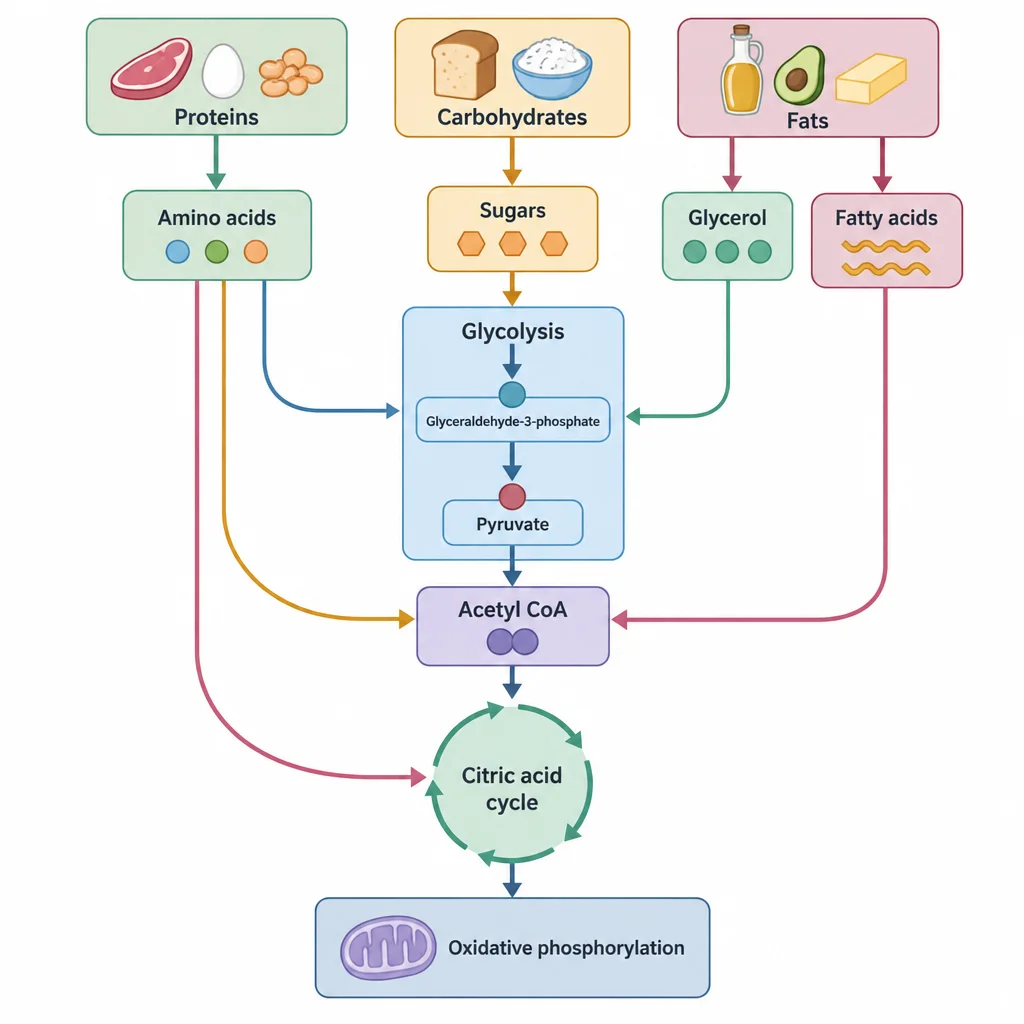
Sharing pathways makes respiration efficient. Enzymes are proteins, and building each one costs the cell energy. Because one set of enzymes handles sugars, amino acids, and fats, the cell doesn’t have to make a separate set for each fuel.
Proteins
Proteins are chains of amino acids. Enzymes in digestive juices or inside cells first snip the bonds that hold the amino acids together. The 20 kinds of amino acids differ in their side chains, the part that varies from one amino acid to the next. Because of those differences, amino acids enter respiration at different points:
- Breakdown products of some amino acids enter glycolysis at later steps.
- From others, an acetyl group is removed, attached to CoA, and sent into the citric acid cycle as acetyl CoA.
- Still others are modified and enter the citric acid cycle directly.
Fats
A fat molecule is built from glycerol, a small three-carbon molecule, joined to fatty acids, long chains of carbon and hydrogen. Cells first split fats into these two parts, and each part goes its own way:
- Glycerol is converted to glyceraldehyde-3-phosphate, the three-carbon molecule made in the cleavage phase of glycolysis, and continues through the rest of glycolysis.
- Fatty acids are taken apart two carbons at a time. Each two-carbon acetyl unit attaches to CoA and enters the citric acid cycle as acetyl CoA.
| Fuel | Broken down into | Where the pieces enter |
|---|---|---|
| Carbohydrates | Sugars such as glucose | Start of glycolysis |
| Proteins | Amino acids | Later steps of glycolysis, as acetyl CoA, or directly into the citric acid cycle |
| Fats | Glycerol and fatty acids | Glycerol: glycolysis, as glyceraldehyde-3-phosphate. Fatty acids: citric acid cycle, as acetyl CoA |
Check yourselfWhat advantage do cells gain by breaking down carbohydrates, proteins, and fats through the same pathways?
Check yourselfWhere do the pieces of a fatty acid enter cellular respiration?
Fatty acids are cut into two-carbon acetyl units that attach to CoA. They enter the citric acid cycle as acetyl CoA, skipping glycolysis and pyruvate breakdown.
Practice questions
1 of 2
Cells break down sugars, fats, and proteins using many of the same pathways and enzymes. What is the main advantage of this arrangement?
2 of 2
Before a protein from food can be used as fuel for cellular respiration, what must happen first?