Making ATP without oxygen
Oxygen isn’t always available. Microbes in deep soil or in your intestines live without it, and your muscles can run short of it during a hard sprint. Cells have two ways to keep making ATP when oxygen is missing.
Two strategies
An environment that lacks oxygen is anaerobic. Many bacteria and archaea, and some fungi, live in anaerobic places. Your muscle cells can become anaerobic during strenuous exercise, especially at the start, when they use oxygen faster than the blood delivers it.
Cells cope with a lack of oxygen in one of two ways:
- Anaerobic respiration uses a substance other than O₂ as the final electron acceptor of the electron transport chain.
- Fermentation makes ATP by substrate-level phosphorylation alone, without any net oxidation of the organic molecules being broken down.
Anaerobic respiration: a stand-in for oxygen
In aerobic respiration, cytochrome oxidase at the end of the electron transport chain hands electrons to O₂, reducing it to water. Many bacteria that live without oxygen have chain proteins that work in a similar way but hand the electrons to a different molecule.
Escherichia coli (E. coli), a bacterium that lives in your intestines, is an example. Without oxygen, it makes nitrate reductase, an enzyme that uses nitrate (NO₃⁻) as the final electron acceptor and converts it to nitrite (NO₂⁻).
Bacteria have no mitochondria, so the chain sits in E. coli’s plasma membrane. Electrons travel from NADH to NADH dehydrogenase, then to ubiquinone, then to cytochrome b, and finally to nitrate reductase.
This chain builds an H⁺ gradient across the plasma membrane in three ways:
- NADH dehydrogenase pumps H⁺ out of the cytoplasm, the cell’s interior.
- Ubiquinone picks up H⁺ inside the cell and carries it to the other side of the membrane.
- Converting nitrate to nitrite uses up H⁺ inside the cell.
As in mitochondria, H⁺ flowing back in through ATP synthase makes ATP by chemiosmosis.
Fermentation and the NAD⁺ problem
Animals and yeast can use only O₂ as the final electron acceptor. Without oxygen, their electron transport chain and citric acid cycle stop, and glycolysis becomes their only source of ATP.
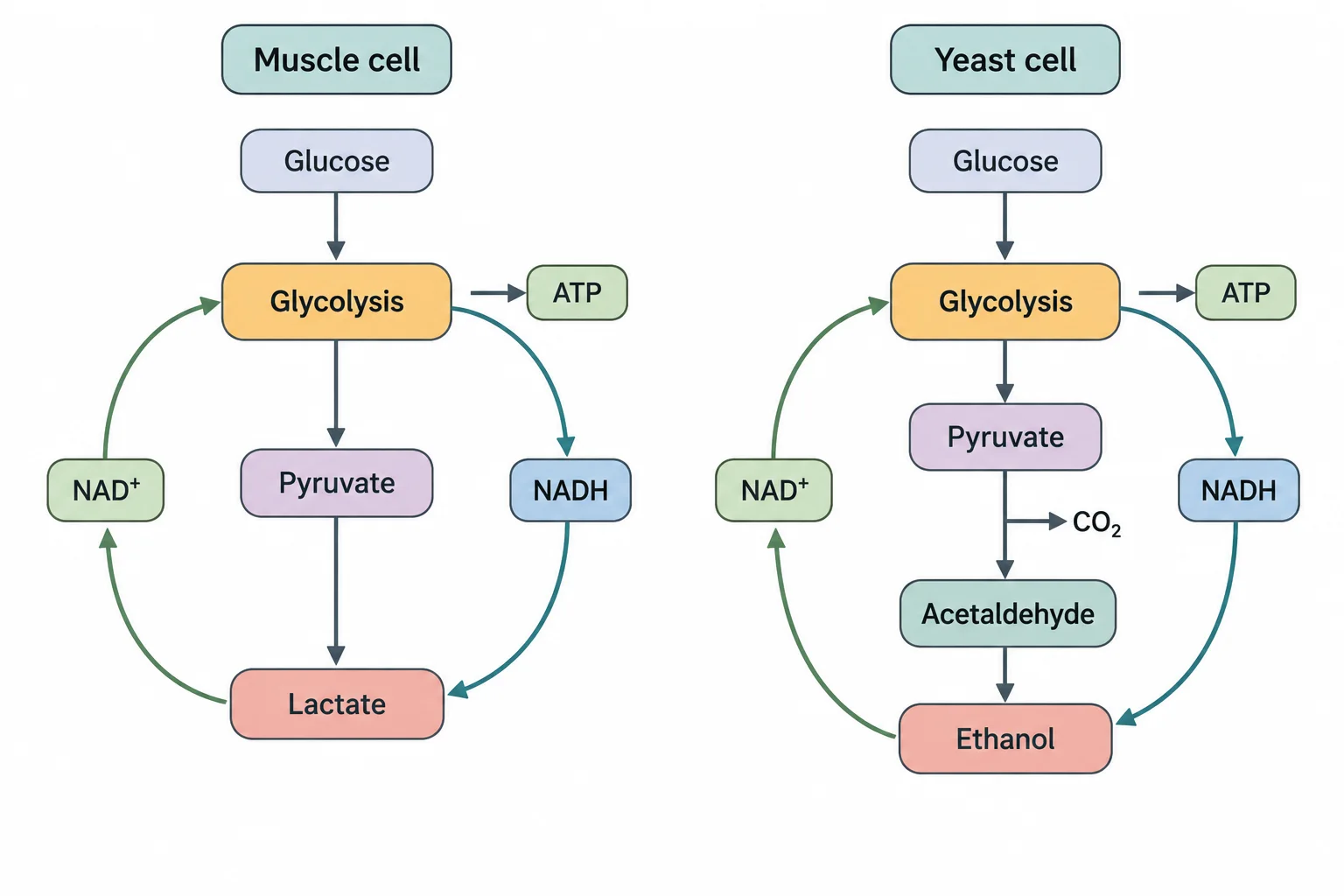
That creates a problem. Glycolysis uses up NAD⁺ and produces NADH, and normally the electron transport chain turns NADH back into NAD⁺. Without the chain, NADH piles up and NAD⁺ runs low. Both are harmful:
- Excess NADH starts dumping electrons onto whatever molecules are nearby. That creates free radicals, unstable, highly reactive chemicals that damage DNA and proteins.
- Without NAD⁺, glycolysis stops, taking the cell’s last source of ATP with it.
Lactate in muscle, ethanol in yeast
- Muscle cells reduce pyruvate to lactate, using electrons from NADH, which becomes NAD⁺. (Lactic acid is the uncharged form of lactate.) Muscle cells release the lactate. Once oxygen is back, cells can take it up, convert it to pyruvate, and use it for energy, or the liver and other tissues can use it to make glucose.
- Yeast cells first break pyruvate into CO₂ and a two-carbon molecule, acetaldehyde. NADH then reduces acetaldehyde to ethanol and becomes NAD⁺. Yeast fermentation is used to make wine, beer, and bread.
Why fermentation earns so little
Fermentation gets energy from organic molecules without any net oxidation, meaning no electrons are removed overall. Electrons are taken from glucose during glycolysis, but they end up back on an organic molecule, lactate or ethanol.
Fermentation yields only 2 ATP per glucose, compared with up to 34–38 for aerobic respiration. Glucose isn’t broken down all the way to CO₂ and water, and the NADH from glycolysis can’t be used to make more ATP.
| Aerobic respiration | Anaerobic respiration | Fermentation | |
|---|---|---|---|
| Where the electrons end up | O₂, forming water | Another substance, such as nitrate | An organic molecule (forming lactate or ethanol) |
| Uses the ETC and ATP synthase? | Yes | Yes | No |
| How ATP is made | Substrate-level phosphorylation and chemiosmosis | Substrate-level phosphorylation and chemiosmosis | Substrate-level phosphorylation in glycolysis only |
Practice questions
1 of 2
Bread dough rises because the yeast in it ferment sugar. Which product of yeast fermentation makes the dough rise?
2 of 2
Why can a person’s muscle cells become anaerobic at the start of a hard sprint?