Pyruvate breakdown and the citric acid cycle
After glycolysis, most of glucose’s energy is still locked inside the two pyruvates. The next two stages, both in the mitochondrial matrix, take pyruvate apart completely: its carbon leaves as CO₂, and its electrons are loaded onto NADH and FADH₂.
Pyruvate becomes acetyl CoA
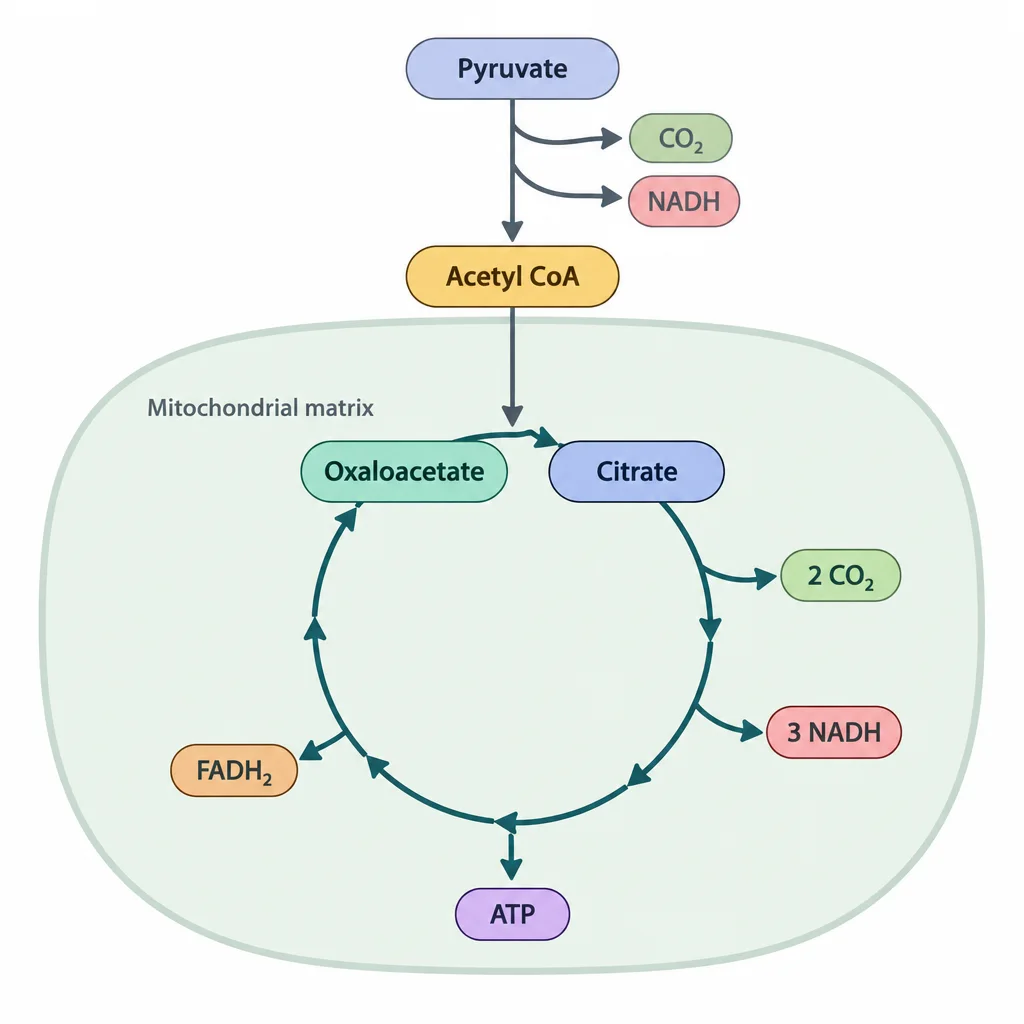
Pyruvate is made in the cytosol, so it first has to be carried into the mitochondrion and on into the matrix. There, a large enzyme complex called pyruvate dehydrogenase breaks it down. (Enzymes named dehydrogenase remove electrons, along with hydrogen, from a molecule.) Three things happen to each pyruvate:
- One carbon is removed and released as CO₂.
- Two high-energy electrons are removed and passed, with an H⁺, to NAD⁺, making NADH.
- The remaining two-carbon acetyl group is attached to coenzyme A (CoA), an organic carrier molecule, forming acetyl CoA. The acetyl group is held by a covalent bond (a strong bond in which atoms share electrons) to a sulfur atom in CoA.
How a metabolic cycle works
Glycolysis runs in a straight line: glucose goes in at one end and pyruvate comes out the other. The third stage is different. It’s a metabolic cycle, a pathway in which some molecules enter and others leave, while a series of organic molecules is rebuilt with every turn. Because those molecules are regenerated, the cycle can run over and over.
This one is the citric acid cycle, also called the Krebs cycle. It’s named for citric acid, or citrate, the first molecule each turn produces. Every turn starts and ends with the same four-carbon molecule, oxaloacetate.
One turn of the cycle
Each turn takes in one acetyl group and runs through eight enzyme-driven steps. In outline:
- The acetyl group (two carbons) is transferred from CoA to oxaloacetate (four carbons), forming citrate (six carbons).
- Over the next several steps, the molecule is rearranged and oxidized. Two carbons leave as two CO₂, balancing the two that the acetyl group brought in.
- The electrons removed along the way reduce 3 NAD⁺ to 3 NADH and 1 FAD to FADH₂.
- One step makes GTP (guanosine triphosphate, a close relative of ATP) by substrate-level phosphorylation. The GTP is then used to make ATP.
- By the end of the eighth step, oxaloacetate is regenerated, ready to accept the next acetyl group.
One glucose makes two pyruvates, so it supplies two acetyl groups and drives two turns of the cycle. Exam questions may ask about either one turn or one glucose, so check which before you count:
| Product | Per turn (one acetyl group) | Per glucose (two turns) |
|---|---|---|
| CO₂ | 2 | 4 |
| NADH | 3 | 6 |
| FADH₂ | 1 | 2 |
| ATP (made via GTP) | 1 | 2 |
Building blocks and brakes
The citric acid cycle does more than release energy. Its intermediate molecules also serve as raw materials for building other molecules the cell needs, including some amino acids, the bases found in nucleotides, and certain lipids. For example, α-ketoglutarate is used to make the amino acid glutamic acid, and oxaloacetate is used to make aspartic acid.
Two things set the cycle’s pace: how much of its substrates (such as acetyl CoA and NAD⁺) is on hand, and feedback inhibition. Three of its steps release especially large amounts of energy, and each can become rate-limiting: the steps run by citrate synthase, isocitrate dehydrogenase, and α-ketoglutarate dehydrogenase.
In mammals, for example, NADH and ATP inhibit isocitrate dehydrogenase, while NAD⁺ and ADP activate it. High NADH and ATP signal that the cell is well stocked with energy, so the cycle slows. High NAD⁺ and ADP signal that energy is running low, so the cycle speeds up.
Check yourselfHow many turns of the citric acid cycle does one glucose drive, and what do they produce in total?
Practice questions
1 of 2
One glucose molecule yields two pyruvates, and both are broken down in the mitochondrial matrix. How much CO₂ and NADH does this step produce in total?
2 of 2
A cell breaks down one glucose molecule completely. Counting only the citric acid cycle, how many NADH and FADH₂ does it make?