The electron transport chain
By the end of the citric acid cycle, all six carbons of glucose have left as CO₂, yet the cell has made only 4 ATP. Most of glucose’s energy now rides on the high-energy electrons carried by 10 NADH and 2 FADH₂. Oxidative phosphorylation turns those electrons into ATP.
Two events, one process
Oxidative phosphorylation takes place along the inner mitochondrial membrane, and it has two parts:
- The electron transport chain (ETC) strips electrons from NADH and FADH₂ and uses their energy to pump H⁺ across the membrane, building up an H⁺ gradient.
- ATP synthase, an enzyme in the same membrane, lets the H⁺ flow back and uses that flow to make ATP from ADP and Pᵢ.
The name covers both parts: NADH and FADH₂ are oxidized, and ADP is phosphorylated.
Members of the chain
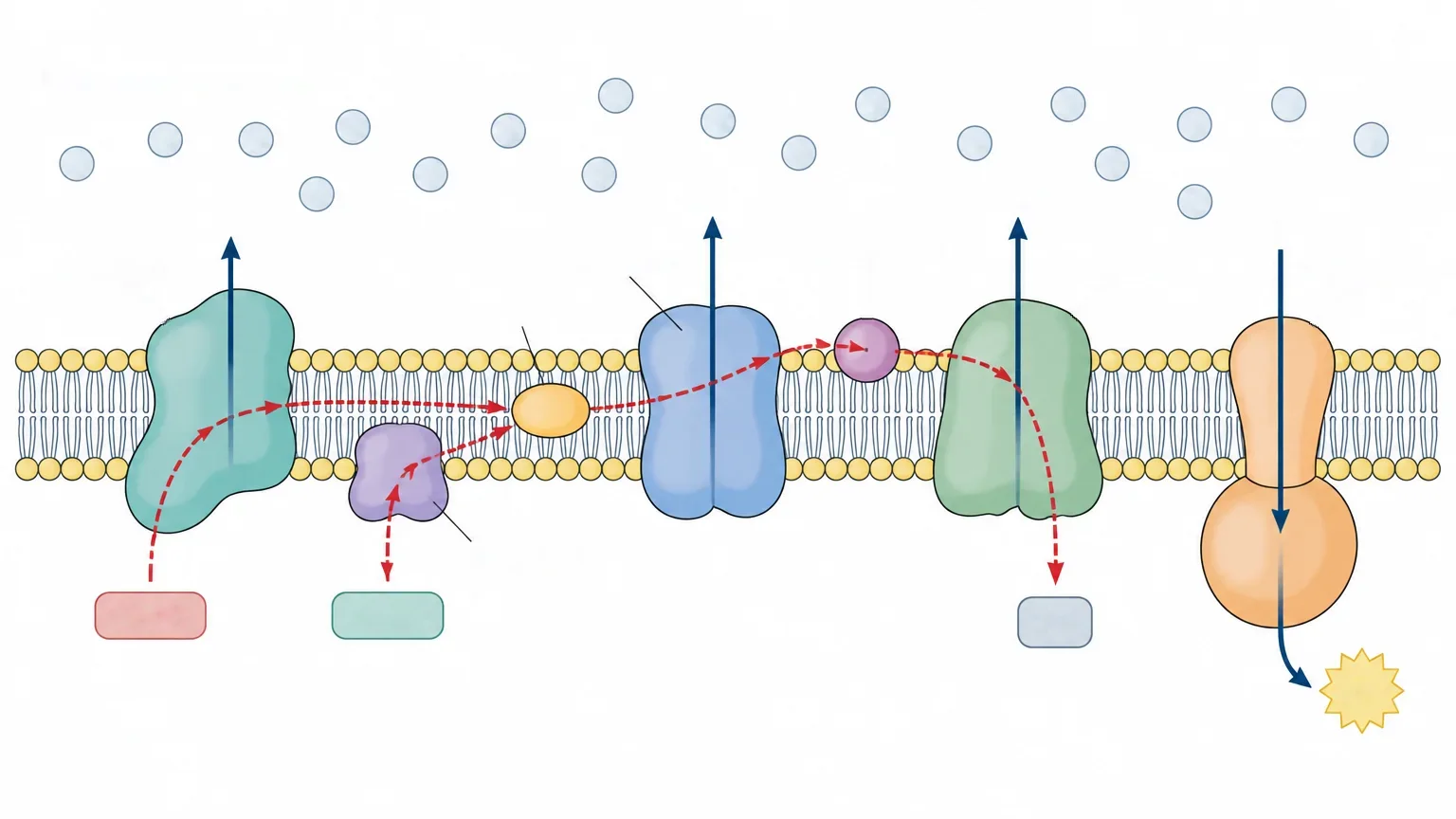
The chain is a team of protein complexes and small organic molecules, all set into the inner membrane. Electrons are handed from one member to the next like a baton in a relay race. Each handoff is a redox reaction: a member is reduced when it takes the electrons and oxidized when it passes them on.
Most members are protein complexes, numbered I through IV. They carry prosthetic groups, small non-protein molecules permanently attached to a protein that help it do its job. Cytochrome oxidase (complex IV), for example, has two prosthetic groups, and each holds an iron atom that can easily take on an electron and pass it along.
Two smaller members shuttle electrons between the complexes. One of them, ubiquinone (Q), isn’t a protein at all; it’s a small organic molecule.
| Member | What it is | What it does |
|---|---|---|
| NADH dehydrogenase (complex I) | Protein complex | Takes electrons from NADH |
| Succinate reductase (complex II) | Protein complex | Takes electrons from FADH₂ |
| Ubiquinone (Q) | Small organic molecule, not a protein | Carries electrons from complex I or II to complex III |
| Cytochrome b-c₁ (complex III) | Protein complex | Passes electrons to cytochrome c |
| Cytochrome c | Small protein | Carries electrons from complex III to complex IV |
| Cytochrome oxidase (complex IV) | Protein complex | Passes electrons to O₂, the end of the chain |
Cytochrome oxidase is named for what it does: it oxidizes (removes electrons from) cytochrome c.
Following the electrons
- NADH gives two high-energy electrons, one at a time, to complex I and becomes NAD⁺. (FADH₂ gives its electrons to complex II instead.)
- Ubiquinone carries the electrons to complex III.
- Cytochrome c carries them from complex III to complex IV.
- Complex IV passes them to oxygen, the final electron acceptor. Oxygen combines with the electrons and H⁺ to form water.
The electrons move in this direction because each member pulls on electrons more strongly than the one before it. That pull is electronegativity, the tendency of an atom or molecule to attract electrons, and it increases along the chain. Oxygen is the most electronegative member, so it sits at the end and keeps the electrons. Because the oxygen you breathe is used here, the ETC is also called the respiratory chain.
For each NADH, the overall reaction is NADH + H⁺ + ½ O₂ → NAD⁺ + H₂O.
Pumping H⁺ builds a gradient
Each time electrons move to a member with a stronger pull, they drop to a lower energy and release a little energy. At particular points along the chain, some of that energy is used to pump H⁺ out of the matrix and into the intermembrane space. This is active transport: it pushes H⁺ toward the side where H⁺ is already crowded, which takes energy.
The result is an H⁺ electrochemical gradient across the inner membrane. It has two parts:
- a chemical part: the H⁺ concentration is higher in the intermembrane space than in the matrix
- an electrical part: the intermembrane space has more positive charge than the matrix
Why cyanide is deadly
Anything that blocks electron flow blocks ATP production. Cyanide inhibits cytochrome oxidase (complex IV), so electrons can’t reach oxygen. The chain shuts down, H⁺ pumping stops, and cells can’t make enough ATP to survive.
Check yourselfCyanide blocks only complex IV, at the very end of the chain. Why does H⁺ pumping stop along the whole chain?
Practice questions
1 of 2
Cyanide blocks cytochrome oxidase (complex IV). What happens in a cell poisoned by cyanide?
2 of 2
The electron transport chain releases the energy of NADH’s electrons in many small steps rather than all at once. How does this help the cell?