Glycolysis splits glucose in two
Glycolysis is the first stage of glucose breakdown. It runs in the cytosol, it doesn’t need oxygen, and it turns a small profit of ATP.
One glucose in, two pyruvates out
The name describes the job: glyco- means sweet, and -lysis means splitting. In glycolysis, one molecule of glucose (six carbons) is converted into two molecules of pyruvate (three carbons each). It takes 10 steps, and a different enzyme runs each step. The first enzyme, hexokinase, attaches a phosphate group to glucose.
Glycolysis works under aerobic conditions (with oxygen) and anaerobic conditions (without oxygen). Bacteria, archaea, and eukaryotes all carry it out, and its steps are nearly identical in almost every species. That sameness suggests glycolysis arose very early in the history of life.
Three phases
The 10 steps fall into three phases.
| Phase | Steps | What happens | ATP and NADH |
|---|---|---|---|
| Energy investment phase | 1–3 | Two ATP each donate a phosphate to glucose, which becomes fructose-1,6-bisphosphate | 2 ATP used |
| Cleavage phase | 4–5 | Fructose-1,6-bisphosphate (six carbons) splits into two molecules of glyceraldehyde-3-phosphate (three carbons each) | None |
| Energy liberation phase | 6–10 | Each glyceraldehyde-3-phosphate is converted to pyruvate | 4 ATP and 2 NADH made |
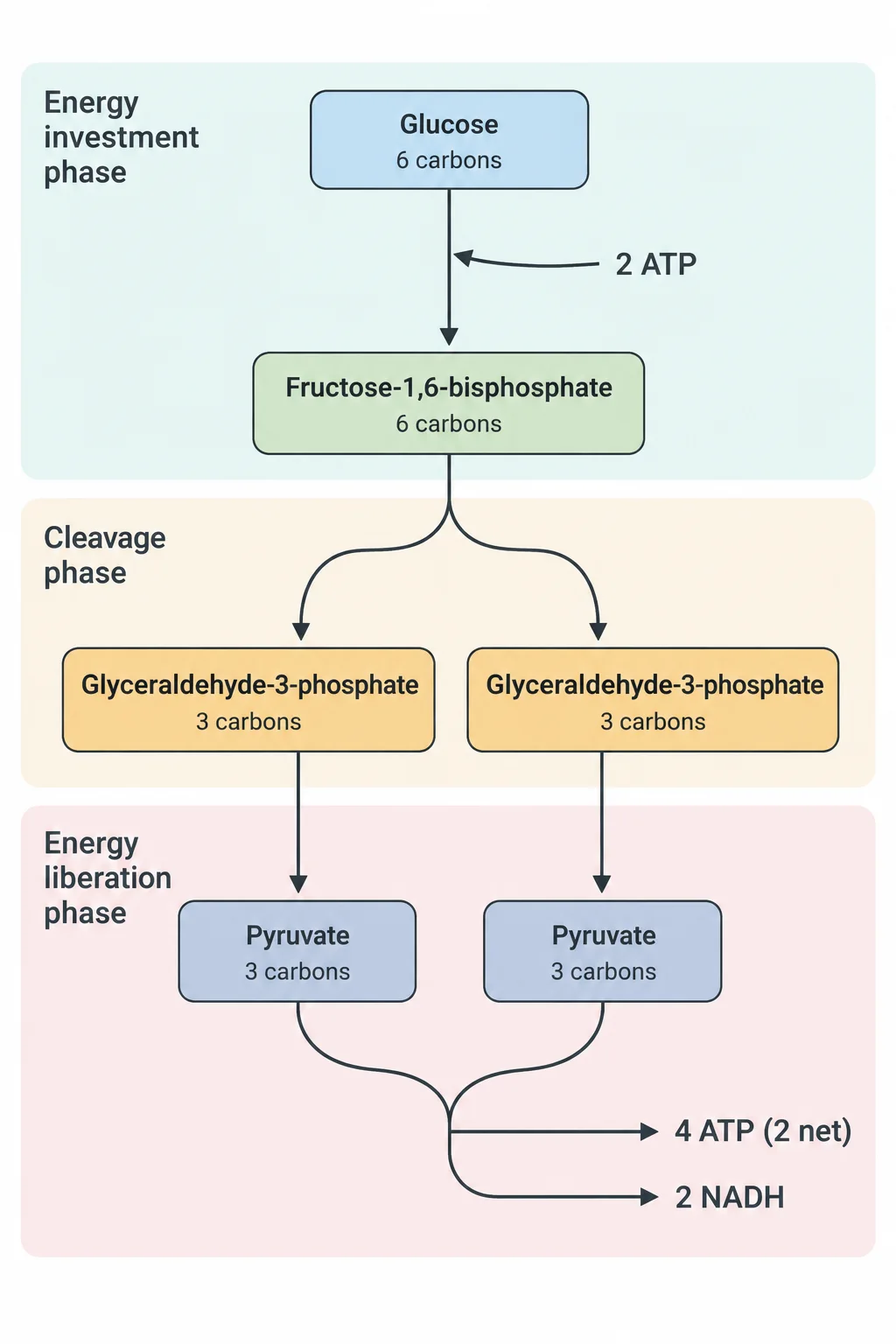
Spending ATP first pays off later. The two added phosphates raise glucose’s free energy, its store of usable energy, which makes the later steps exergonic (energy-releasing) so they can proceed. The cell makes 4 ATP and spends 2, for a net yield of 2 ATP, plus 2 NADH and 2 pyruvate.
Where the payoff comes from
The energy liberation phase makes its ATP by substrate-level phosphorylation, in which an enzyme moves a phosphate from an organic molecule straight onto ADP. Here is what happens to each three-carbon half:
- Glyceraldehyde-3-phosphate is oxidized. It gives two electrons, with an H⁺, to NAD⁺, making NADH, and it picks up a second phosphate group, becoming 1,3-bisphosphoglycerate.
- 1,3-Bisphosphoglycerate hands one of its phosphates to ADP, making ATP.
- After some rearranging, the molecule becomes phosphoenolpyruvate, which hands its remaining phosphate to ADP, making a second ATP. What’s left is pyruvate.
Each glucose supplies two halves, so these steps happen twice: 2 NADH and 4 ATP in all. The two phosphate donors, 1,3-bisphosphoglycerate and phosphoenolpyruvate, are the molecules behind glycolysis’s substrate-level phosphorylation.
The whole pathway adds up to: glucose + 2 NAD⁺ + 2 ADP + 2 Pᵢ → 2 pyruvate + 2 NADH + 2 ATP + 2 H₂O + 2 H⁺.
Keeping glycolysis in check
A cell that already has plenty of ATP shouldn’t keep breaking down glucose. The rate of glycolysis depends on how much glucose is available and on feedback inhibition, in which the end product of a pathway shuts down an enzyme near the start of that pathway.
A key control point is step 3, run by the enzyme phosphofructokinase. It’s the slowest step, the rate-limiting step, so it sets the pace for the whole pathway.
When ATP is abundant, ATP binds to an allosteric site on phosphofructokinase, a spot separate from where the reaction happens. Binding changes the enzyme’s shape and switches it off. It works like a thermostat: once the house is warm, the furnace shuts off.
Glycolysis and cancer scans
Many cancer cells rely heavily on glycolysis for ATP, while healthy cells make most of theirs by oxidative phosphorylation. This preference is the Warburg effect. In roughly 80% of cancer types, the cells make unusually large amounts of glycolysis enzymes. One proposed reason is that the inside of a growing tumor runs low on oxygen, and glycolysis doesn’t need oxygen.
Doctors use this to find tumors with positron-emission tomography (PET). The patient is injected with FDG (fluorodeoxyglucose), a radioactive look-alike of glucose, and cells that take up a lot of glucose, such as cancer cells, take up a lot of FDG.
Hexokinase adds a phosphate to FDG, but the product can’t continue through glycolysis, so it builds up inside those cells, and the scanner shows them as bright spots. The brain glows too, because it uses a great deal of glucose, and so do the kidneys and bladder, which filter and collect FDG.
Check yourselfGlycolysis makes 4 ATP per glucose. Why is its net yield only 2?
The energy investment phase spends 2 ATP attaching phosphates to glucose. The energy liberation phase then makes 4, so the cell comes out 2 ATP ahead.
Check yourselfWhy do tumors light up on a PET scan that uses FDG?
Tumor cells carry out high levels of glycolysis, so they take up a lot of FDG. Hexokinase adds a phosphate to it, and the product can’t go further down the pathway, so it accumulates in the tumor, where the scanner detects its radioactivity.
Practice questions
1 of 3
Glycolysis begins by spending 2 ATP to attach phosphate groups to glucose. What does this investment accomplish?
2 of 3
A patient is injected with FDG, a radioactive look-alike of glucose, and then given a PET scan. Why do many tumors show up as bright spots?
3 of 3
On a PET scan using FDG, a patient’s lung tumors glow, but so does the brain, which has no tumor. What best explains the bright brain?