Reading human pedigrees
Mendel could choose which pea plants to cross and raise hundreds of offspring. Human geneticists can do neither, for ethical and practical reasons. Instead they work backward from families that already exist.
Family trees as data
A family tree that tracks a trait is a pedigree, and studying one over a few generations is pedigree analysis. It is especially useful for genetic diseases. Many disease genes come in a common allele and a rare mutant allele, and the symptoms come from the mutant one. A pedigree can show whether that mutant allele is dominant or recessive and help predict who in the family is likely to be affected.
Pedigrees are less definitive than breeding experiments. Human families are small, so chance can make the numbers stray far from the expected ratios.
Pedigree symbols
| Symbol | Meaning |
|---|---|
| Square | Male |
| Circle | Female |
| Filled symbol | Affected by the trait |
| Half-filled symbol | Heterozygous carrier |
| Unfilled symbol | Unaffected |
| Horizontal line between two people | A couple who have children |
| Vertical line | Connects parents to their children |
Generations are numbered with Roman numerals, oldest (I) at the top. Within a generation, people are numbered left to right, and siblings hang from a shared horizontal line in birth order. So “II-3” means the third person in the second generation.
A carrier is a heterozygote for a recessive disease allele: the person carries the allele and can pass it on but doesn’t show the disease.
The recessive pattern
Cystic fibrosis (CF) is a recessive disease that affects the lungs, pancreas, intestine, and sweat glands. Only people with two copies of the disease allele have it.
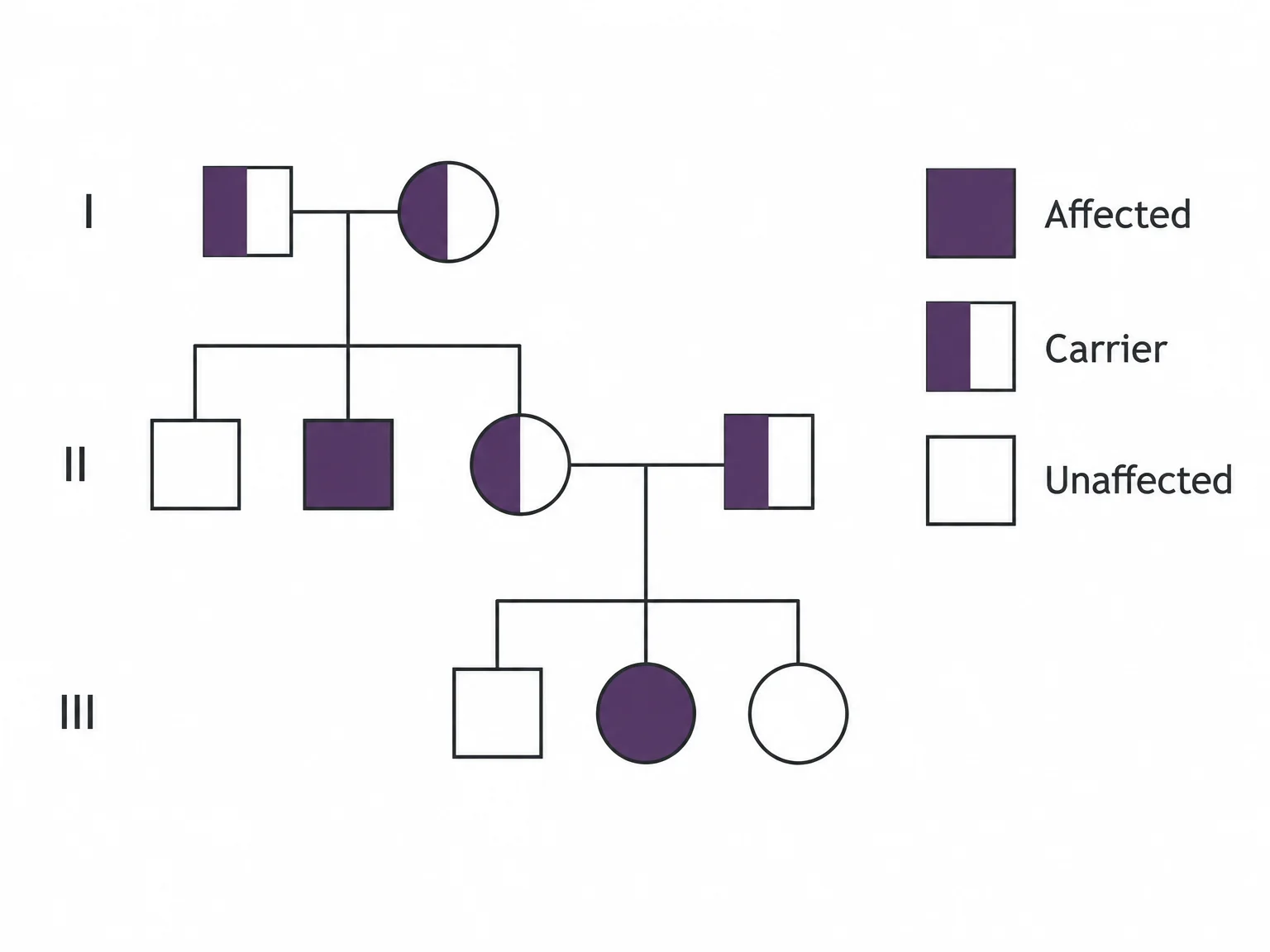
Look for these clues to a recessive disease:
- Two unaffected parents can have an affected child. Both parents must be heterozygous carriers.
- Those same parents can also have unaffected children, since a child must inherit the allele from both parents to be affected.
- Two affected parents have only affected children, since both are homozygous recessive and have only the disease allele to pass on. (For diseases that limit survival or fertility, such families are rare.)
Check yourselfAn affected couple has three children, and one is unaffected. Which inheritance pattern does that rule out?
The dominant pattern
Huntington’s disease is caused by a dominant allele. It destroys brain cells involved in movement, thinking, and emotion, with symptoms usually starting between ages 30 and 50. One copy of the allele is enough to cause it.
Clues to a dominant disease:
- Every affected person has at least one affected parent. The trait doesn’t skip generations.
- An affected parent who is heterozygous can still have unaffected children, by passing on the normal allele.
- Two unaffected parents don’t have affected children, since neither carries the allele.
| Pedigree clue | Recessive | Dominant |
|---|---|---|
| Affected child of two unaffected parents | Common | Doesn’t happen |
| Unaffected child of two affected parents | Doesn’t happen | Possible |
| Affected people’s parents | Often both unaffected | At least one affected |
| Skips generations | Can | No |
Autosomal inheritance
Both of these diseases come from genes on autosomes, the chromosomes that are the same in both sexes, where most human genes sit. Traits from autosomal genes follow autosomal inheritance patterns: cystic fibrosis is autosomal recessive, and Huntington’s disease is autosomal dominant. Genes on the sex chromosomes follow different patterns, because males and females carry different sex chromosomes.
Practice questions
1 of 3
On a pedigree, what does a filled square represent?
2 of 3
Why do human geneticists study pedigrees instead of running breeding experiments like Mendel’s?
3 of 3
Which inheritance pattern does cystic fibrosis follow?